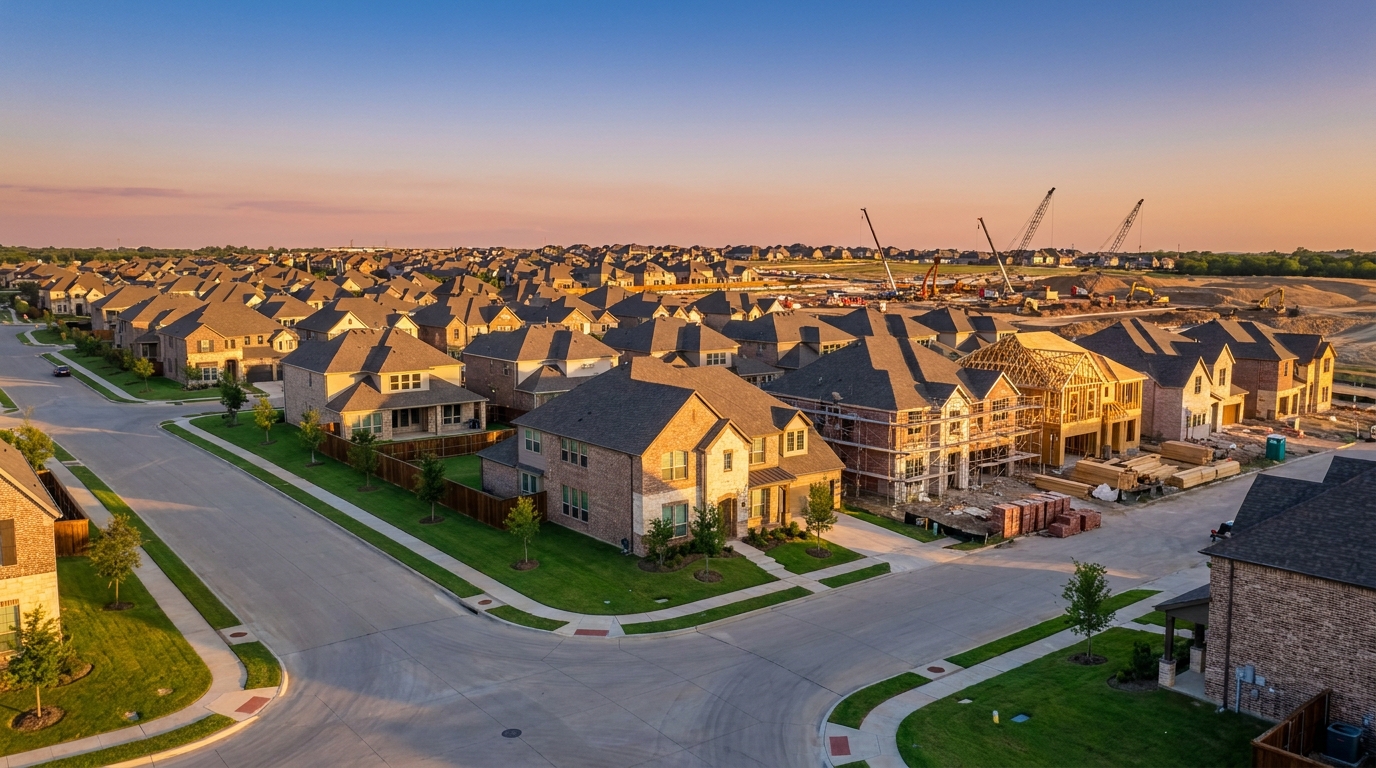
If you want a glimpse of America's suburban future, just drive north of Dallas. In towns like Celina, Prosper, and McKinney, the air is thick with the smell of fresh-cut lumber and the sound of nail guns is a constant soundtrack. Cranes pepper the horizon, and vast tracts of former ranch land are rapidly transforming into master-planned communities. This isn't just a local trend; North Texas is the epicenter of a national phenomenon. The Dallas-Fort Worth metroplex is building more new homes than any other metropolitan area in the United States, and it isn't even close.
The sheer volume is staggering. In 2023, the Dallas-Fort Worth area issued permits for nearly 50,000 new single-family homes, outpacing its longtime Texas rival, Houston, and leaving every other American city far behind. When you add apartments and other multi-family units, the DFW metro saw over 75,000 total new housing units permitted. This building blitz is fueled by one of the largest domestic migrations in recent history, as both people and corporations flock to the Lone Star State.
But this boom raises a critical question. In a country grappling with a severe housing shortage, is Texas building the solution? As thousands of new homes come online, are they actually making the dream of homeownership more attainable for the average person? The reality on the ground is more complicated, revealing a crucial gap between the number of new houses and the number of people who can actually afford to buy them.
- The Scale of the Texas Boom
- Why Here? Why Now? The Drivers of Demand
- Dallas Takes the Crown
- The Affordability Question: More Houses, But For Whom?
- Challenges on the Horizon
- What's Next for the Texas Housing Market?
The Scale of the Texas Boom
The headline isn't an exaggeration. According to data from the U.S. Census Bureau and the National Association of Home Builders, Texas is in a league of its own. For several years running, the state's major metropolitan areas have dominated the top of the national construction charts. It's not just Dallas; Houston, Austin, and San Antonio are all housing-growth powerhouses.
In most rankings, the Dallas and Houston metros consistently occupy the number one and two spots nationally for new housing permits. In 2023, these two cities alone accounted for roughly one out of every ten single-family homes built in the entire country. To put it in perspective, the DFW metro area alone permitted more single-family homes than the entire state of California. Austin, despite its smaller size, is also a top-ten market, driven by its booming tech scene.
This concentration of development in the "Texas Triangle"-the region connected by DFW, Houston, San Antonio, and Austin-represents a massive shift in America's economic and demographic landscape. The state's population grew by more than 470,000 people in 2023 alone, the most of any state. All those new residents need a place to live, and builders are racing to keep up.
Why Here? Why Now? The Drivers of Demand
This boom isn't accidental. It's the result of a perfect storm of business-friendly economic policy, strategic corporate relocations, and a massive influx of new residents.
Corporate Migration and Job Growth
For more than a decade, Texas has successfully courted some of the biggest names in business. Companies like Toyota, Charles Schwab, and Caterpillar have moved their North American headquarters to the DFW area. Oracle and Tesla have made Austin their corporate home. More recently, Goldman Sachs began construction on a massive new campus in Dallas, and companies like McKesson and AECOM have also moved their headquarters here, cementing the region's status as a corporate hub.
These companies are drawn by a combination of Texas's famous business-friendly tax structure (no state corporate or individual income tax), a large and growing workforce, and a central location that simplifies national operations. Every headquarters relocation brings thousands of high-paying jobs, which in turn creates powerful, sustained demand for housing.
Population Surge
Where the jobs go, people follow. Texas has been a top destination for movers for years, with a significant number of new residents coming from high-cost states like California, New York, and Illinois. For many, the appeal is simple: a lower cost of living and the ability to buy a larger home for less money. While Texas home prices have risen significantly, they remain well below the median prices in coastal markets.
A report from the Texas Real Estate Research Center at Texas A&M University highlights that this influx is not just about affordability. It's also about opportunity. The state's diverse and resilient economy, spanning technology, finance, energy, and logistics, provides a wide range of career paths for new arrivals.
A Builder-Friendly Environment
Perhaps the most crucial factor is that Texas simply makes it easier to build. Compared to many other states, Texas has fewer zoning restrictions and a more streamlined permitting process, particularly in the vast unincorporated areas surrounding its major cities. This pro-growth attitude means developers face fewer regulatory hurdles and can bring projects from concept to completion much faster.
This agility allows developers to acquire large parcels of land and develop master-planned communities at a scale that would be nearly impossible in more regulated markets. It is a fundamental reason why Texas can ramp up housing supply in a way that coastal states with stricter land-use laws simply cannot match.
Dallas Takes the Crown
While the entire state is growing, Dallas-Fort Worth has emerged as the clear leader. DFW's economic diversity is a key strength. Unlike Houston, which is heavily tied to the energy sector, or Austin, which is dominated by tech, DFW has a balanced mix of industries, including finance, transportation, professional services, and technology. This balance insulates DFW from the boom-and-bust cycles that can affect more specialized economies, creating a steady, reliable demand for housing.
Furthermore, the physical geography and infrastructure of North Texas are perfectly suited for large-scale development.
A Tale of Two Cities (and Many Suburbs)
The growth isn't happening in downtown Dallas. It's exploding in the exurbs. Collin, Denton, and Kaufman counties are seeing some of the most intense development in the nation. This is where builders can find the land needed for the single-family homes that are in highest demand. These new communities are often meticulously designed with extensive amenities, including parks, resort-style pools, dedicated schools, and integrated retail centers, effectively creating self-contained suburban ecosystems.
This outward expansion is supported by relentless infrastructure investment, such as the expansion of the Dallas North Tollway and State Highway 121, which serve as arteries feeding this explosive suburban growth. This combination of economic strength and physical capacity has solidified DFW's position as America's new construction capital.
The Affordability Question: More Houses, But For Whom?
With so many new homes being built, you might expect prices to fall, or at least stabilize. But that's not what's happening. The median home price in DFW has climbed dramatically over the past five years. The construction boom has increased the supply of housing, but it hasn't solved the affordability problem.
The Rising Cost of Everything
Builders face the same inflationary pressures as everyone else. The costs of land, labor, and materials like lumber and concrete have all risen sharply. According to the National Association of Home Builders, construction costs have increased by more than 35% since 2020. These higher costs are passed directly to the homebuyer, meaning that a new home today is inherently more expensive to build and buy than it was just a few years ago.
The Missing Middle
The economics of development push builders toward higher-end homes where profit margins are fatter. Constructing a $250,000 starter home simply isn't as profitable as building a $550,000 four-bedroom house. This leaves a gaping hole in the market for what planners call the "missing middle"-modestly priced homes that are within reach for first-time buyers and middle-income families. While thousands of homes are being built, many of them are priced at $500,000 and up. For example, while the median household income in DFW is around $80,000, the median price for a new construction home often pushes past $450,000. This gap makes homeownership a steep climb for many families, even with a strong job market.
A Role for New Ownership Models
This affordability crunch is forcing buyers to get creative, leading to a rise in alternative ownership models. Co-ownership, where two or more people who aren't married buy a property together, is gaining traction. By pooling resources for the down payment and sharing mortgage payments, buyers can access homes and neighborhoods that would otherwise be out of reach. Platforms and legal frameworks are emerging to facilitate these arrangements, helping friends, family members, or even investing partners navigate the complexities of joint ownership. This approach directly tackles the gap between high home prices and individual purchasing power.
Challenges on the Horizon
The Texas growth story is impressive, but it's not without its challenges. The relentless pace of development is putting a significant strain on the state's infrastructure.
- Traffic and Infrastructure: Roads are becoming more congested, and the commute from the outer suburbs to urban job centers is getting longer.
- Schools and Services: Rapidly growing school districts are struggling to build new facilities and hire enough teachers to keep up with the influx of new families.
- Water Resources: In a state that frequently deals with drought, ensuring a sustainable water supply for millions of new residents is a growing concern. For example, growing communities in Collin and Denton counties are grappling with how to secure long-term water rights, a complex and expensive process that pits the needs of new subdivisions against those of agriculture and established cities.
On the economic front, the housing market remains sensitive to national trends. While the Texas economy is robust, it's not immune to national financial headwinds. The Federal Reserve's interest rate hikes have already pumped the brakes on the market's most frenetic activity, sidelining some buyers and making developers more cautious about starting new projects.
What's Next for the Texas Housing Market?
Looking ahead, Texas-and Dallas in particular-is poised to remain the engine of America's housing development. The fundamental drivers of growth, from its business-friendly climate to its central role in the national economy, are firmly in place. The demand for housing is not expected to disappear.
The real test will be whether the state can manage this growth sustainably. Can it build the infrastructure needed to support its expanding population? Can developers and policymakers find ways to create more housing that is affordable for the workers who power the state's economy?
The Dallas-Fort Worth metroplex isn't just building houses; it's building a new template for the American suburb. The question is whether that template will be one of broad opportunity or growing inequality. The outcome will shape the future of homeownership for a generation.