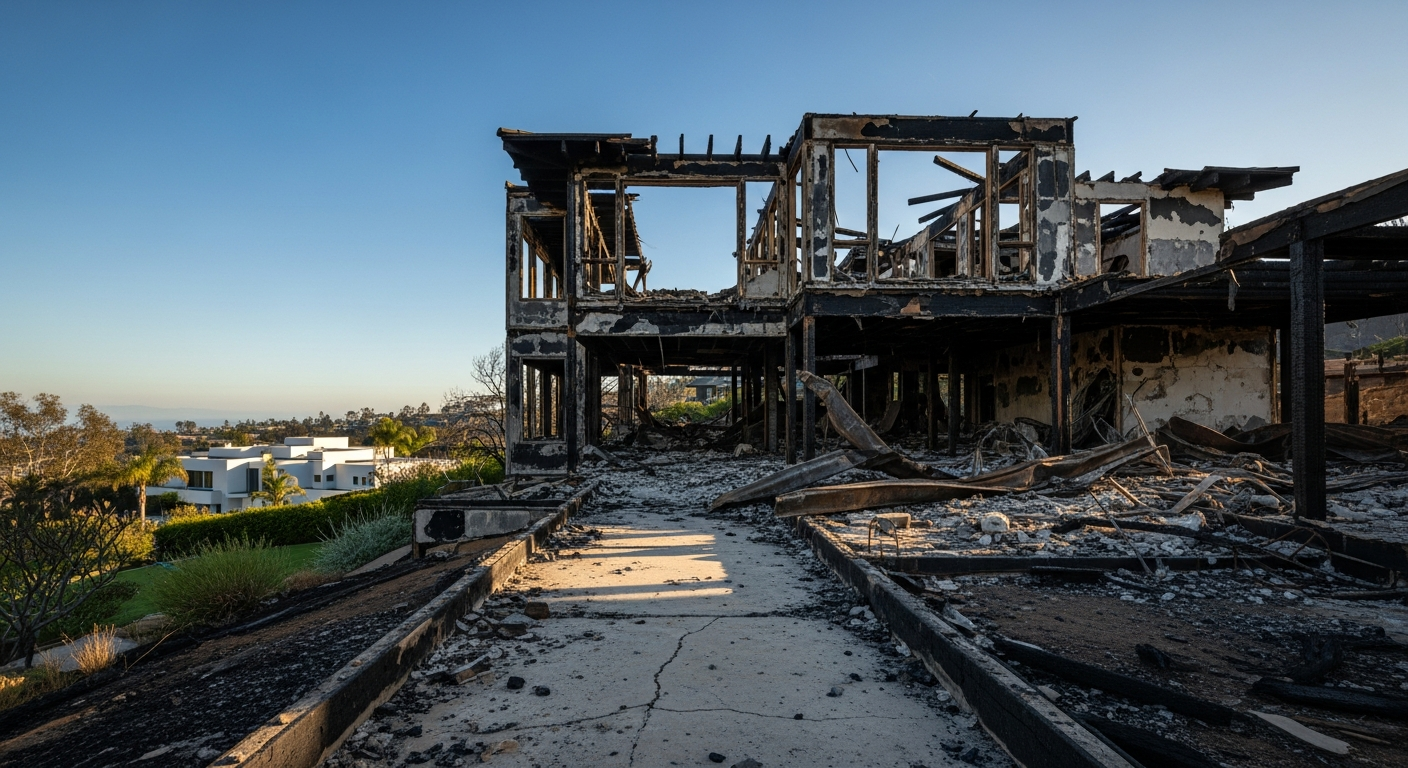
A three-bedroom house in Torrance, a suburb in the sprawl of metropolitan Los Angeles, recently sold for $1 million. This would be unremarkable news in Southern California, except for one detail: the house was a burned-out ruin. The roof had a gaping hole, the windows were boarded up, and the interior was charred from a fire that rendered it completely unlivable. It sold for two percent above its list price.
To an outsider, this sounds absurd. To anyone who has tried to buy a home in a California coastal city, it makes a certain kind of terrifying sense. The sale is a stark illustration of a fundamental truth about real estate in the state’s most desirable markets: you are not buying a house. You are buying the dirt it sits on. The structure is often just an afterthought-or in this case, a liability to be demolished.
This isn't just a quirky real estate story; it's a masterclass in the economic forces gripping the state. The sale exposes the intense scarcity, tangled policy decisions, and deep structural problems that define California's housing market. To understand why a ruin can command a seven-figure price is to understand the state itself, and the financial future of millions of its residents.
You're Not Buying a House, You're Buying the Land
In most real estate markets, a property's value is a combination of the land and the structure built on it. In high-demand California markets, this equation is dangerously skewed. The land is the prize. The real estate agent who handled a previous sale of the Torrance property stated the obvious: it "sold for the land value." He noted that a comparable home in move-in condition would command around $1.5 million. The math is simple and brutal.
| Metric | Torrance "As-Is" Property | Comparable Move-In Ready Home |
|---|---|---|
| Sale Price | $1,000,000 | ~$1,500,000 |
| Structure Value | ~$0 (or negative, considering demolition) | ~$400,000 - $500,000 |
| Land Value | ~$1,000,000+ | ~$1,000,000+ |
| Implication | The buyer bought a location and a permit to build-nothing more. | The value is split between the physical home and the premier land it occupies. |
So what makes a patch of dirt in Torrance worth a million dollars? A few powerful forces are at play.
First, there are the geographical constraints. Los Angeles is locked in by the Pacific Ocean to the west and mountains to the north and east. You cannot simply create more land. Second, there's the relentless economic pull. The region remains a global hub for entertainment, tech, and trade, creating high-paying jobs that draw people in. This creates ferocious competition for a finite resource.
But the most significant factor is man-made: zoning. The vast majority of residential land in California is zoned exclusively for single-family homes. This legal framework, designed to protect the suburban ideal of a single home with a yard, has inadvertently turned that dream into a luxury good. This legal restriction acts as a hard cap on density, making each approved parcel of land extraordinarily valuable. The value isn't just in the soil; it's in the scarce legal permission to build that comes attached to it.
How California Built a Housing Shortage, Decade by Decade
The million-dollar ruin didn't happen overnight. It is the result of a half-century of policy decisions that systematically choked the creation of new housing, even as the state's population and economy boomed.
The Rise of "Not In My Backyard"
Following a massive post-World War II building boom, many California communities reacted by putting up walls-not physical ones, but regulatory ones. A movement of local control, often framed around preserving "community character" or preventing traffic, led to widespread downzoning (reducing the number of homes that could be built on a parcel) and the implementation of complex, lengthy, and expensive approval processes for new construction. This "NIMBY" or "Not In My Backyard" sentiment became a powerful political force at the local level, making it incredibly difficult for developers to build anything other than luxury single-family homes.
The Double-Edged Sword of Environmental Review
The California Environmental Quality Act (CEQA), passed in 1970, is a landmark law intended to protect the state's natural resources. It requires developers to study and mitigate the environmental impacts of their projects. While its goals are noble, CEQA has been weaponized by project opponents to delay or kill housing projects-even environmentally friendly ones. In a now-infamous case, a group in Berkeley used CEQA to argue that UC Berkeley students were a form of environmental pollution, successfully halting the construction of needed student housing for a time. The threat of a multi-year CEQA lawsuit, regardless of its merits, is often enough to make a project financially unworkable.
The Persistence of Single-Family Zoning
The biggest structural barrier remains the dominance of single-family zoning. In a city like Los Angeles, around 75 percent of residential land is zoned for single-family homes only. This style of low-density zoning became the default after World War II, effectively outlawing the kinds of duplexes, triplexes, and small apartment buildings-often called "missing middle" housing-that were common in older neighborhoods. The result is a landscape legally frozen in time, unable to adapt to modern housing needs. According to research from the American Enterprise Institute, the state needs an estimated 2.2 million additional housing units to meet demand, yet housing production has lagged for decades, creating the massive supply-and-demand imbalance we see today.
Can Policy Fix a Problem This Big?
In Sacramento, state lawmakers aren't blind to the crisis and have passed a flurry of laws aimed at boosting housing supply. The results, however, have been mixed, often running into the same local headwinds that created the problem in the first place.
The ADU Boom: A Drop in the Bucket?
One of the most visible policy changes has been the push for Accessory Dwelling Units (ADUs), or backyard cottages. By streamlining the approval process, the state has unlocked a boom in ADU construction, which now accounts for roughly 20 percent of all new residential construction in some years. This is a significant reform, according to Eric McGhee of the Public Policy Institute of California. Still, it's not a panacea. Many ADUs are not added to the general rental market; they may be used as home offices, art studios, or housing for family members. While they add units, their overall effect on market-rate affordability is still being debated. It is a meaningful step, but not a leap.
State vs. Local: The Zoning Wars
More ambitious state laws, like Senate Bills 9 and 10, have attempted to override restrictive local zoning. SB 9, for example, allows homeowners to split their single-family lots and build up to four units in total. In theory, this could unlock huge swaths of land for gentle density. In practice, adoption has been painfully slow. Many cities have fought back, passing local 'poison pill' ordinances with strict design standards, hefty fees, or owner-occupancy mandates that make using the law nearly impossible for the average homeowner. This tug-of-war reveals the fundamental conflict in California housing policy: the state's push for more homes clashing with the century-old tradition of local control over land use.
The New Reality and the Search for Alternatives
Behind the million-dollar price tags are real human costs. The crisis is a story of three-hour 'super commutes,' of teachers unable to live in the communities they serve, and of a generation of young professionals locked out of the cities where they work. The median price for a mid-tier home in California is now over twice the national average, according to the state's Legislative Analyst's Office. This pushes homeownership out of reach not just for low-income families, but for nurses, firefighters, and tech workers who, by any other measure, are successful.
This brutal affordability forces people to get creative. Many have long turned to friends and family to pool resources for a down payment, entering into informal partnerships to buy a single property, a move that comes with significant personal and financial risks if not structured correctly.
To address this, more formal models are gaining traction. Tenancy-in-common (TIC) arrangements, long a staple of the San Francisco market, allow multiple buyers to purchase a multi-unit building together. Now, new platforms and companies are emerging to streamline this for single-family homes. They create structured legal and financial frameworks-handling everything from co-ownership agreements to financing-that make buying a home with others more secure and accessible. This model, exemplified by companies like Rhome, lowers the immense financial barrier to entry, allowing people to pool their resources without taking on unmanaged risks.
These solutions aren't just workarounds; they are rational responses to a deeply dysfunctional market. The sale of a burned-out house in Torrance for a million dollars is not an anomaly. It's a flare sent up from the front lines of the housing crisis, signaling that the old model of a single family affording a single home is no longer the default reality for millions in California. The value is locked in the land, and finding ways to share ownership of that land may be one of the few viable paths forward for an entire generation.