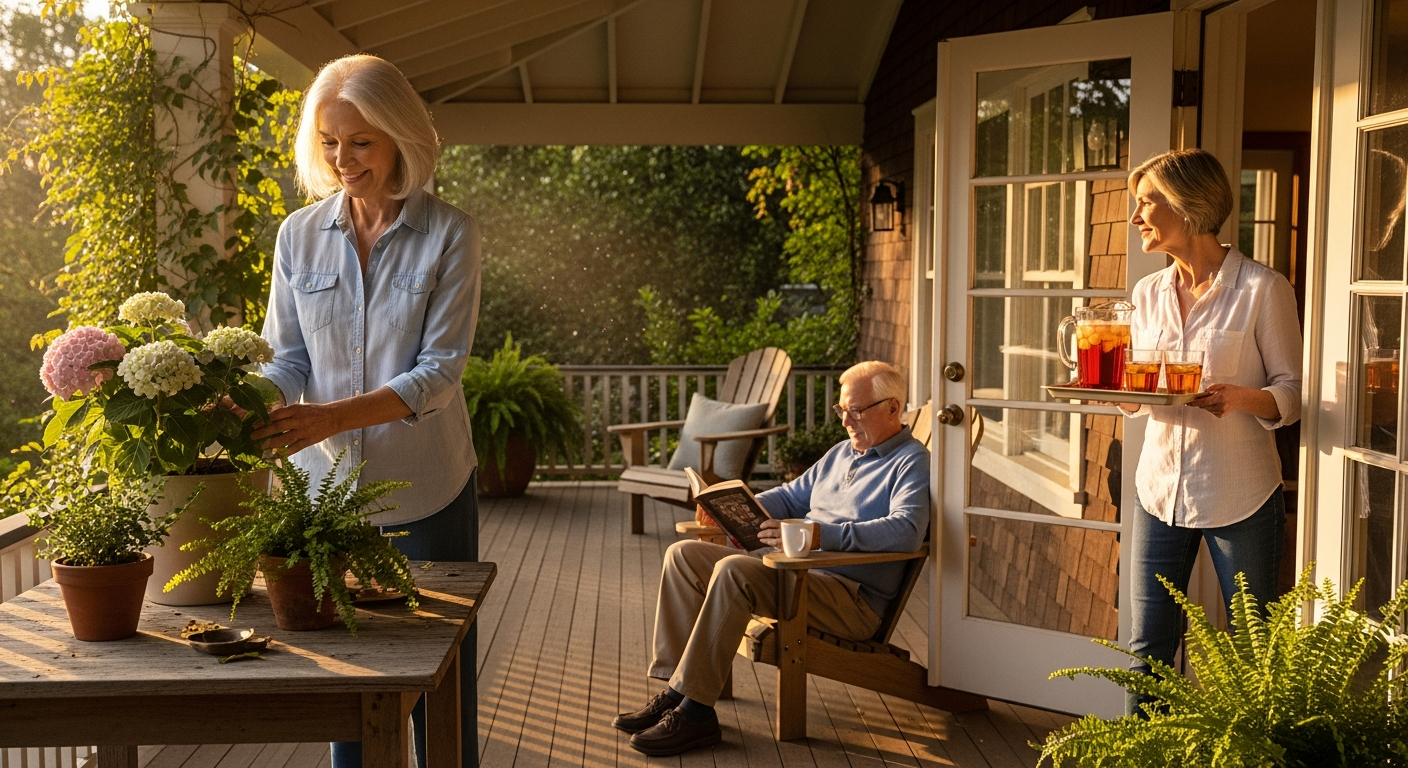
There is a moment that many older adults recognize. The house that felt right for decades starts to feel like a lot of maintenance for one person. The neighborhood is familiar, but the daily rhythms have grown quieter than they used to be. Assisted living feels premature and frankly unwanted. Renting feels like giving something up. Moving closer to adult children means relocating from the community that actually matters.
None of those options is quite right. Co-ownership is a fourth path, and for a growing number of older adults, it is the one that actually fits.
When two to four people co-own a primary residence through a structured ownership entity, they each live in the home as their primary residence, each hold a defined ownership share, and each benefit from the financial and social advantages of sharing a high-quality home that none of them might have purchased alone. The co-owners can be friends, siblings, former colleagues, neighbors who decided to make a deliberate move together, or people who connected specifically around the idea of sharing a home.
Why Co-Ownership Appeals to Older Adults Beyond Cost
The financial case for co-ownership is real, and we will get to it. But the reasons older adults are drawn to this model often start somewhere more fundamental than the numbers.
Loneliness among older adults is a serious and well-documented public health concern. Not the mild loneliness of a quiet weekend, but the chronic isolation that comes from living alone without daily human contact. Co-ownership does not solve loneliness by forcing togetherness. It solves it by building a home environment where genuine community is the baseline rather than something you have to schedule.
When you co-own a home with one, two, or three other people whose company you genuinely value, you have neighbors who are also housemates. The morning coffee ritual, the shared decision about what to do with the backyard, the other person who notices when you seem off: these are the small but meaningful textures of shared life that cannot be replicated by living alone and planning social activities around it.
The maintenance burden is another dimension that matters enormously as people age. A large home owned by one person requires that person to manage every repair call, coordinate every contractor, carry every decision. When ownership and responsibility are shared, the load is distributed. A co-owner with physical limitations does not have to shoulder the whole of a home's upkeep alone. The others share it, by agreement.
There is also a dimension of mutual support that older co-owners often describe as the arrangement's deepest benefit. Co-owners notice when something seems wrong. They can drive to an appointment when driving becomes difficult. They are present in a way that quarterly visits from adult children cannot be. This is not caregiving in the clinical sense. It is the ordinary attentiveness of people who share a home and actually know each other's daily patterns.
None of this requires that the co-owners be close friends before they buy together. Some older adults who choose co-ownership are lifelong friends making a deliberate choice. Others are acquaintances who share values about how they want to live and decide to build something together. The structure accommodates both.
Financial Benefits: More Home, Lower Individual Cost
The financial picture for older adults who co-own looks meaningfully different from either solo homeownership or renting.
When two or three people combine their resources, the math shifts substantially. Down payments, closing costs, and ongoing mortgage payments are shared proportionally. The combined purchasing power of two or three co-buyers typically reaches homes that are significantly larger, better located, or in better condition than what any one of them would buy alone.
For older adults who have been disciplined savers but not wealthy accumulators, this matters a lot. A retirement fund that is reasonable but not lavish, combined with a co-buyer in a similar position, may put within reach a home in a desirable neighborhood that neither person could have purchased independently. The home itself becomes a better asset: better maintained, in a stronger location, and more likely to hold or grow its value over time.
Monthly carrying costs split as well. Mortgage, property taxes, insurance, and utilities shared among co-owners create a cost structure that is often dramatically lower than what each person would pay if they owned or rented solo. This matters practically in retirement, when income is fixed and the ability to absorb large unexpected costs is more limited than it was during peak earning years.
For older adults who own a home already, co-ownership can be a path to putting equity to work that has been sitting idle. Selling an existing home and pooling the proceeds with one or more co-buyers can generate a down payment that far exceeds what any one person would bring to a solo purchase, opening the door to a home that works better for this chapter of life.
Income Considerations for Seniors: What Lenders Count
One of the most important things older adults need to know about co-ownership financing is that the income types common in retirement count for mortgage qualification purposes.
Social Security income is included. Pension distributions are included. Distributions from IRAs and 401(k) accounts are included when they can be documented as regular and ongoing. Investment income from taxable accounts can often be counted as well. A lender evaluating co-buying applicants looks at the combined picture of all applicants, and for older adults, that combined picture often includes retirement income streams that are highly stable, even if they look different from a traditional W-2 salary.
FHA loans, which require a minimum down payment of 3.5 percent, are available to qualified borrowers regardless of age. There is no upper age limit for an FHA mortgage. The Fair Housing Act prohibits age-based discrimination in mortgage lending. An older adult who meets the income, credit, and primary residency requirements has exactly the same access to FHA financing as a 30-year-old buyer.
For co-buyers applying together, the income of all applicants is considered jointly. This means a group of two or three older adults whose individual incomes might each fall short of qualifying for a desirable home can often qualify together. The combined income picture is typically much stronger than any individual member's income in isolation.
What lenders want to see is consistency and documentation. Fixed income sources like Social Security and pension payments are often simpler to document than variable employment income. Retirement account distributions should be documented with statements showing a history of regular withdrawals. A lender who works with co-buyers can help structure the application in a way that presents the combined income picture most clearly.
Estate Planning Considerations for Senior Co-Owners
For older adults who are co-buying, estate planning is not an afterthought. It is one of the most important things to get right before closing, and the governance agreement is where it has to be addressed explicitly.
Here is why this matters specifically for older co-owners: the probability that a succession scenario will become relevant during the ownership period is higher than it is for buyers in their 30s. This is not morbid. It is realistic planning, and doing it well is what protects both the surviving co-owners and the estate of the co-owner who dies.
The governance agreement must address several succession scenarios clearly.
Death of a co-owner. When a co-owner dies, their ownership interest does not automatically pass to the surviving co-owners. It passes according to their estate documents, or by intestacy law if they have none. The governance agreement should specify what happens next: whether surviving co-owners have a right of first refusal to purchase the deceased member's interest, the timeline for exercising that right, and how the purchase price is determined. A fair market appraisal is the standard mechanism.
Transfer to heirs. If the surviving co-owners choose not to exercise the right of first refusal, or if no such right exists, the deceased co-owner's interest may pass to an heir. The governance agreement should specify whether an heir who inherits an ownership interest automatically becomes a full voting member of the entity or only holds economic rights (the right to share in proceeds if the home sells). In most co-ownership arrangements, full voting membership requires consent from the remaining co-owners, which protects them from being forced into a governance relationship with someone they did not choose.
Incapacity. An older co-owner who becomes incapacitated and can no longer manage their affairs poses a different challenge. The governance agreement should address how decisions are made on behalf of an incapacitated member, typically by a duly appointed agent under a durable power of attorney. Each co-owner should have a durable power of attorney in place so that if they become unable to act for themselves, someone can act on their behalf within the ownership structure.
Primary residency changes. If a co-owner's health requires a move to a care facility, they can no longer meet the primary residency requirement. The governance agreement should provide a structured exit path for this scenario: typically, the co-owner sells their interest to the remaining members at a fair price, with a timeline that gives everyone reasonable time to arrange financing.
Because these questions intersect with individual estate planning, each co-owner should work with their own estate attorney. The goal is to make sure each person's will or other estate documents are consistent with the governance agreement's succession provisions. Conflicts between the two documents can create significant legal complications for everyone involved.
Accessibility Considerations in the Home Search
For older adults, the physical design of a home is not a secondary consideration. It is often the difference between a home that works for a decade and one that creates problems within a few years.
Single-story layouts are the most straightforward solution. A home where the bedroom, bathroom, kitchen, and living areas are all on one level eliminates the risk of stairs becoming a barrier as mobility changes over time.
When a single-story home is not available, ground-floor primary suites become a priority. A home where at least one full bedroom and bathroom are on the entry level gives each co-owner the option to transition their daily living to the ground floor if needed, while still enjoying a larger home with upper-level spaces used for guests or storage.
Wider doorways accommodate wheelchairs and walkers. Walk-in showers without threshold lips are safer than tub/shower combinations. Grab bars in bathrooms are inexpensive to add but significantly easier to install during construction or renovation than retrofitted into finished tile. Lever-style door handles and faucets require less hand strength than knobs.
For older co-buyers, it is worth explicitly naming these priorities before beginning the home search. What reads as a floor plan preference is actually a safety and longevity question. A Rhome advisor and a buyer's agent who understands accessibility can help filter the search to homes that meet these needs, or identify homes where targeted modifications would bring them up to standard.
One advantage of co-ownership in this context: when modifications are needed, the cost is shared. A roll-in shower conversion or a ramp installation that would feel like a significant expense for a solo owner becomes a shared improvement for co-owners, and the governance agreement can specify how those costs are allocated.
Co-Ownership Is Not Assisted Living
This distinction matters, and it is worth stating directly.
Assisted living facilities provide medical and personal care services in a congregate setting. Co-ownership is a form of homeownership. These are different things, and conflating them misrepresents what co-ownership offers.
Co-ownership does not provide nursing care, medication management, or structured medical support. It does not involve staff, programming, or an institutional environment. What it provides is a well-maintained, privately owned primary residence where the owners are people who know and look out for each other, by choice and relationship, not by contract.
Many older adults choose co-ownership precisely because they do not want, and do not need, the services that assisted living provides. They are healthy, independent, and fully capable of managing their daily lives. What they want is to do so in a home rather than an institution, with people they actually know rather than in isolation, and with ownership rather than a monthly fee that purchases no equity.
For adults who are aging in good health and want to proactively design their living situation, co-ownership is a primary residence solution. It is not a care arrangement, and it should not be evaluated as one.
That said, co-owners who want to address the possibility that one or more of them may eventually need care services can plan for it. The governance agreement can include provisions for how care needs are handled within the home, and separately, each co-owner's individual healthcare and estate planning documents can address the broader arc of their care preferences. Co-ownership and future care planning are compatible. They just operate in separate documents and at different scales.
How Rhome Serves Senior Co-Buyers
Rhome structures co-ownership through an ownership entity because that structure is the one that gives co-owners the clearest legal foundation, the cleanest exit paths, and the most flexibility when life circumstances change.
For older adults, the Rhome process covers the same ground it covers for any co-buyer group: helping the group form the entity, structuring the governance agreement to reflect the group's specific circumstances and priorities, coordinating the mortgage application, and providing a framework for the decisions that come up before, during, and after closing.
For senior co-buyers in particular, the governance agreement review should give extra attention to succession, incapacity, and the exit provisions that address primary residency changes. These are not hypothetical scenarios to plan around someday. They are practical questions that deserve clear answers before everyone signs.
Lenders who work with Rhome co-buyers understand how to evaluate the income mix that older adults bring: Social Security, retirement distributions, pension payments, and investment income. If your income comes primarily from these sources rather than a salary, that is not an obstacle. It is simply a qualification structure that a knowledgeable lender knows how to handle.
For older adults who want to co-own a home that fits the next chapter of their lives, the path exists. It requires some upfront work: honest conversations with potential co-owners, careful attention to the governance agreement, coordination with estate planning attorneys, and thoughtful attention to the physical characteristics of the home itself. None of that is insurmountable. All of it is manageable with the right support.
---
FAQ
See below for frequently asked questions about senior co-ownership.

