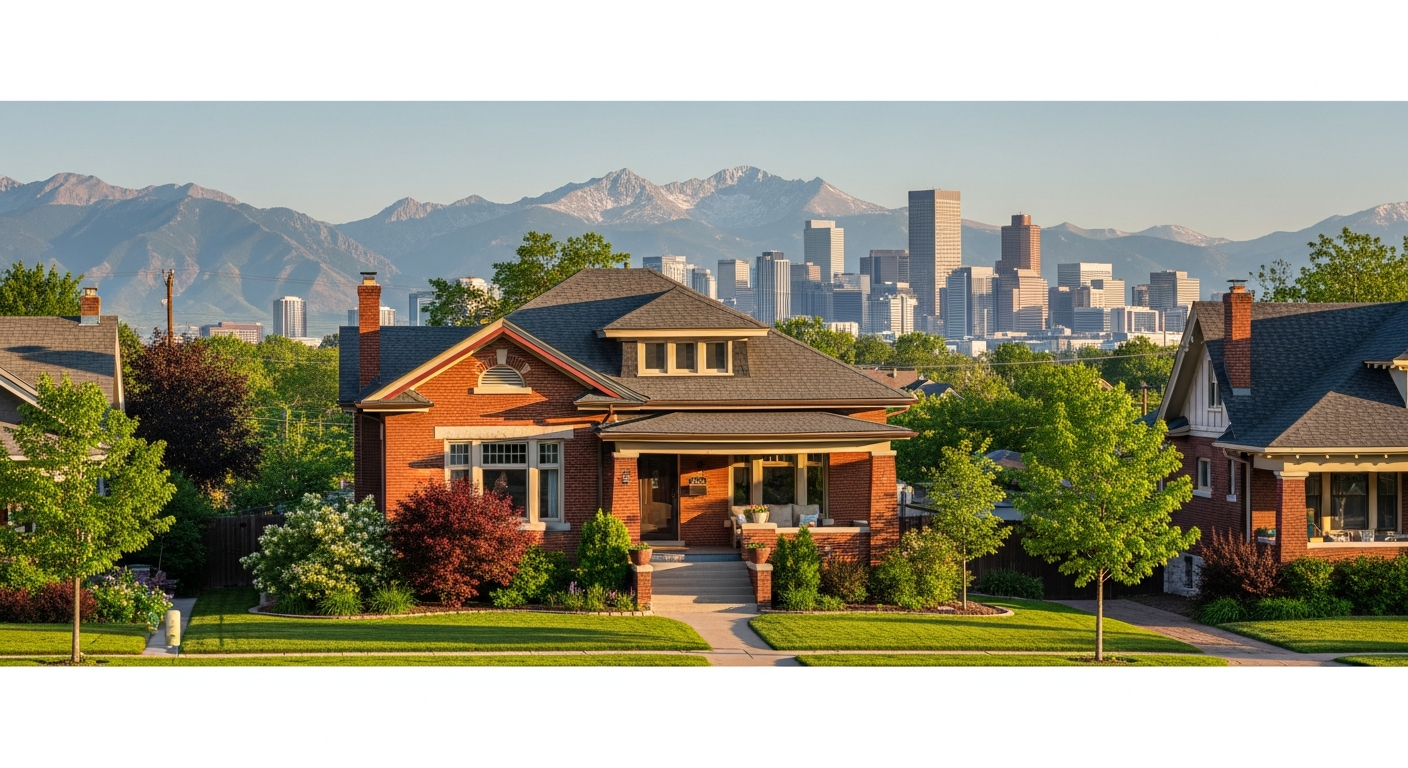
Denver has a way of making the rent-or-own question feel impossible. Rents keep climbing. Home prices haven't come down meaningfully. And the gap between what a single buyer can qualify for and what a Denver home actually costs has stretched to the point where the traditional path of saving for years and buying solo feels increasingly unreachable.
Co-ownership is a different path. Two to four buyers purchase a home together through a shared ownership structure, each occupying it as a primary residence, each building real equity. The down payment is split. The mortgage is split. And what was out of reach for one person becomes genuinely attainable.
This article breaks down the actual numbers for Denver: what renting costs you over five years, what co-buying a $550K–$650K Denver-area home looks like, and how the two paths compare when you run them out to the horizon.
Denver's Rent Reality
Denver has been one of the fastest-growing rental markets in the country for the better part of a decade. As of early 2025, the median rent for a one-bedroom apartment in Denver proper sits around $1,700 to $1,750 per month, depending on neighborhood and source. A two-bedroom in a desirable area like Capitol Hill, Five Points, or Congress Park runs $2,100 to $2,400 or higher.
Those aren't peak numbers from the 2022 frenzy. Those are the floor in the current market.
Rent in metro Denver climbed steadily from 2015 through 2022, softened slightly in 2023 as new apartment supply hit the market, then stabilized at levels that still represent a fundamental affordability problem for middle-income households. According to the U.S. Census Bureau, Denver's median household income is roughly $75,000 to $80,000. Standard rent-burden thresholds say a household shouldn't spend more than 30 percent of gross income on housing. That puts a "healthy" rent ceiling at around $1,875 to $2,000 per month.
One-bedrooms are barely below that ceiling. Two-bedrooms blow through it for most households.
And here's what makes it worse: every dollar of rent is a dollar that builds zero wealth. It covers shelter. It keeps the lights on. But it doesn't compound, it doesn't appreciate, and it doesn't show up on your net worth statement.
The Denver Renter's Trajectory Over Five Years
Let's model a realistic scenario. You're renting a one-bedroom in a solid Denver neighborhood at $1,750 per month. That's $21,000 per year.
Over five years at a conservative 3 percent annual rent increase, here's what the picture looks like:
- Year 1: $1,750/month, $21,000/year
- Year 2: $1,803/month, $21,630/year
- Year 3: $1,857/month, $22,278/year
- Year 4: $1,913/month, $22,953/year
- Year 5: $1,970/month, $23,637/year
Total rent paid over five years: approximately $111,500.
Equity built: zero.
That number doesn't include renters insurance, storage units for overflow, parking fees, or the periodic moving costs when leases end and landlords raise rents beyond what feels acceptable. It also doesn't account for the fact that rent increases have exceeded 3 percent in most Denver neighborhoods over the past decade.
At the end of five years, the renter is exactly where they started financially, except the market has moved further ahead of them.
Co-Ownership Math in Denver
Now let's run the co-ownership scenario.
Denver's median home price sits in the $550,000 to $600,000 range as of 2025, with desirable neighborhoods like Washington Park, Highlands, and Sloan's Lake running higher. Suburbs like Arvada, Westminster, and Lakewood offer solid options in the $480,000 to $580,000 range. For this comparison, we'll use a purchase price of $600,000.
Down Payment
Rhome's co-ownership model uses FHA financing, which requires 3.5 percent down. On a $600,000 home, that's $21,000 total.
With two co-buyers, each puts in $10,500.
With three co-buyers, each puts in $7,000.
For context, many Denver renters have more than $10,500 sitting in savings right now, not earning meaningful returns. The barrier isn't cash on hand. It's the perception that buying requires a $60,000 down payment, which the co-ownership model eliminates.
Monthly Payment (Two Co-Buyers)
On a $600,000 purchase with 3.5 percent down:
- Loan amount: approximately $579,000
- Interest rate assumption: 6.75 percent (30-year fixed, consistent with 2025 market rates)
- Principal and interest: approximately $3,755/month
- Property taxes: approximately $420/month (Denver's effective tax rate is roughly 0.50–0.55 percent)
- Homeowners insurance: approximately $130/month
- FHA mortgage insurance: approximately $350/month
- HOA (if applicable): $0–$300/month depending on property
Total estimated monthly PITI: approximately $4,655/month without HOA.
Split two ways: $2,328 per co-buyer per month.
Split three ways: $1,552 per co-buyer per month.
For a two-buyer scenario, each co-owner pays roughly $2,328 per month and owns an actual share of a home in a real Denver neighborhood. That's $578 more per month than the one-bedroom rent example, but the money is doing something fundamentally different.
For three co-buyers, the payment drops to $1,552 per person. That is cheaper than renting a one-bedroom apartment in Denver, with homeownership attached.
What Each Co-Buyer Gets
Each co-buyer is an equal owner in the shared ownership structure that holds the property. Each person's name, ownership percentage, and rights are documented in a governance agreement. Each person occupies the home as their primary residence. No short-term rentals, no subleasing, no passive investor arrangements. This is a group of people buying a home they live in together.
The ownership structure means each co-buyer builds equity as the mortgage is paid down, and each participates in any appreciation the Denver market delivers.
Five-Year Wealth Comparison
Let's run both scenarios to the five-year mark.
Renter After Five Years
- Total housing costs paid: approximately $111,500
- Equity built: $0
- Net wealth change from housing: $0 (assuming no investing of the savings differential)
Co-Owner After Five Years (Two-Buyer Scenario)
Assumptions:
- Purchase price: $600,000
- Down payment contribution: $10,500 per person
- Monthly payment: $2,328 per person
- Total housing costs over five years: approximately $139,680 per person
- Denver home appreciation: conservative 3.5 percent annually (Denver's long-term average has been higher)
After five years:
- Estimated home value: approximately $713,000
- Remaining loan balance: approximately $537,000 (after five years of payments at 6.75%)
- Total equity in home: approximately $176,000
- Each co-buyer's share (50%): approximately $88,000
- Each person's net wealth gain: approximately $88,000 minus the $10,500 down payment already deployed = net position well ahead
The co-owner spent roughly $28,000 more on housing over five years than the renter. But they built approximately $88,000 in equity. The renter built nothing.
That's a $116,000 swing in net worth over five years, and it compounds from there.
If three people split the home instead, the individual cost difference from renting shrinks dramatically, and the equity outcome is still roughly $59,000 per person on a one-third share. Again, built from a $7,000 entry point.
When Renting Makes More Sense
This comparison isn't meant to tell everyone in Denver to stop renting tomorrow. Renting is the right call in specific situations.
Short time horizons. If you're planning to leave Denver in two years or less, co-ownership doesn't make financial sense. Transaction costs alone (closing costs on entry, selling costs on exit) eat into the gains. Co-ownership is a medium to long-term commitment, typically three to seven years minimum.
Active career transitions. If your income is variable or you're mid-transition between jobs or industries, adding a long-term financial obligation to that instability is genuinely risky. Stability of income matters when you're co-buying.
Genuine incompatibility with co-living. Co-ownership works best when co-buyers have compatible living styles and a clear governance agreement about shared spaces, guests, costs, and decision-making. It's not the right fit for everyone, and that's honest.
No suitable co-buyers in your network. Rhome helps match potential co-buyers, but the relationship still needs to work at a human level. If you haven't found co-buyers you trust, waiting and building that network is better than rushing.
Renting is a legitimate choice when any of these apply. The point isn't that renting is bad. The point is that for many Denver residents who have been renting for years with no real exit plan, co-ownership is an option they've probably never seriously evaluated.
The Mountain-Adjacent Lifestyle Premium
There's a dimension to owning in Denver that doesn't show up in a spreadsheet.
Denver sits at the edge of something genuinely remarkable. Within 90 minutes, you have Breckenridge, Vail, Rocky Mountain National Park, and more skiing, hiking, and outdoor terrain than most people could explore in a lifetime. That proximity has a dollar value in the real estate market, and it shows up in long-term appreciation trends that have consistently outpaced the national average.
Owning in Denver means your home is anchored in a market that people keep moving to. The in-migration numbers have been consistent for years. The tech sector, healthcare sector, and outdoor recreation economy all pull talent toward Colorado. That demand supports prices.
For renters, that demand shows up as rent hikes they can't control. For owners, it shows up as appreciation.
Co-ownership lets you participate in that appreciation at a fraction of the solo-buyer entry cost. Instead of watching the Denver market move further away from you, you hold a piece of it.
That's the version of the rent-or-own question that rarely gets asked clearly in Denver. Not "can I afford to buy alone?" but "can I afford to keep not owning?" For a lot of renters who have been in the city for three, four, or five years, the answer to the second question is becoming harder to ignore. The math has been moving in one direction. Co-ownership is a way to stop being a spectator to it.
FAQ
Note: See faqItems for FAQ content.
