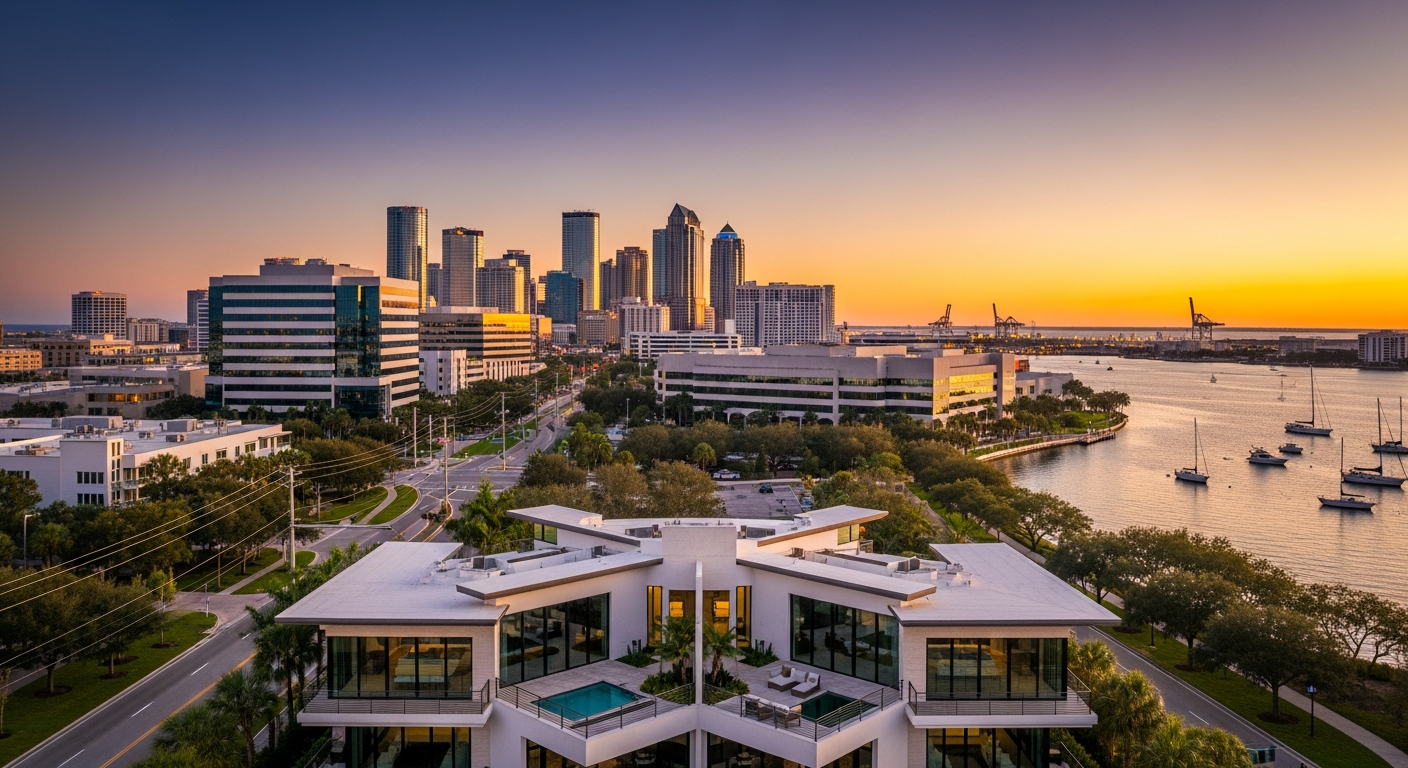
Tampa has a way of surprising people. Visitors come for the bay, the food scene, or a Lightning game, and they leave wondering whether they could actually live here. Many of them can, but the math has gotten tighter over the past several years. Home prices that once made Tampa a bargain compared to Miami or Orlando have risen substantially, and the insurance market has added a new layer of complexity that buyers need to understand before they commit.
Co-ownership changes that math. When two to four people buy a Tampa home together as co-owners, each living there as a primary residence, the barriers that price out individual buyers start to come down. This guide walks through what that looks like in practice: the market, the neighborhoods, the legal context, the financing, and the honest picture on insurance.
The Tampa Market Today
Tampa's growth over the past decade has been driven by something more durable than a single industry. The metro area is home to a large defense and cybersecurity presence anchored by MacDill Air Force Base, a financial services cluster that includes Raymond James and Amscot, a growing tech sector, and one of Florida's busiest port economies. USF Health and AdventHealth anchor a significant healthcare employment base. That diversity has kept the job market relatively stable even as other Sun Belt cities have seen corrections.
The population of the Tampa-St. Petersburg-Clearwater metropolitan area has grown consistently, making it one of the larger metros in the Southeast. Hillsborough County, where the city of Tampa sits, has added residents year after year, and that demand has kept home prices elevated relative to where they were before 2020.
As of mid-2025, median home prices in Tampa proper were hovering in the mid-$300,000s, with significant variation by neighborhood. Inventory has improved somewhat from the historic lows of 2021 and 2022, meaning buyers have more options than they did a few years ago, and bidding wars have become less common in many price ranges. That said, Tampa is not a buyer's market in the traditional sense. Well-priced homes in desirable neighborhoods still move quickly.
The aftermath of major storm seasons has also shaped the market in a specific way: homes with documented flood zone status, older roofs, or proximity to vulnerable coastal areas are receiving more scrutiny from both buyers and insurers. This is relevant context for anyone choosing a neighborhood.
Florida Real Estate Law: What Co-Buyers Should Know
Florida has a few features that make it genuinely attractive for primary residence ownership, along with some considerations that require advance planning.
No state income tax. Florida has no personal income tax, which means the financial benefit of homeownership is not partially offset by a state tax burden on income. For people relocating from high-tax states, this is a meaningful difference.
Homestead exemption. Florida's homestead exemption reduces the assessed value of a primary residence by up to $50,000 for property tax purposes. Crucially, it also caps annual increases in assessed value at 3% or the rate of inflation, whichever is lower. For co-owners using a shared ownership structure, preserving homestead eligibility requires careful setup. The structure must be documented correctly so that each co-owner qualifies as a Florida resident who actually occupies the property as their primary home. Rhome's legal structure is designed with this in mind, but co-buyers should confirm the specifics with a Florida-licensed attorney.
Homestead protection. Florida's homestead laws also protect primary residences from most creditor claims. This adds another reason to ensure the ownership structure is drafted correctly so that co-owners receive appropriate protections.
Documentary stamp tax. Florida imposes a documentary stamp tax on deed transfers and mortgage notes. This is a closing cost buyers sometimes overlook. On a $350,000 purchase, the doc stamp on the deed alone runs several hundred dollars, and the note carries its own rate. Build this into your closing cost estimates.
Insurance. Florida's property insurance market deserves its own section, and it gets one below.
Key Neighborhoods for Primary Residents
Tampa's neighborhoods have distinct personalities, price points, and trajectories. Here is an honest look at the areas that make the most sense for people buying to live.
South Tampa
South Tampa encompasses Hyde Park, Palma Ceia, Bayshore, and surrounding blocks. This is Tampa's premium residential corridor: walkable streets, mature tree canopy, proximity to Bayshore Boulevard, and a genuine sense of neighborhood that many newer developments lack. Median prices in the best blocks of South Tampa are well above the citywide figure, often in the $500,000s to $700,000s and higher for single-family homes. Co-ownership makes South Tampa accessible to buyers who could not clear the bar alone.
Seminole Heights
Seminole Heights has completed its transformation from overlooked to established. The neighborhood sits just north of downtown, and its bungalow stock has been steadily renovated over the past fifteen years. It has a strong local food and coffee culture, walkable commercial corridors along Florida Avenue and Central Avenue, and a community character that attracts people who want urban feel without downtown density. Prices are more moderate than South Tampa, which is part of the appeal.
Ybor City
Ybor City is Tampa's historic Latin quarter, and it is in the middle of a longer-arc revival. The area's brick streets, cigar-factory architecture, and proximity to downtown have attracted younger buyers and renters. Some blocks are fully renovated; others are still works in progress. Co-buyers with a longer horizon and comfort with an evolving neighborhood profile will find value here. The planned streetcar expansion and continued downtown investment point toward continued appreciation.
Riverview
Riverview sits southeast of Tampa along the Alafia River and US-301 corridor. It is not urban, but it offers something else: relative value. Families and professionals who need more space at a more accessible price point find Riverview appealing. New construction has been active here, and the commute to downtown Tampa or Brandon is manageable. For co-buyers who prioritize square footage and modern finishes over walkability, Riverview is worth a serious look.
New Tampa and Wesley Chapel (just north)
The northern growth corridor has attracted significant development. These areas offer newer housing stock, good school options, and access to I-75, making them practical for people who work throughout the metro. They lack the historic character of Seminole Heights or South Tampa, but the trade-off is newer infrastructure and lower per-square-foot prices.
Florida Housing Programs
Florida Housing Finance Corporation (Florida Housing) administers several programs that can layer onto a co-ownership purchase. The most relevant for co-buyers are:
Florida HFA Preferred and HFA Advantage loans. These are conventional loan products with below-market interest rates available through participating lenders. They require buyers to meet income limits and purchase price caps, which vary by county.
Florida Assist second mortgage. Florida Housing offers a zero-interest, deferred second mortgage of up to $10,000 to help with down payment and closing costs. This is a genuine subsidy: no monthly payment, no interest accruing, deferred until sale or refinance.
Hometown Heroes program. For Florida residents employed in certain occupations, including healthcare, education, law enforcement, and military, Hometown Heroes offers down payment and closing cost assistance of up to 5% of the loan amount. The maximum assistance amount has varied as the program has been refunded over time, so check current availability.
Not all of these programs are straightforwardly compatible with entity-structured purchases. Co-buyers should discuss the ownership structure with a participating lender early in the process. In some cases, the loan is structured at the individual level and the entity holds title separately; in others, the financing and title structure need to be coordinated. A Rhome advisor can walk through how this typically works in practice.
FHA Co-Buying Math in Tampa
FHA financing is one of the most accessible paths for co-buyers, and it works well in Tampa's price range. FHA allows co-borrowers who will all occupy the property as their primary residence, which is exactly the Rhome model.
Here is how the numbers look on a representative Tampa purchase:
Home price: $350,000
Down payment (3.5%): $12,250 total
Per person (two co-buyers): $6,125
Per person (three co-buyers): approximately $4,083
That per-person down payment figure is genuinely different from what individual homeownership requires. A buyer stretching to afford a $350,000 home alone needs $12,250 down before closing costs, private mortgage insurance considerations, and reserves. Splitting that obligation makes the entry point far more achievable.
FHA also requires an upfront mortgage insurance premium of 1.75% of the loan amount, rolled into the loan, plus an annual MIP that varies with down payment and loan term. On a $337,750 base loan (after 3.5% down on a $350,000 home), the upfront MIP adds approximately $5,911 to the loan balance. Monthly MIP runs roughly $140 to $150 per month at current rates for this loan size. Co-buyers should factor this into their monthly cost projections.
FHA loan limits for Hillsborough County (where Tampa sits) are updated annually. As of 2025, the limit for a single-family property in Hillsborough County was above $400,000, which covers a meaningful portion of Tampa's market. For higher-priced neighborhoods like South Tampa, co-buyers may need to look at conventional financing.
Insurance in Florida: An Honest Conversation
Florida's property insurance market is difficult, and Tampa buyers deserve a straight account of what that means.
After a series of expensive storm seasons and ongoing legal issues in the insurance industry, a number of major national insurers reduced their Florida exposure or exited the state entirely. This created a market where fewer carriers were competing, premiums rose significantly, and some buyers found coverage harder to obtain than it had been in prior years.
For Tampa specifically, there are a few layers of risk:
Flood insurance. Flood insurance in Florida is typically purchased separately from homeowners insurance, either through the National Flood Insurance Program (NFIP) or a private carrier. Homes in designated flood zones require flood insurance if financed with a federally backed loan. Tampa Bay's geography means a meaningful number of properties, especially those close to the bay, waterways, or low-lying areas, carry flood zone designations. Check FEMA flood maps before making an offer on any property.
Wind and hurricane coverage. Most homeowners policies in Florida do cover wind damage, but many carry a separate hurricane deductible, often expressed as a percentage of the home's insured value rather than a flat dollar amount. On a $400,000 home, a 2% hurricane deductible means $8,000 out of pocket before the policy pays. Know your deductible structure.
Premium levels. Annual homeowners insurance premiums in Florida have risen substantially in recent years. Buyers in the Tampa area should expect meaningful annual insurance costs that are notably higher than national averages. The specific premium will depend on the home's construction year, roof age and material, elevation, flood zone status, and distance from the coast. Get insurance quotes before going under contract, not after. Surprises at closing are avoidable.
Citizens Property Insurance. Citizens is the state-backed insurer of last resort in Florida. It remains an option for buyers who cannot secure private coverage, but Citizens has also been working to reduce its policy count and has increased premiums. It is not the fallback it once was.
For co-buyers, the insurance cost is shared, which helps. But it needs to be built into the monthly budget calculation alongside the mortgage, property taxes, and HOA fees. Rhome's co-ownership model accounts for shared insurance costs in the co-ownership agreement.
How Rhome Works in Tampa
Rhome structures co-ownership through a shared ownership entity that holds title to the property. Each co-owner holds a membership interest in the entity proportional to their contribution, and the co-ownership agreement spells out everything that matters: how costs are split, how decisions are made, what happens if one person wants to sell, and how the home is eventually transferred or sold.
This is not a rental arrangement and it is not a vacation property play. Every co-owner must occupy the home as their primary residence. That requirement is built into the structure and reflects the fundamental premise of the model: people who live together have aligned incentives to maintain the property and the relationship.
The Tampa market is a good fit for Rhome for a few reasons. The price points in neighborhoods like Seminole Heights, South Tampa, and Ybor City are high enough that co-ownership provides real purchasing power, but not so high that FHA limits become a barrier for most buyers. The city's growth trajectory means that the equity built through co-ownership has real upside over a multi-year hold. And Tampa's renter population includes a lot of people who would prefer to own if the path were clear: young professionals, transplants from more expensive cities, and people who have been waiting for the right moment.
Co-buyers who work with Rhome go through the same prequalification and home search process as any buyer, with the added step of matching with co-buyers whose preferences and financial profiles are compatible. Rhome handles the entity formation and co-ownership agreement drafting. The result is a purchase that is legally clean, financially structured, and built to last.
FAQ
See faqItems below.