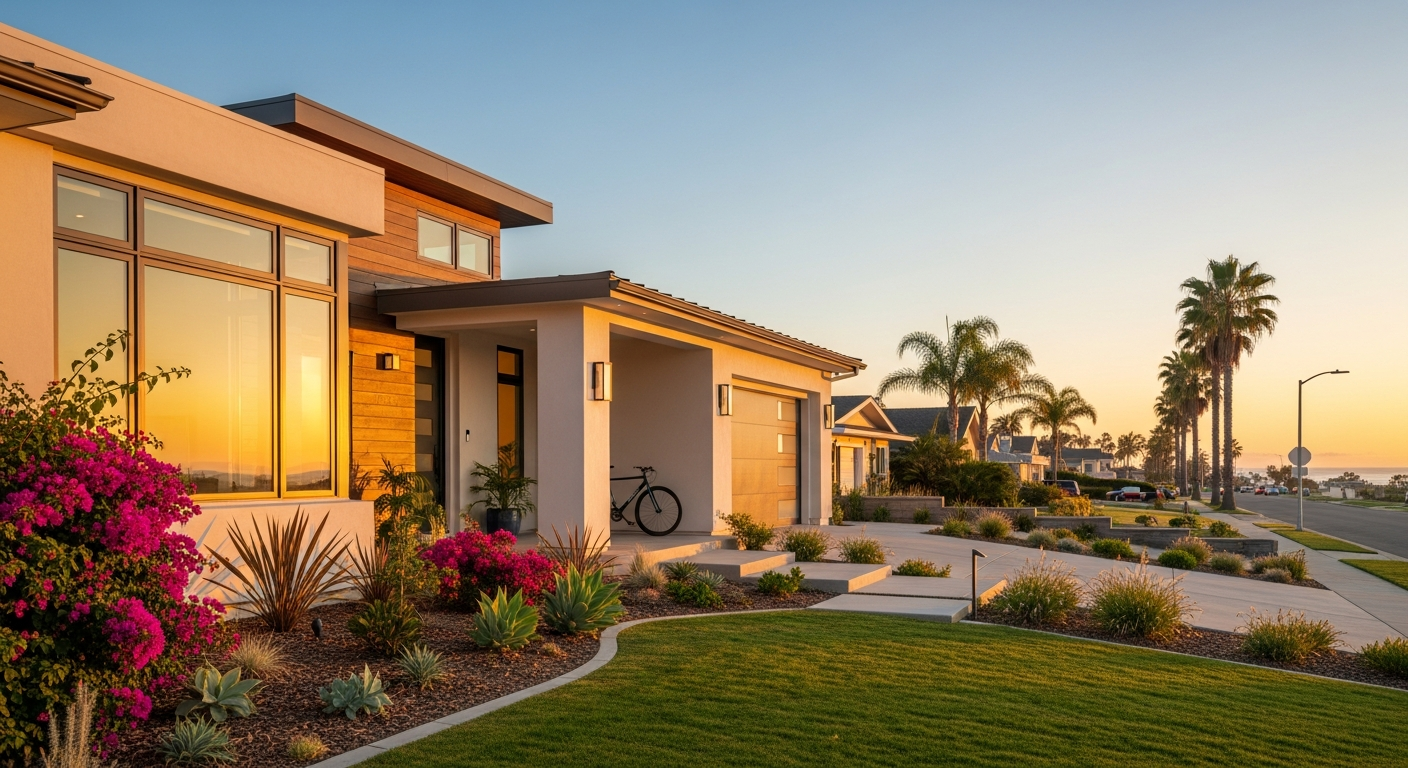
San Diego is not a vacation city. It is a city where biotech researchers build careers, military families put down roots, and a growing generation of nurses, teachers, and tradespeople are trying to buy homes and stay long-term. The problem is straightforward: prices have climbed so far beyond what most single incomes can support that the traditional path to homeownership simply does not work for a large share of the people who live and work here.
Co-ownership is one serious, structured answer to that gap. Under the Rhome model, two to four buyers purchase a primary residence together, structure their ownership through an ownership entity, split the down payment, and share a single mortgage. Everyone lives in the home as their primary residence. This is not a rental strategy or a vacation share. It is a path to stable, permanent homeownership in one of the most competitive markets in the country.
San Diego's Housing Market: What You're Up Against
San Diego has been one of the most expensive housing markets in the United States for years, and that position has only hardened over time. Median home prices in the county have held well above $800,000 in recent years, with many desirable inland neighborhoods pushing significantly higher. A 20 percent conventional down payment on an $850,000 home is $170,000 out of pocket before closing costs. Even the FHA minimum of 3.5 percent requires nearly $30,000 on that same purchase.
The forces behind the prices are not mysterious. San Diego has a concentrated cluster of globally significant industries. The biotech and life sciences sector employs tens of thousands of high-skill workers, and is anchored by institutions like UC San Diego, the Salk Institute, and Scripps Research. The defense and military economy is enormous: Naval Base San Diego, Marine Corps Air Station Miramar, Marine Corps Base Camp Pendleton, and NAS North Island collectively make San Diego one of the largest military concentrations in the country. Telecom, clean energy, and professional services add further depth to the employment base.
The result is a city with strong, sustained demand from well-employed people. Supply has not kept pace. Zoning constraints, coastal geography, and limited buildable land have kept new construction below demand for decades. People who want to stay in San Diego compete intensely for the homes that come to market.
For workers outside the top income tiers, this creates a fundamental problem. Saving for a full down payment while paying San Diego rents often takes a decade or more. Co-ownership compresses that timeline dramatically by distributing the capital requirement across multiple buyers.
California Real Estate Law and the LLC Structure
California is a community property state, which is relevant context for anyone buying property here. Community property rules apply specifically to married couples and, for many purposes, registered domestic partners. They generally do not affect how unmarried co-buyers structure their ownership.
For groups of two to four buyers who are not married to one another, the most common and cleanest co-ownership structure is an ownership entity. Each buyer holds an ownership interest in the entity, which in turn holds title to the property. The governance agreement defines each member's ownership percentage, their share of the mortgage and operating expenses, the process for one member eventually buying out another, and the rules governing how the home can be sold or transferred.
This structure provides meaningful protections that a simple joint tenancy or tenancy-in-common arrangement does not. The governance agreement is a private document that the co-owners negotiate and sign before closing. It anticipates life changes, including job relocation, relationship changes, and financial hardship, and spells out how those situations will be handled without requiring the group to sell the home.
California has well-developed LLC law, and real estate attorneys who specialize in co-ownership structures are available throughout San Diego County. Anyone pursuing co-ownership should have independent legal review of the governance agreement before signing.
Neighborhoods Worth Knowing for Primary Residents
San Diego County is large and varied. The right neighborhood for a co-ownership group depends on commute patterns, lifestyle priorities, and budget, but several areas consistently show up as strong options for buyers focused on primary-residence value.
City Heights sits a few miles east of downtown and has undergone steady investment over the past decade. It is genuinely diverse, walkable in many sections, and connected to transit. Home prices have risen but remain meaningfully lower than coastal communities. The community has a strong local identity and a real neighborhood feel that supports year-round living.
North Park is one of San Diego's most established urban neighborhoods, known for its walkable commercial corridors, older Craftsman and Spanish Colonial housing stock, and proximity to Balboa Park. It draws young professionals and is one of the few neighborhoods in the city where residents can realistically go without a car for daily life. Competition is real, but the neighborhood rewards buyers who commit to it.
El Cajon in the East County offers some of the most accessible price points in San Diego County while remaining fully integrated into the metro area. Highway access is straightforward, the community is large and economically active, and buyers can often find detached single-family homes at prices that make co-ownership genuinely meaningful in terms of the space and quality they can access.
Chula Vista in South County has grown substantially and is home to a large, established population of working families. The Otay Ranch area in particular has seen significant development with newer housing stock, good schools, and solid infrastructure. Prices remain below the county median in many pockets, and the area offers real long-term stability as a primary residence location.
Logan Heights and Barrio Logan are close to downtown and the waterfront, historically undervalued relative to their location, and seeing increasing interest from buyers who want proximity to the urban core without the prices of Little Italy or Mission Hills.
The common thread across these areas: they are real neighborhoods where people work, raise families, and build roots. They are not weekend destinations. They are primary-residence communities.
CalHFA Programs and What They Offer
The California Housing Finance Agency runs several programs that can work alongside co-ownership strategies, though buyers should understand the specifics carefully.
CalHFA's MyHome Assistance Program provides a deferred-payment junior loan of up to 3.5 percent of the purchase price, which can be used toward the FHA down payment requirement. The CalHFA FHA loan program pairs a CalHFA-originated first mortgage with FHA insurance. There are income limits, which vary by county and household size, and purchase price limits as well. San Diego County limits are higher than many parts of the state given the market, but they do cap eligibility at a level below the median in many neighborhoods.
For co-buying groups, CalHFA eligibility depends on the specific program and how income and occupancy are evaluated. Not every program is available for entity-held purchases, and some assistance programs require the primary borrower to be a first-time homebuyer. Buyers interested in combining CalHFA assistance with co-ownership should work with a lender experienced in both structures before assuming they can layer them.
The core point is that California has made meaningful effort to support homeownership access, and some of those tools are available to co-buyers. A qualified lender who understands the San Diego market and co-ownership financing can help buyers identify which programs apply to their specific situation.
The FHA Co-Buying Math in San Diego
FHA financing allows a down payment as low as 3.5 percent of the purchase price. For a group of buyers purchasing together, that down payment is split among all co-owners according to their ownership percentage.
Here is what that means in concrete terms. If four buyers purchase a home at $750,000, the total FHA down payment is $26,250. Split four ways at equal ownership, each buyer contributes approximately $6,563 toward the down payment. The monthly mortgage payment on the remaining $723,750 at current interest rates is split proportionally as well.
For non-military income earners in San Diego, where rents regularly exceed $2,500 for a two-bedroom apartment and savings accumulate slowly, this math changes the equation fundamentally. Instead of saving $170,000 alone over a decade, a buyer can pool resources with trusted co-buyers, qualify on the basis of combined income, and purchase a home with a manageable individual contribution.
FHA loans do require that all borrowers occupy the property as their primary residence. This aligns exactly with the Rhome model. Every co-owner lives in the home. There is no absentee ownership, no subletting, and no vacation framing. The occupancy requirement is not a limitation to work around. It is the foundation of the structure.
It is worth noting that FHA loan limits in San Diego County are set higher than the national standard to account for local market conditions, which expands the range of properties accessible through this path.
How Rhome Works in San Diego
Rhome provides the structure, tools, and guidance for co-buyers to move from the idea of buying together to a closed transaction and a functioning co-ownership arrangement.
The process begins before anyone makes an offer. Rhome helps co-buyer groups get aligned on ownership percentages, cost-sharing arrangements, and the terms of their governance agreement. This work happens upfront so that the group enters the buying process with clarity rather than uncertainty.
Rhome connects buyers with lenders experienced in co-ownership and FHA co-borrower transactions in California. It provides a governance agreement framework reviewed by real estate attorneys, covering the scenarios that matter most: what happens when one owner wants to sell, how buyouts are valued, how decisions about the property are made, and how costs are divided month to month.
Once the group is under contract, Rhome's tools help manage the ongoing logistics of shared homeownership. Payment tracking, communication between co-owners, and documentation are all handled in one place.
In San Diego specifically, Rhome has worked with buyers across a range of neighborhoods and income situations. The market is hard, but the combination of pooled purchasing power, FHA financing, and a sound legal structure makes it navigable for buyers who are committed to primary-residence homeownership in the city.
If you are looking at San Diego homes and wondering whether co-ownership could work for your situation, see how Rhome works or browse available homes in the area.
FAQ
See the FAQ section below.