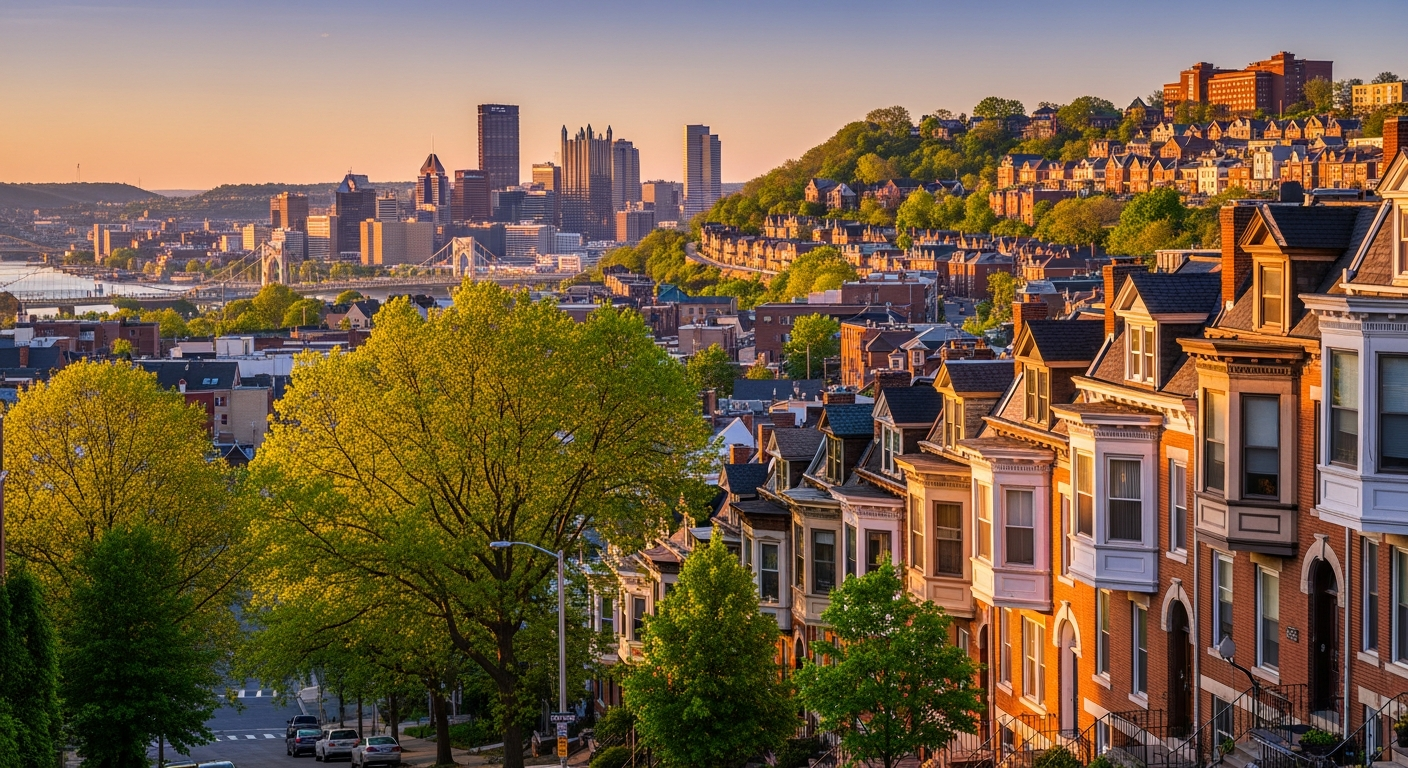
Pittsburgh doesn't ask you to suspend disbelief about homeownership. The
prices are real, the neighborhoods are genuinely interesting, and the city
has been quietly building one of the more durable economies in the Rust Belt
for the past two decades. If you've been watching from the sidelines in a
more expensive market, Pittsburgh might be the place where buying actually
makes sense, especially when you do it with a co-owner.
Co-ownership through Rhome means two to four buyers purchase a primary
residence together, each holding a share of an ownership entity that owns the home.
Everyone lives there as their primary residence. The FHA loan program is
available, which means the group's combined down payment can be as low as
3.5 percent of the purchase price. In Pittsburgh, where that purchase price
is often well below the national median, the numbers can be genuinely
surprising.
Pittsburgh's Economy and Why It's Still Underpriced
For a long time, Pittsburgh's reputation was frozen somewhere in the 1970s:
steel gone, population declining, a city working through a long industrial
hangover. That story is at least two decades out of date.
Pittsburgh today is home to two world-class research universities in
Carnegie Mellon University and the University of Pittsburgh. CMU in
particular has become one of the most important computer science and
robotics institutions in the world, and that concentration of technical
talent has attracted a real technology industry. Companies focused on
autonomous vehicles, AI, and software have established significant presences
in the city. UPMC, the University of Pittsburgh Medical Center, is one of
the largest employers in Pennsylvania and one of the top hospital systems in
the country. Combined, the tech and medical sectors have created a stable,
skilled-labor economy that looks very different from what the city's old
reputation would suggest.
The result is a city where wages have been rising, population in desirable
inner neighborhoods has stabilized or grown, and home prices have
appreciated meaningfully over the past decade. But because Pittsburgh
started from such a low baseline, it remains far more affordable than cities
with comparable economic profiles. Boston, Seattle, and Austin all have
strong tech and university ecosystems. None of them have Pittsburgh's price
tags.
That gap is unlikely to last indefinitely. Buyers who get in now are
positioned well.
Pennsylvania Real Estate Law: What to Know
Pennsylvania is a partial attorney-closing state. While you don't always
need an attorney at the table, many transactions do involve one, and in
practice most Pittsburgh buyers work with a real estate attorney,
particularly when there's a co-ownership entity involved. If you're forming a co-ownership
structure, legal counsel isn't optional, it's the right move regardless of what
the law strictly requires.
Transfer taxes in Pennsylvania work at two levels. The state levies a 1
percent transfer tax on the purchase price. Municipalities add their own,
and in Pittsburgh that adds another 1 percent, bringing the combined rate to
2 percent. By convention, this is typically split between buyer and seller,
though that's negotiable in the offer. Your Rhome co-ownership structure
should account for both the transfer tax at purchase and the governance
agreement that governs your ownership entity going forward.
Allegheny County uses a triennial reassessment system for property taxes,
meaning values are officially reassessed every three years. The county's
effective property tax rates are modest by national standards, which
contributes meaningfully to Pittsburgh's overall affordability as a place to
own.
The Neighborhoods Worth Knowing
Pittsburgh is a city of neighborhoods, roughly 90 of them by official count,
each with its own character. For co-owners looking at primary residence
purchases, a handful stand out.
Shadyside sits between Carnegie Mellon and the East End, with Victorian
rowhouses and well-preserved architecture on tree-lined streets. It's
walkable, has good transit access, and has been consistently desirable for
decades. Prices here are higher by Pittsburgh standards but still accessible
relative to comparable neighborhoods in other cities.
Lawrenceville is the city's most prominent example of neighborhood
reinvention. What was once a working-class industrial corridor along the
Allegheny River became, over about fifteen years, one of Pittsburgh's most
energetic places to live. Butler Street has restaurants, independent retail,
and a density of activity that feels genuinely urban. Co-owners who want a
live-in neighborhood with momentum look here first.
Oakland is the city's institutional core, home to both UPMC and the
universities. It's dense, walkable, and close to an enormous concentration
of jobs. For co-owners where at least one person works in medicine or
academia, the commute math makes Oakland hard to ignore.
Polish Hill is smaller and quieter, a hillside neighborhood with modest
brick homes, long views, and a character that hasn't been scrubbed clean by
development. It appeals to buyers who want Pittsburgh at a more human scale,
and prices reflect that it's still relatively under the radar.
Mount Washington deserves its own mention for the views alone. Perched
on a bluff directly south of downtown, Mount Washington looks across the
Ohio River confluence to the Pittsburgh skyline, one of the more dramatic
urban vistas in the country. Getting there involves the Duquesne Incline or
a short highway drive. For co-owners willing to trade a bit of transit
convenience for one of the best views a primary residence can offer, it's
worth serious consideration.
PHFA: Pennsylvania's State Homebuyer Programs
The Pennsylvania Housing Finance Agency runs several programs that can work
alongside a co-ownership purchase. The PHFA's Keystone Home Loan program
offers competitive 30-year fixed rates for buyers who meet income and
purchase price limits. The Keystone Advantage Assistance Loan Program
provides a second mortgage of up to 4 percent of the purchase price to help
with down payment and closing costs.
Income and purchase price limits vary by county. Allegheny County has its
own set of limits, and Pittsburgh's home prices often fall well within those
thresholds. PHFA programs can be layered with FHA financing, which is a
meaningful advantage for co-owners using the Rhome structure.
It's worth engaging a Pittsburgh-area lender familiar with PHFA early in
your process. Not every lender participates, and the underwriting timelines
can be slightly longer than a standard conventional loan.
The FHA Co-Buying Math in Pittsburgh
This is where Pittsburgh's affordability becomes genuinely compelling. Let's
work through it.
FHA loans require 3.5 percent down. Under the Rhome co-ownership model, that
down payment is shared across all co-owners. If two people are buying
together, each person's contribution is half that amount. Three people: a
third each. Four: a quarter each.
Consider a home priced at $280,000, which is a realistic figure for a
well-located, character-rich Pittsburgh property in a neighborhood like
Lawrenceville or Polish Hill. The total FHA down payment is $9,800. Split
two ways, each buyer contributes $4,900. Split three ways, each person
brings $3,267 to close.
For context, the same math applied to a $650,000 home in another city would
require $11,375 per person in a two-person buy. Pittsburgh's price point
cuts that number by more than half before you even split it.
Closing costs run roughly 2 to 5 percent of the loan amount, so budget for
those separately. But the core barrier, the down payment, is small to begin
with and gets smaller as each co-owner's individual share.
Monthly carrying costs divide similarly. A $280,000 purchase with a 30-year
FHA loan at prevailing rates (rates fluctuate, so consult your lender for
current numbers) produces a principal, interest, and mortgage insurance
payment that, split two or three ways, often comes out below what each
person would pay in rent for a comparable space. The rent-versus-own math in
Pittsburgh frequently favors ownership, and co-ownership makes it even more
accessible.
How Rhome Works in Pittsburgh
Rhome's model is built for exactly this kind of market. You start by finding
co-owners, which might mean a sibling, a close friend, a partner, or
colleagues who've had the same conversation about whether homeownership is
actually within reach. Each person goes through prequalification so the
group understands its collective buying power.
Rhome establishes the ownership structure that holds the property. The
co-ownership agreement covers the things that matter: who pays what, how
decisions get made, what happens if one person wants to sell or needs to
exit. These aren't hypothetical edge cases; they're the foundation of a
stable shared purchase, and having them in writing before you buy protects
everyone.
From there, the process looks like a conventional home purchase. You work
with an agent, make offers, go through inspection and appraisal, and close.
Pittsburgh's market is competitive in the most desirable neighborhoods but
not the frenzied environment buyers encounter in coastal cities. There's
usually time to think and negotiate, which is exactly the environment you
want for a first co-ownership purchase.
All co-owners must live in the home as their primary residence. Rhome isn't
an investment structure; it's a path to actual homeownership for people who
want to live somewhere together.