There is a version of the American housing conversation that never mentions Omaha. The discourse gravitates toward coastal cities, toward San Francisco and New York and Boston, markets where the word "affordability" sounds almost ironic. Omaha does not generate those headlines. And that is, in its own way, the point.
Omaha is a city of roughly half a million people, anchored by a cluster of Fortune 500 companies that includes Berkshire Hathaway, Union Pacific, and Mutual of Omaha. The regional economy is diversified across finance, insurance, healthcare, agriculture, and logistics. Unemployment has historically tracked below the national average. The population has grown steadily for decades. And the housing market, relative to almost any comparable city on either coast, remains accessible in ways that feel almost incongruous with Omaha's economic fundamentals.
For two to four people who want to co-own a primary residence together, Omaha is one of the most compelling markets in the country. The math works. The legal framework is straightforward. The neighborhoods are real. And yet co-buying as a formal, structured approach to homeownership has barely reached the Midwest in terms of public conversation. That is beginning to change.
The Omaha Housing Market: A Grounded Overview
Omaha's median home price has risen meaningfully over the past several years, as it has across most U.S. markets. Still, when you place Omaha alongside peer cities in coastal metros, the gap remains significant. Median home prices in Omaha have generally hovered in the $260,000 to $300,000 range in recent years, with variation by neighborhood, property type, and market timing. That stands in sharp contrast to markets like Denver, Seattle, or the Bay Area, where median prices in desirable neighborhoods routinely exceed $700,000 or $1 million.
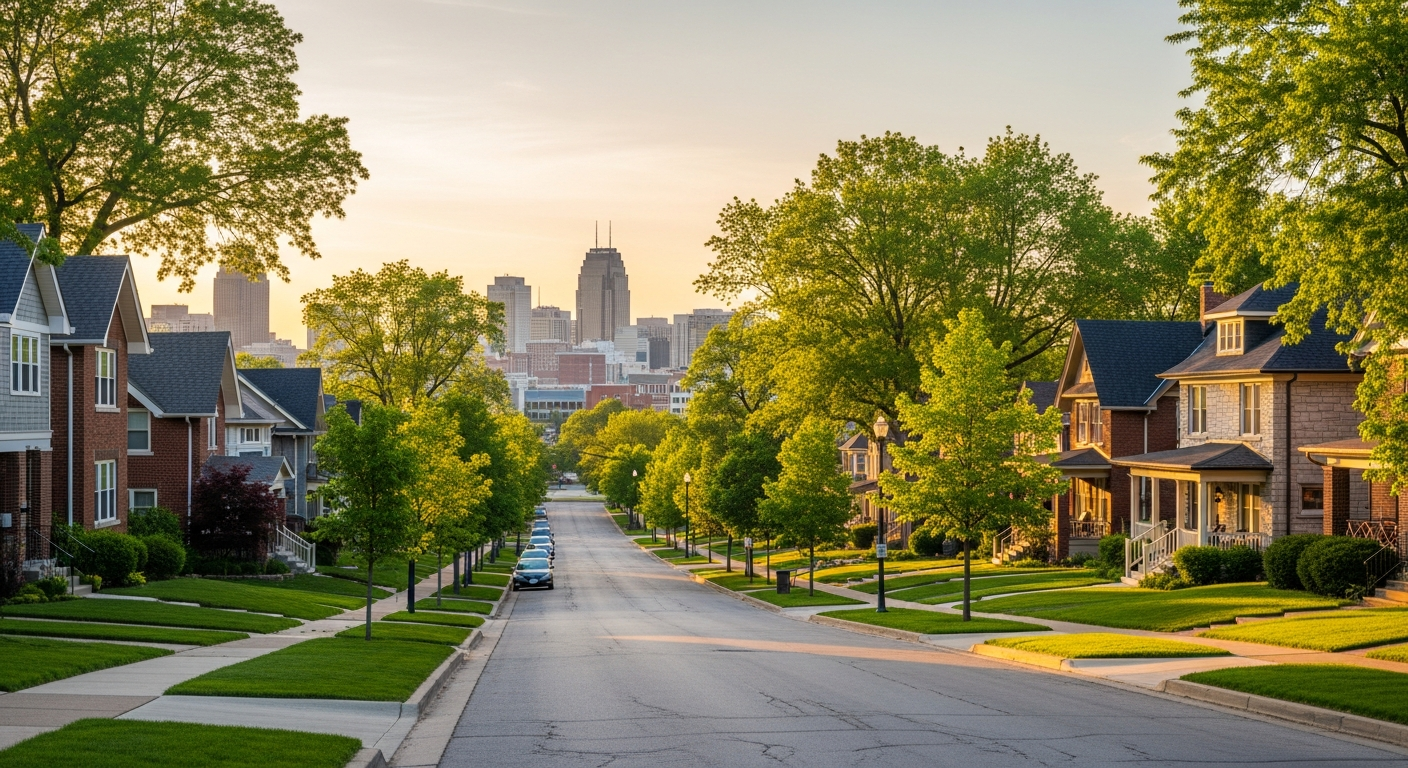
What makes Omaha interesting for co-buyers is not just the absolute price. It is the relationship between price, income, and what is actually available. Omaha's housing stock includes a substantial supply of character-rich single-family homes built between the 1920s and 1970s: craftsman bungalows in walkable neighborhoods, brick colonials with mature tree canopies, updated mid-century ranches. These are the kinds of homes that in a coastal city would carry a price premium simply by virtue of their bones. In Omaha, they are part of the regular market.
The city's property tax structure also matters. Nebraska's effective property tax rates are moderate within the Midwest, and Douglas County, which encompasses Omaha, has assessment practices that are relatively transparent and predictable. Co-buyers can model monthly costs with reasonable confidence rather than discovering a property tax shock after closing.
For context on what the media tends to overlook: Omaha has one of the lowest housing cost-to-income ratios among mid-sized American cities, it has maintained positive population growth that supports long-term home values, and it offers a lifestyle that does not require a car for everything in its established inner-ring neighborhoods. The national conversation simply has not caught up to what residents already know.
Nebraska Real Estate Law for Co-Buyers
Before two or more people can co-buy a home in Nebraska, they need to understand how the state handles shared ownership of real property.
Tenancy in common is the default form of co-ownership in Nebraska when no other structure is specified. Each owner holds a defined percentage interest, which can be unequal, and each can sell or bequeath their share without the consent of the others. There is no right of survivorship. For co-buyers contributing different amounts to a purchase, tenancy in common reflects economic reality more accurately than joint tenancy, but it also leaves major decisions to state law rather than a private agreement, which is a significant limitation.
Joint tenancy requires all four unities: same time, same title, same interest, and same possession. Nebraska courts require that joint tenancy be expressly stated in the deed. If one owner dies, their interest passes automatically to surviving co-owners without going through probate. This structure is sometimes used by siblings or family members, but for unrelated co-buyers with different financial circumstances, it creates complications around unequal contributions and exit rights.
LLC ownership is the structure Rhome uses, and it is the right fit for most co-buyer groups. A Nebraska limited liability company is formed under the Nebraska Uniform Limited Liability Company Act (Neb. Rev. Stat. sections 21-101 through 21-194). The Rhome ownership structure holds title to the property. Each co-buyer holds a membership interest in the structure, defined in the governance agreement. The governance agreement can specify unequal ownership percentages, cost-sharing arrangements, buyout procedures, decision-making rules, and provisions for life events that a deed simply cannot address.
Nebraska's LLC law is well-established and gives members wide latitude to structure their arrangements by contract. Courts in Nebraska have consistently upheld operating agreements as enforceable private contracts. For co-buyers who want a clear, documented framework for living together and eventually unwinding the arrangement, the Rhome ownership structure with a well-drafted governance agreement is the only configuration that provides the necessary flexibility.
One thing Nebraska does not have: a state-level beneficial ownership registry requirement for residential purchases as of early 2026. Federal reporting requirements under the Corporate Transparency Act apply to most small LLCs, and co-buyers should confirm current federal obligations with their attorney before closing.
Forming a Nebraska LLC is administratively simple. Articles of Organization are filed with the Nebraska Secretary of State, and the filing fee is modest. The governance agreement is where the real work happens, and it should be drafted with the help of a licensed Nebraska real estate attorney who understands co-ownership structures.
Key Omaha Neighborhoods for Co-Buyers
Omaha's neighborhoods vary considerably in character, price point, and what they offer for a group of people looking to share a home. Here are four that consistently generate interest from co-buyers.
Dundee
Dundee is one of Omaha's most architecturally distinguished neighborhoods, situated just west of Midtown in a grid of tree-lined streets. The housing stock is predominantly early-to-mid 20th century: Tudor revivals, four-squares, and craftsman bungalows with original woodwork and character that newer construction cannot replicate. Dundee runs pricier than some Omaha neighborhoods, with many homes falling in the $350,000 to $550,000 range, but for co-buyers splitting that cost, it represents genuine value for the quality of what you are getting. The neighborhood is walkable to shops, restaurants, and coffee, which matters for groups of people with different schedules who want a shared living environment that does not require a car for every errand.
Benson
Benson has undergone a notable revitalization over the past decade and a half. It is now one of Omaha's more active neighborhood commercial corridors, with independent restaurants, bars, record stores, and a genuine sense of street life. Housing prices in Benson are more accessible than Dundee, with a mix of older single-family homes and smaller multi-unit buildings that co-buyers with different configurations might find attractive. For a group of two or three younger buyers who want to be close to where things happen in Omaha, Benson is worth serious attention.
Midtown
Midtown Crossing, Omaha's urban mixed-use district near 33rd and Farnam, anchors a broader Midtown area that offers convenient access to downtown employment, the medical center complex, and Creighton University. The housing in broader Midtown ranges from renovated brick two-story homes to newer construction condos, and prices vary accordingly. For co-buyers who prioritize proximity to work over neighborhood aesthetics, Midtown offers a compelling case, and the access to the interstate network means easy navigation across a city that is geographically spread out.
Aksarben Village
Aksarben Village is a planned mixed-use development built on the former site of Ak-Sar-Ben racetrack, southwest of downtown. It blends retail, office space, restaurants, and residential in a walkable format that feels different from older Omaha neighborhoods but has developed a genuine community identity. The University of Nebraska Omaha campus is nearby. For co-buyers who want newer construction, easier maintenance, and walkability without the older-home project list, Aksarben is a strong candidate. Prices here skew toward the newer end of the Omaha spectrum, but co-buying makes them significantly more approachable.
Nebraska Investment Finance Authority Programs
The Nebraska Investment Finance Authority (NIFA) administers several homebuyer assistance programs that can benefit Omaha co-buyers. These programs operate through NIFA-approved participating lenders and have income limits, purchase price limits, and residency requirements that vary by program and household.
NIFA's First Home program offers below-market interest rate mortgage financing for eligible first-time homebuyers. In Nebraska, "first-time homebuyer" is defined as someone who has not owned a principal residence in the past three years. The program works through participating lenders and is designed to make homeownership more accessible to buyers whose incomes might qualify them for a loan but not at prevailing market rates.
NIFA's Homebuyer Assistance (HBA) program pairs with the First Home mortgage to provide down payment and closing cost assistance, typically structured as a second mortgage at a reduced interest rate. The assistance amount is based on a percentage of the purchase price and is subject to income and purchase price limits that NIFA updates periodically. Buyers should verify current limits with a NIFA-approved lender.
NIFA's Military Home program offers equivalent benefits for active duty military members, veterans, and surviving spouses without the three-year first-time-homebuyer restriction.
The important question for co-buyers is how NIFA programs interact with the Rhome ownership structure. Like most state housing finance agency programs, NIFA assistance is designed for individual borrowers who will hold title directly, not through a business entity. If the purchase is structured with the ownership entity holding title, NIFA assistance is generally not compatible in the standard configuration. Co-buyers who want to access NIFA assistance should discuss the structure of their transaction with a NIFA-approved lender early in the process, before assumptions solidify. Rhome can help facilitate that conversation.
All NIFA programs require borrowers to complete an approved homebuyer education course, and the property must serve as the borrower's primary residence, which aligns with the co-ownership model Rhome supports.
FHA Co-Buying Math in the Omaha Market
FHA loans allow a minimum down payment of 3.5% for borrowers with a credit score of 580 or higher. When two, three, or four buyers pool their resources toward that 3.5%, the individual contribution per person drops meaningfully, which is one of the core affordability arguments for co-buying.
Here is how the numbers look at Omaha price points:
$280,000 home (a representative mid-range Omaha single-family in Benson or parts of Midtown):
- 3.5% down payment: $9,800
- Split two ways: $4,900 per person
- Loan amount: $270,200
- At 7% interest rate (illustrative): monthly principal and interest roughly $1,798
- Split two ways: roughly $899 per person before property taxes, insurance, and MIP
$380,000 home (Dundee character home, updated craftsman, or newer construction in Aksarben):
- 3.5% down payment: $13,300
- Split two ways: $6,650 per person
- Loan amount: $366,700
- At 7%: monthly principal and interest roughly $2,440
- Split two ways: roughly $1,220 per person before property taxes, insurance, and MIP
$480,000 home (larger Dundee home, premium Aksarben unit, or a home for three co-buyers splitting more broadly):
- 3.5% down payment: $16,800
- Split three ways: $5,600 per person
- Loan amount: $463,200
- At 7%: monthly principal and interest roughly $3,083
- Split three ways: roughly $1,028 per person before property taxes, insurance, and MIP
For 2024, the FHA loan limit in Douglas County for a single-family home was $498,257. Most Omaha co-buyers will find ample inventory within that ceiling. Properties above the limit would require conventional financing, which generally means a higher down payment but no FHA mortgage insurance premiums.
Speak on FHA mortgage insurance: FHA loans carry an upfront mortgage insurance premium of 1.75% of the loan amount, typically rolled into the loan, and an annual MIP that runs approximately 0.55% of the outstanding balance for a 30-year loan with 3.5% down. On a $270,200 loan, that is roughly $124 per month in annual MIP, split two ways at $62 per person. It is a real cost, but for buyers who do not have a large down payment, the access to ownership often justifies it, particularly in a market as accessible as Omaha.
All co-borrowers on an FHA loan must meet FHA's credit and income guidelines individually, and all must intend to occupy the property as a primary residence. That is a core FHA requirement and also a core Rhome requirement. This is not a structure for absentee ownership or rental arbitrage. It is for people who want to live in the home they own.
Why Omaha Underperforms Its Value in National Coverage
Omaha suffers from a kind of inverse prestige problem. Coastal media covers housing markets that are in crisis, where prices are so high that the story writes itself. Omaha does not fit that frame. Home prices are not in crisis. Supply, while tightening in desirable neighborhoods, has not collapsed. And so Omaha does not generate the feature stories that Seattle or Miami generate.
But this creates an interesting asymmetry for people who actually look at the numbers. Omaha has:
- A stable, diversified employment base anchored by major corporations and a strong healthcare sector
- Housing prices that remain accessible relative to income levels in a way that few comparable mid-sized cities can match
- Established, walkable neighborhoods with genuine architectural character
- A local restaurant and culture scene that has developed considerably over the past 15 years
- A university presence (University of Nebraska Omaha, Creighton University) that anchors stable rental and ownership demand
- Infrastructure investment that has improved the Riverfront and downtown connectivity
None of this gets the coverage it deserves because there is no crisis to cover. For co-buyers who are thinking about where their ownership dollar goes furthest, that is precisely the point. The lack of national hype is not a warning sign. It is an opportunity.
There is also a network dimension worth naming. Co-buying works best when the people involved are genuinely connected to a place: their employers are there, their social networks are there, they expect to be in the city for the medium term. Omaha has the kind of community infrastructure, the neighborhood associations, the local institutions, the sense of settled identity, that makes that long-term orientation realistic. Co-buyers who plant themselves in Dundee or Benson are not making a speculative bet on a market they know nothing about. They are buying into something with roots.
How Rhome Works in Omaha
Rhome is designed for exactly this kind of co-ownership: two to four buyers who want to own a primary residence together, live in it, and structure the arrangement with the legal and financial framework it deserves.
Here is what Rhome brings to an Omaha co-purchase:
Ownership structure formation and governance agreement. Rhome coordinates the formation of a Nebraska ownership entity and works with attorneys to draft a governance agreement specific to your group. That means your ownership percentages, your cost-sharing arrangement, your buyout provisions, and your decision-making rules are documented in a private contract that actually fits your situation.
Lender coordination. Co-buying involves underwriting complexity that not every lender is prepared for. Rhome works with lenders who understand how to underwrite co-buyer transactions and who know the Nebraska and Douglas County market.
Co-buyer matching. If you are one or two buyers looking for additional co-owners, Rhome can connect you with vetted buyers who share your target market, budget, and timeline.
Structure support after closing. Questions come up. A member wants to exit earlier than expected. A member's financial situation changes. The governance agreement is built to handle those moments, and Rhome is available when they arise.
For Omaha specifically, the combination of accessible price points and Rhome's structure means that the path to homeownership for two people with reasonable incomes and decent credit is genuinely achievable. You do not need a large down payment. You do not need a single income that can carry a full mortgage alone. You need a group, a clear agreement, and the right support.
To get started, visit rhome.com/how-it-works or browse available homes at rhome.com/homes.
Frequently Asked Questions
See FAQ section below.