When two to four people decide to co-own a primary residence together, they are not just choosing a home. They are choosing a neighborhood, a daily rhythm, and a shared way of living. The neighborhood's design shapes all of that more than most buyers realize. New Urbanism, a planning movement that puts walkability, mixed uses, and human-scaled streets at the center of community design, has produced some of the most livable neighborhoods in the United States. For co-owners in particular, those principles translate into concrete everyday advantages.
This article explains what New Urbanism is, how walkability affects home values and your ability to finance a home, why co-owners often find walkable neighborhoods especially practical, and how to evaluate any neighborhood before you commit.
What New Urbanism Actually Is
New Urbanism is an urban planning and design philosophy that emerged in the United States in the early 1990s. Its founders, architects Andres Duany and Elizabeth Plater-Zyberk among others, were reacting to the sprawl of post-war suburbia: the cul-de-sacs with no destinations, the strip malls accessible only by car, the absence of public space that invites people to linger.
New Urbanist neighborhoods are built around a different set of priorities:
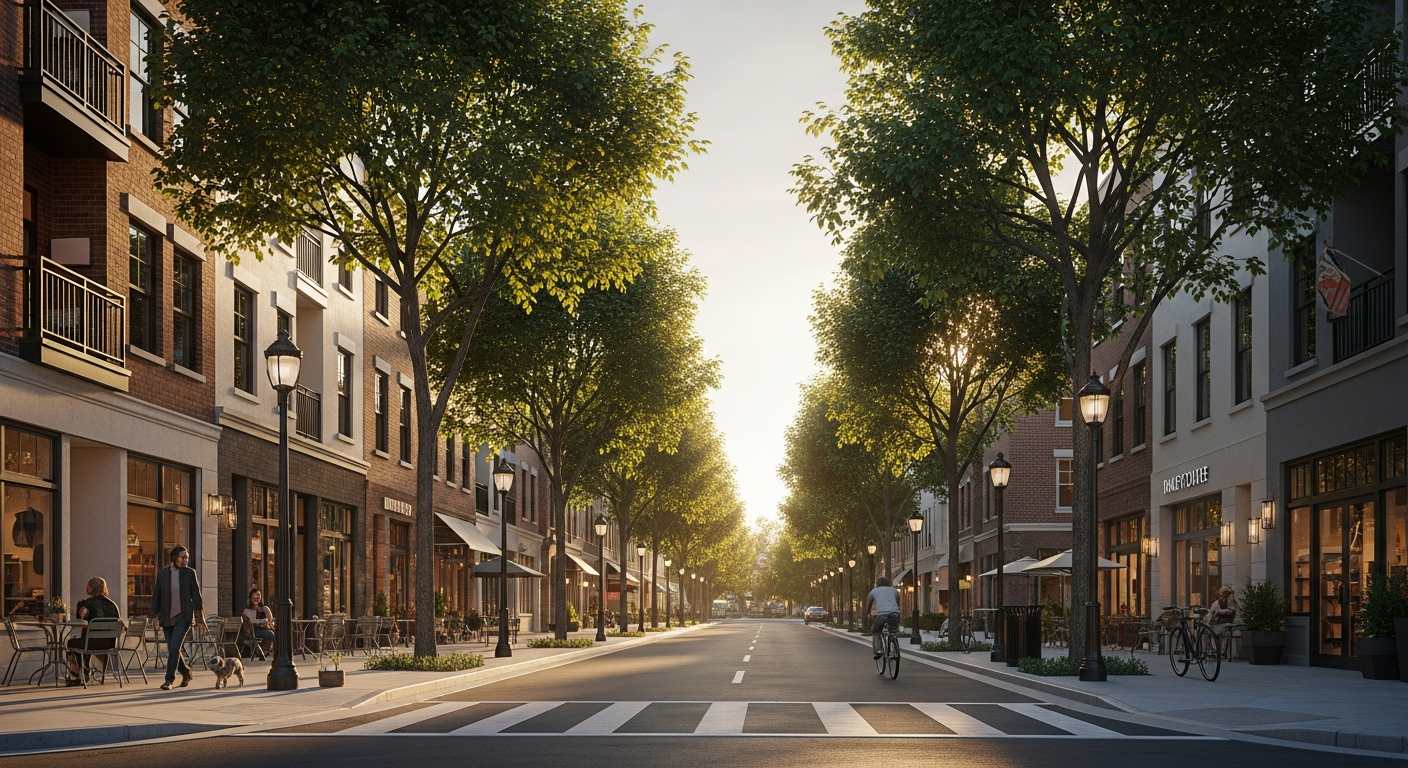
- Walkability. Streets are designed for pedestrians first. Sidewalks are wide, blocks are short, and destinations like cafes, parks, and grocery stores are within a ten-minute walk of most front doors.
- Mixed uses. Residential and commercial buildings share the same streets. You might live above a bookstore or next to a small restaurant. This reduces the need to drive for routine errands.
- Defined neighborhood centers. Each neighborhood has a focal point, often a town square, market street, or park, that draws people together and creates a sense of place.
- Human-scaled architecture. Buildings face the street, have front porches or stoops, and are designed to engage pedestrians rather than to be experienced from a car window.
- Transit access. Many New Urbanist communities are designed around transit stops or at least connected to transit networks.
Well-known New Urbanist communities in the United States include Seaside, Florida (where the movement first gained wide attention), Kentlands in Gaithersburg, Maryland, Mueller in Austin, Texas, Stapleton (now Central Park) in Denver, Colorado, and many neighborhoods developed under the HOPE VI program in cities across the country.
Beyond planned communities, New Urbanist principles have also shaped infill development and the revitalization of older urban neighborhoods, from Atlanta's Beltline corridor to neighborhoods in Portland, Minneapolis, and Washington, D.C.
How Walkability Affects Home Value
Walkability has a measurable effect on residential property values. Research from the National Association of Realtors and academic urban economics literature has consistently found that homes in walkable neighborhoods command price premiums over otherwise comparable homes in car-dependent areas. The relationship is not subtle. In dense metro markets, the premium can be meaningful.
The mechanism is straightforward. Walkable neighborhoods reduce transportation costs. A household that can walk to work, a grocery store, a pharmacy, and a restaurant several times a week is paying less for gasoline, car maintenance, and potentially car ownership itself. That savings has real financial value, and the real estate market prices it in.
Walkability also tends to correlate with neighborhood stability and investment over time. Communities with active street life and accessible amenities tend to attract continued private and public investment, which supports long-term value.
For co-owners, this matters for two reasons. First, the home is a primary residence and a financial asset. Buying in a walkable neighborhood tends to support stronger long-term appreciation. Second, walkability affects daily life quality for all co-owners in concrete, practical ways.
Walk Score and Mortgage Qualification
Walk Score is the most widely used numerical rating of neighborhood walkability. It assigns a score from 0 to 100 based on the distance to amenities like grocery stores, restaurants, schools, parks, and transit stops, weighted by how useful they are and how safely a pedestrian can reach them.
The general interpretation:
- 90 to 100: Walker's Paradise. Daily errands do not require a car.
- 70 to 89: Very Walkable. Most errands can be accomplished on foot.
- 50 to 69: Somewhat Walkable. Some errands can be done on foot.
- 25 to 49: Car-Dependent. Most errands require a car.
- 0 to 24: Almost all errands require a car.
Lenders and appraisers do not use Walk Score directly in qualification decisions, but walkability affects appraisals indirectly. Appraisers must justify valuations using comparable sales in the same neighborhood or market area. When a neighborhood's walkability supports higher market values, those comps support the appraisal, which affects the loan-to-value ratio and financing terms.
For co-buyers financing through a co-ownership structure, this means that a stronger neighborhood profile, including walkability, can support the appraisal needed to close on the home.
Why Co-Owners Often Prefer Walkable Neighborhoods
Co-ownership under the Rhome model means two to four qualified buyers purchase a primary residence together. Each person occupies the home as their primary residence. That arrangement creates a few dynamics that make walkable neighborhoods especially practical.
Reduced dependence on a single car. In car-dependent suburban environments, a household often needs as many cars as it has adult drivers. In a walkable neighborhood, co-owners can genuinely reduce car ownership, sharing one vehicle or using transit and walking for many daily trips. The cost savings from reduced car ownership are real and recurring.
Shared proximity to amenities. When multiple co-owners have different jobs, routines, and social lives, a central, walkable location tends to work better for everyone than a remote suburban address that is optimal for one person but inconvenient for others.
Daily life quality for multiple residents. Walkable neighborhoods tend to have more street activity, more accessible parks and cafes, and more spontaneous social interaction. For co-owners building a shared home life, that environment often supports a better day-to-day experience than a quiet cul-de-sac.
Access to transit. Many co-owners are younger buyers who rely on transit or prefer not to own multiple cars. Walkable neighborhoods with transit access support those preferences.
How to Evaluate Walkability Before You Buy
Before committing to a neighborhood, here is a practical evaluation framework.
Look up the Walk Score. Visit walkscore.com and enter the property address. Review not just the overall score but the transit score and bike score separately. Understand what is driving the numbers.
Walk the neighborhood yourself. Numbers do not capture everything. Visit at different times of day, including a weekday morning and a weekend afternoon. Are people outside? Are streets well-maintained and pleasant to walk? Are there destinations that would be part of your actual routine, not just on the map?
Check the amenity map. The Walk Score map shows specific nearby businesses. Verify that the grocery stores, cafes, and transit stops shown are actually operating. Map data can lag behind business closures.
Assess the street design. Wide sidewalks, street trees, traffic-calmed streets, and pedestrian crossings at intersections all signal a neighborhood designed for walking. Wide arterials with few crosswalks and fast traffic are difficult to walk safely, regardless of what is nearby.
Research the trajectory. Is the neighborhood improving? Are new businesses opening? Are there planned transit or infrastructure investments? Walkable neighborhoods that are still improving often represent better long-term value than those already fully priced in.
Talk to people who live there. Current residents have knowledge that no website captures. Ask what they walk to, what they wish were closer, and how the neighborhood has changed.
New Urbanist Communities Across the United States
If you are specifically interested in neighborhoods built on New Urbanist principles, here are some examples across different regions:
East Coast. Kentlands in Gaithersburg, Maryland, is one of the most studied New Urbanist communities. Harbor Town in Memphis, Tennessee, brought New Urbanism to a mid-sized Southern city. The planned communities of the Sea Islands in South Carolina reflect Duany's ongoing influence in the region.
Southeast. Seaside, Florida, is the founding example, though its fame has made it expensive. Celebration, Florida, was developed by Disney with strong New Urbanist influence. Avalon Park in Orlando is a more accessible newer example.
Midwest. Kirkwood Station in St. Louis, mixed-use infill near light rail, reflects New Urbanist principles. Several neighborhoods in Cincinnati and Columbus have seen walkable infill development.
West. Mueller in Austin is a model transit-oriented New Urbanist community built on a former airport site. The Stapleton redevelopment in Denver, now called Central Park, is one of the largest New Urbanist projects in the country. Several neighborhoods in Portland, Oregon, have evolved with strong New Urbanist characteristics.
Pacific Northwest and Mountain West. Issaquah Highlands east of Seattle was planned around walkable centers. Many inner neighborhoods of Boise, Idaho, reflect traditional neighborhood design that aligns with New Urbanist principles.
These are starting points, not an exhaustive list. New Urbanist principles have influenced infill development in nearly every major metro area.
What This Means for Your Co-Ownership Decision
Neighborhood choice is one of the most consequential decisions in any home purchase. For co-owners, the stakes are shared. A neighborhood that works well for all co-owners on a daily basis, that is easy to navigate without a car, that has accessible amenities, and that is positioned well for long-term value, makes the entire co-ownership arrangement more sustainable.
New Urbanist and walkable neighborhoods are not the right fit for every group of co-buyers. Some people prioritize space, quiet, or proximity to specific employers outside walkable cores. But understanding walkability as a variable, using Walk Score as a tool, and visiting neighborhoods in person before committing are steps that every co-buyer should take.
Rhome connects buyers with properties and helps structure the legal and financial arrangement. But the neighborhood is yours to evaluate. Take the time to walk it.
FAQ
Does a high Walk Score directly affect our mortgage approval?
Not directly. Lenders do not use Walk Score in their qualification formulas. But walkability can affect appraisal values because appraisers rely on comparable sales in the neighborhood, and walkable neighborhoods often support higher market values. A strong appraisal supports the loan-to-value ratio that lenders require.
Can co-owners in a walkable neighborhood realistically share one car?
It depends on the specific neighborhood and each co-owner's commute and routine. In a neighborhood with a Walk Score above 80 and good transit access, it is genuinely feasible for co-owners to reduce total car ownership compared to a car-dependent address. The savings can be meaningful over time.
Are New Urbanist communities more expensive than conventional suburbs?
Often, yes. Walkable, well-designed neighborhoods tend to command price premiums because demand for them is high and supply is limited. Co-ownership can help buyers access those neighborhoods despite the higher price point, because purchasing with one to three other co-owners significantly increases total buying power.
Do all co-owners need to agree on the neighborhood before searching?
Yes, alignment on neighborhood is one of the most important early conversations for any group of co-buyers. Location affects everyone's daily life for years. Reaching agreement on priorities, walkability, commute access, school districts, proximity to family, before beginning a property search makes the process more efficient and reduces conflict later.
What is the difference between a walkable neighborhood and a New Urbanist community?
All New Urbanist communities are designed to be walkable, but not all walkable neighborhoods are formally New Urbanist. Many older urban neighborhoods in American cities, built before the era of suburban sprawl, are highly walkable without having been planned under any formal design philosophy. New Urbanism is a specific design and planning movement. Walkability is the practical outcome it aims for, but that outcome can be achieved through many paths, including the organic growth of older city neighborhoods.