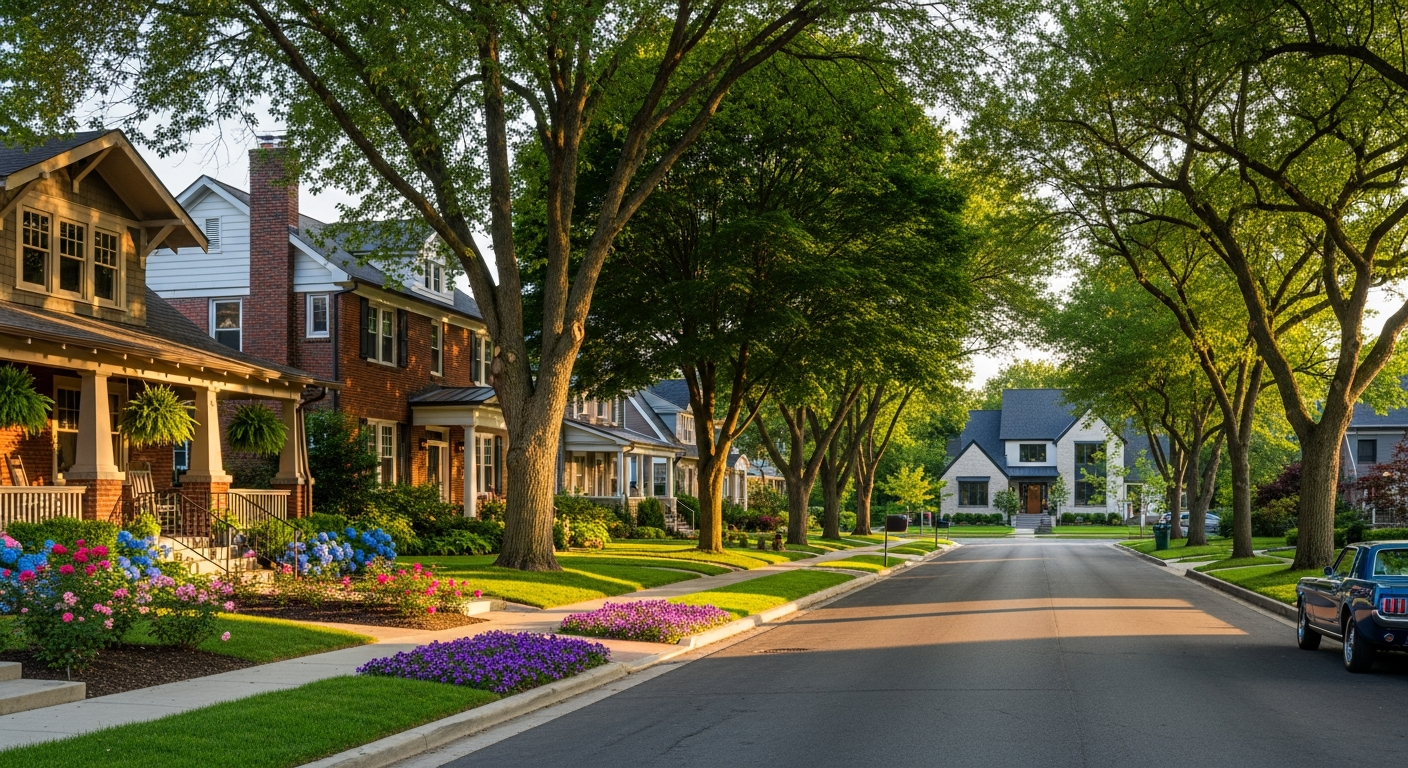
Homeownership has always been about more than a mortgage. When someone buys a home, they're making a bet on a place. They're deciding that this street, this block, this neighborhood is where they want to plant themselves for the foreseeable future. That act of commitment, repeated across thousands of households, is what makes a neighborhood stable.
Co-ownership, at its core, is a way to extend that kind of commitment to buyers who might otherwise be locked out of the market. And the downstream effects on neighborhoods are worth paying attention to.
How Owner-Occupancy Stabilizes Neighborhoods
Researchers who study neighborhood change have long noticed a pattern: blocks and districts where more residents own their homes tend to hold together better over time. Property values are more consistent. Residents participate more in local civic life. Turnover is lower, so neighbors actually know each other. Maintenance standards stay higher because owners have a financial stake in what happens to their properties.
The mechanism here isn't mysterious. Renters, through no fault of their own, often have shorter planning horizons. A lease is twelve months. A landlord might sell. The uncertainty makes deep neighborhood investment harder to justify. Owners, by contrast, are often thinking in years and decades. They join the school board. They show up at zoning meetings. They plant trees that won't be mature for twenty years.
This isn't a judgment about renters. It's an observation about incentives. The structure of ownership creates a different relationship to place than the structure of renting.
How Co-Ownership Puts More Buyers Into Ownership
The clearest impact co-ownership has on neighborhoods is simple: it converts buyers from the rental market into the ownership market.
Consider a buyer who earns a solid income but lives in a market where median home prices have outpaced what she can qualify for alone. Without co-ownership, she rents. With co-ownership, she and a co-buyer pool their qualifying income and down payment, purchase a home together as primary residents, and become owners.
That's a household that moves from the rental column to the ownership column. One more owner-occupant on the block. One more person whose financial fate is tied to the neighborhood. One more voice in the local conversation about what this place should become.
Repeat that across dozens or hundreds of transactions in a given city, and the aggregate effect starts to matter.
The Multiplier Effect of Multiple Owners in One Property
One of the underappreciated aspects of co-ownership is that a single property can produce two or more committed, vested community members instead of one.
In a traditional sale, one buyer becomes one owner. In a co-ownership arrangement with two buyers, both of them are full legal owners. Both have their financial wellbeing tied to what happens to the property and the surrounding neighborhood. Both have reason to care about the schools, the parks, the commercial corridor down the street.
That's a multiplier effect that single-owner purchases can't produce. A home that might otherwise house one owner-occupant now has two people with genuine skin in the game, contributing to the social fabric that makes neighborhoods function.
This matters especially in neighborhoods where investor-owned rentals have concentrated. A single investor who buys a property and rents it out contributes one owner to the legal rolls, but often zero owner-occupants to the day-to-day life of the block. Co-ownership reverses that math.
Co-Ownership vs. Investor-Owned Rentals: What Neighborhood Research Shows
There's a well-documented phenomenon in housing research: when investor-owned rentals concentrate in a neighborhood, the effects on neighborhood health are often negative. Properties are maintained to different standards. Tenant turnover is higher. The long-term outlook for property values can soften.
None of this means that all rental housing is harmful, or that landlords are the villain of the story. Rental housing serves an essential function. But the research does suggest that neighborhoods with higher rates of owner-occupancy tend to have better long-term outcomes across a range of indicators, from crime rates to school performance to property value appreciation.
Co-ownership is not rental housing. It is ownership, with all the legal, financial, and psychological ties that come with it. Each co-owner has their name on the deed. Each is a full equity holder. Each has strong personal and financial reasons to care how the block looks and how the neighborhood performs.
When co-ownership competes with investor purchases for available housing stock, it tilts the ownership mix toward genuine occupants. That's exactly the direction neighborhood stabilization research points to.
What the Research Says About Homeownership Rates and Stability
Academic literature on homeownership and neighborhood outcomes is extensive. Economists and urban planners have studied the relationship for decades, and while the findings are nuanced, a few things come through consistently.
Higher owner-occupancy rates correlate with stronger neighborhood cohesion. Owners are more likely to know their neighbors, participate in local organizations, and take action when problems arise on the block. They're also more likely to invest in maintenance and improvement, both because they benefit directly from doing so and because they plan to be around long enough to enjoy the results.
Neighborhoods that experience rapid increases in rentership, often due to investor activity or economic distress, can enter a cycle that's hard to reverse. Declining maintenance leads to declining values, which discourages investment, which accelerates decline. Getting ahead of that cycle, by keeping homeownership accessible to a wider range of buyers, is one of the most effective things a housing market can do.
Co-ownership contributes to this by making the ownership threshold reachable for buyers who might otherwise tip into renting or leave a neighborhood entirely. Keeping those buyers in the market, and specifically in the ownership market, is stabilizing at the community level.
How Rhome's Primary-Residence Requirement Ensures Genuine Community Members
Not all co-ownership platforms are built the same way. The details of how co-ownership is structured determine whether it actually produces the neighborhood benefits described above, or whether it creates a different kind of investor arrangement under a different name.
Rhome requires that every co-owner use the property as their primary residence. This isn't a soft preference or a suggested norm. It's a structural requirement built into how the platform works.
The reason is straightforward. The neighborhood benefits of co-ownership come from owner-occupancy. They come from people who live in the home, walk the neighborhood, send their kids to the local schools, and have their daily lives rooted in the community. An investor who buys a share of a property but doesn't live there is not an owner-occupant. They don't produce the stabilizing effects that the research describes.
By requiring primary residence, Rhome ensures that every co-ownership arrangement it facilitates puts actual residents into actual homes as actual owners. That's the mechanism that connects co-ownership to neighborhood stability in a meaningful way.
The primary-residence requirement also protects co-owners from each other. It means that when you co-buy with someone, you know they're going to be there. They're invested in the same things you're invested in. The home isn't a financial instrument for them. It's where they live.
What This Means for Neighborhoods in Practice
The effects of co-ownership on neighborhoods don't show up in a single transaction. They compound over time, as more buyers make it into ownership who otherwise wouldn't have.
Consider a neighborhood that's on the edge, where rising prices have been pushing out owner-occupants and drawing in investors looking for rental yield. Co-ownership can slow or reverse that shift by giving owner-occupant buyers the purchasing power to compete. Two buyers pooling their resources can often match or exceed what an investor buyer offers, while committing to live in the home themselves.
Or consider a neighborhood that's simply expensive, where the barrier to entry has made homeownership an aspiration rather than a reality for most working adults. Co-ownership lowers that barrier without changing the fundamental nature of what ownership is. Buyers who enter the market through co-ownership become owners in every sense that matters to neighborhood health: they have equity, they have commitment, they have a long-term horizon.
The aggregate of those individual choices is a neighborhood with more people who are rooted in it. More people maintaining their properties. More people showing up to PTA meetings and neighborhood watch groups and city council hearings. More people who have a reason to care what happens next.
That's what neighborhood stabilization actually looks like, not a policy program or a planning document, but a community full of people who decided to stay.
FAQ
See faqItems below.

