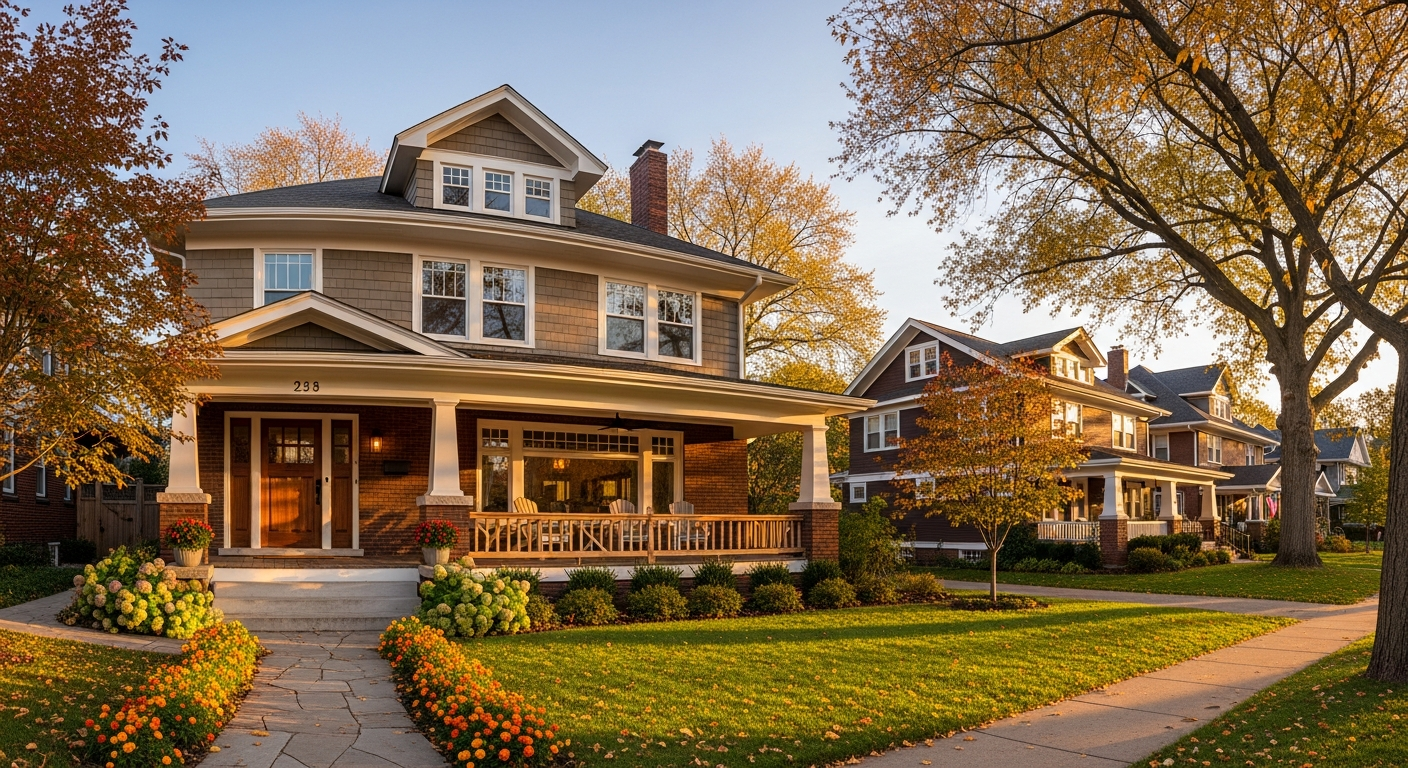
Missouri is an affordable state by national standards, but affordability is relative. In Kansas City's hottest neighborhoods, starter homes routinely list above $300,000. In St. Louis's Central West End, a well-kept bungalow can hit $400,000 or more. For buyers who earn solid incomes but haven't had years to stack a down payment, co-ownership is becoming a serious path to a home they'd genuinely want to live in.
Rhome structures co-ownership the right way: two to four buyers purchase a primary residence together through a shared ownership entity, split the FHA-eligible 3.5% down payment among themselves, and all commit to living in the home as their primary residence. It's not a real estate investment play. It's not a timeshare. It's co-buying a place you actually call home, with the legal structure to protect everyone.
Here's how that plays out specifically in Missouri.
Missouri Real Estate Law: What Co-Buyers Should Know
Missouri is a deed of trust state, which means that when you take out a mortgage, a neutral third-party trustee holds legal title to the property until the loan is paid off. This is standard across most of the country and doesn't create any unusual complications for co-buyers.
Under Missouri law, property can be held through several ownership structures. Tenancy in common allows multiple owners to hold unequal or equal shares, with each owner's interest passing to their estate upon death. Joint tenancy with right of survivorship means surviving owners automatically inherit a deceased owner's share. And of course, property can be held through a legal entity such as an LLC.
Rhome uses an ownership structure for co-ownership, and Missouri is straightforward to work with here. Missouri LLCs are governed by the Missouri Limited Liability Company Act (Chapter 347 of the Revised Statutes of Missouri). Filing a domestic LLC with the Missouri Secretary of State is a relatively simple process, and Missouri does not impose excessive annual fees or burdensome reporting requirements on small entities.
One important consideration: because the ownership structure holds title to the property, the Rhome co-ownership agreement functions as the foundational document governing how co-owners share expenses, handle maintenance decisions, manage disputes, and eventually exit the arrangement. Missouri courts will generally enforce well-drafted governance agreements, so having a thorough agreement in place from day one is essential.
Missouri also has no state-level transfer tax, which is a meaningful advantage. When co-owners eventually sell or adjust ownership, they won't face a state transfer tax that some other states impose.
Kansas City: Underrated Affordability with Real Neighborhood Character
Kansas City consistently ranks among the most affordable major metros in the country, but that framing can be misleading. The city has distinct neighborhoods that command meaningfully different price points, and the gap between them matters when you're planning a co-purchase.
The Plaza and Brookside
The Country Club Plaza area and neighboring Brookside are Kansas City's most walkable, amenity-rich residential neighborhoods. Beautiful Tudor revival architecture lines the streets of Brookside, with independent shops and restaurants within easy walking distance. The Plaza itself offers a dense, urban-adjacent lifestyle that's unusual for a Midwestern city.
Home prices in these areas reflect their desirability. Modest three-bedroom homes in Brookside regularly list in the $350,000 to $550,000 range, and well-preserved larger homes can exceed that considerably. For buyers who want genuine walkability and a community feel, co-ownership makes Brookside accessible at price points that would otherwise require a much longer savings runway.
Westport
Westport sits just north of the Plaza and offers a slightly grittier, more eclectic vibe. It's a neighborhood in ongoing transition, with older housing stock, a lively entertainment district, and increasing buyer interest from younger professionals. Prices are somewhat lower than Brookside, with more inventory in the $275,000 to $425,000 range, but the trajectory is upward.
Co-buyers who want to get into a neighborhood before prices fully reflect its desirability often look at Westport. The brick bungalows and older two-stories that define much of the housing stock here can be genuinely charming homes, and splitting acquisition costs makes them reachable.
Lee's Summit
About twenty miles southeast of downtown Kansas City, Lee's Summit often surprises people who haven't looked at it carefully. It offers excellent school districts, newer housing stock, and strong city services at price points that remain meaningfully below the Plaza corridor. Three and four-bedroom homes in the $280,000 to $400,000 range are common.
For co-buyers with families or who prioritize space and suburban amenities, Lee's Summit delivers substantial value. It's also a practical choice for two co-buying households whose daily lives center on different parts of the metro, since it sits at a reasonable midpoint.
St. Louis: Architectural Richness at Remarkable Values
St. Louis is one of the most architecturally striking cities in America relative to its cost of living, and that combination makes it exceptionally interesting for co-buyers. The city's brick rowhouses, four-family flats, and craftsman bungalows were built to last and have lasted, giving buyers access to homes with genuine character.
Central West End
Central West End is St. Louis's premier walkable urban neighborhood, anchored by Forest Park and lined with restaurants, coffee shops, and boutiques along Euclid Avenue. The housing stock ranges from apartment buildings converted to condominiums to grand single-family homes on tree-lined streets.
Single-family homes in Central West End can reach $400,000 to $700,000 or more at the higher end, but the neighborhood also has a meaningful inventory of smaller, well-positioned homes in the $300,000 to $450,000 range. Co-ownership lets buyers access the neighborhood's lifestyle at a cost that's split between two, three, or four committed co-owners.
Shaw
Shaw is the neighborhood where St. Louis's affordability really shines. It borders Tower Grove Park, one of the finest Victorian-era parks in the country, and its housing stock includes some of the city's best-preserved brick bungalows and craftsman homes. Prices in Shaw are notably lower than comparable neighborhoods in peer cities, with solid three-bedroom homes frequently listing in the $180,000 to $320,000 range.
For co-buyers, Shaw represents an opportunity to acquire a genuinely beautiful home in a neighborhood with strong bones at a very low total cost basis. At those price points, the 3.5% FHA down payment split among co-owners becomes a very small number per person.
Maplewood
Maplewood sits just west of the St. Louis city limits in St. Louis County and has developed a strong identity over the past decade. Its Manchester Road corridor has become a destination for independent restaurants and local businesses, and the residential streets behind the commercial strip offer well-maintained older homes at prices that remain below many comparable St. Louis County suburbs.
Three-bedroom homes in Maplewood regularly list in the $225,000 to $375,000 range, and the neighborhood's walkability and community feel make it consistently popular with younger buyers. Co-buyers who want suburban stability with urban character often land here.
Missouri Housing Development Commission Programs
The Missouri Housing Development Commission, known as MHDC, administers several programs designed to help Missouri residents achieve homeownership. The two most relevant for co-buyers are the First Place Loan program and the Next Step program.
The First Place Loan program offers below-market interest rates on 30-year fixed mortgages for first-time homebuyers, defined as buyers who haven't owned a primary residence in the past three years. Importantly, income and purchase price limits apply, and these limits vary by county, so buyers should check current MHDC guidelines for their specific target area.
The Next Step program serves buyers who don't qualify as first-time homebuyers under the federal definition. It offers competitive interest rates on 30-year fixed loans without the first-time buyer requirement.
MHDC also offers the Cash Assistance Loan program, which pairs with their mortgage products to provide down payment and closing cost assistance. This assistance comes in the form of a second loan, generally at a low interest rate, rather than a grant.
For co-buyers, MHDC program eligibility can be more nuanced. Because all co-owners are borrowers on an FHA loan, all of them must meet the relevant income and first-time buyer criteria to qualify for certain programs. Buyers should discuss this with an MHDC-approved lender early in the process to understand what's available to their specific group.
FHA Co-Buying Math in Missouri
One of the most powerful aspects of the Rhome model is how FHA financing works for co-buyers. FHA loans require a minimum 3.5% down payment for borrowers with credit scores of 580 or above. That down payment is calculated on the total purchase price, and it's split among all co-owners.
Here's how the numbers work on a representative Missouri purchase:
Example: A $350,000 home in Brookside, Kansas City
- Total FHA down payment (3.5%): $12,250
- Split two ways: $6,125 per person
- Split three ways: approximately $4,083 per person
- Split four ways: approximately $3,063 per person
Example: A $260,000 home in Shaw, St. Louis
- Total FHA down payment (3.5%): $9,100
- Split two ways: $4,550 per person
- Split three ways: approximately $3,033 per person
- Split four ways: approximately $2,275 per person
Those are numbers that most working adults can realistically reach in a relatively short savings timeline, especially if they're currently paying rent. The monthly mortgage payment is also split, so the carrying cost per co-owner in Missouri is often competitive with or even lower than local rental rates for comparable living situations.
Missouri's relatively low property taxes add to the picture. Missouri's effective property tax rate ranks among the lower half of U.S. states, which means annual carrying costs after purchase are meaningfully lower than in higher-tax states.
How Rhome Works in Missouri
Rhome handles the structural complexity that would otherwise make co-buying intimidating. Here's what that looks like in practice for Missouri buyers.
First, Rhome helps your group get aligned before you're under contract. That means working through ownership percentages, monthly cost-sharing, decision-making rules, and exit procedures. In Missouri, where the governance agreement carries significant legal weight, getting this document right matters.
Rhome also works with lenders who understand how to underwrite FHA loans for co-buyers purchasing through a shared ownership structure. Not every lender is familiar with this, and working with one who is saves significant time and reduces the risk of surprises during underwriting.
Once under contract, Rhome coordinates with your real estate attorney to ensure the ownership entity is properly formed under Missouri law, the governance agreement covers the scenarios that actually matter, and title is held correctly from day one.
After closing, Rhome provides tools to manage the shared ownership: expense tracking, communication logs, and a clear framework for handling maintenance decisions or any future changes to the ownership structure.
The key requirement for every Rhome co-ownership arrangement is that all co-owners must occupy the home as their primary residence. This isn't just a program rule; it's the foundation of a co-ownership arrangement that actually works. Shared ownership functions best when all owners are invested in the home's condition and community because they live there.
Missouri Markets Beyond Kansas City and St. Louis
While Kansas City and St. Louis get most of the attention, several smaller Missouri markets deserve consideration for co-buyers.
Columbia is home to the University of Missouri and has a stable, education-driven economy. The housing market is relatively liquid, with good inventory across a range of price points, and the city's walkable downtown and strong medical sector make it attractive beyond the university.
Springfield offers some of the most affordable home prices of any Missouri city with meaningful employment options. The Ozarks proximity adds recreational value, and the city's healthcare and education sectors provide employment stability.
Joplin sits at the intersection of Missouri, Kansas, Oklahoma, and Arkansas, and its housing market reflects that regional crossroads position. Prices are low, and buyers willing to consider the market can find substantial homes at costs that make co-buying math almost effortless.
For co-buyers flexible on location, smaller Missouri markets often produce stronger per-person value than the major metros, with the tradeoff being somewhat thinner job markets and fewer urban amenities.
Frequently Asked Questions
See the FAQ section below for detailed answers to common questions about co-ownership in Missouri.