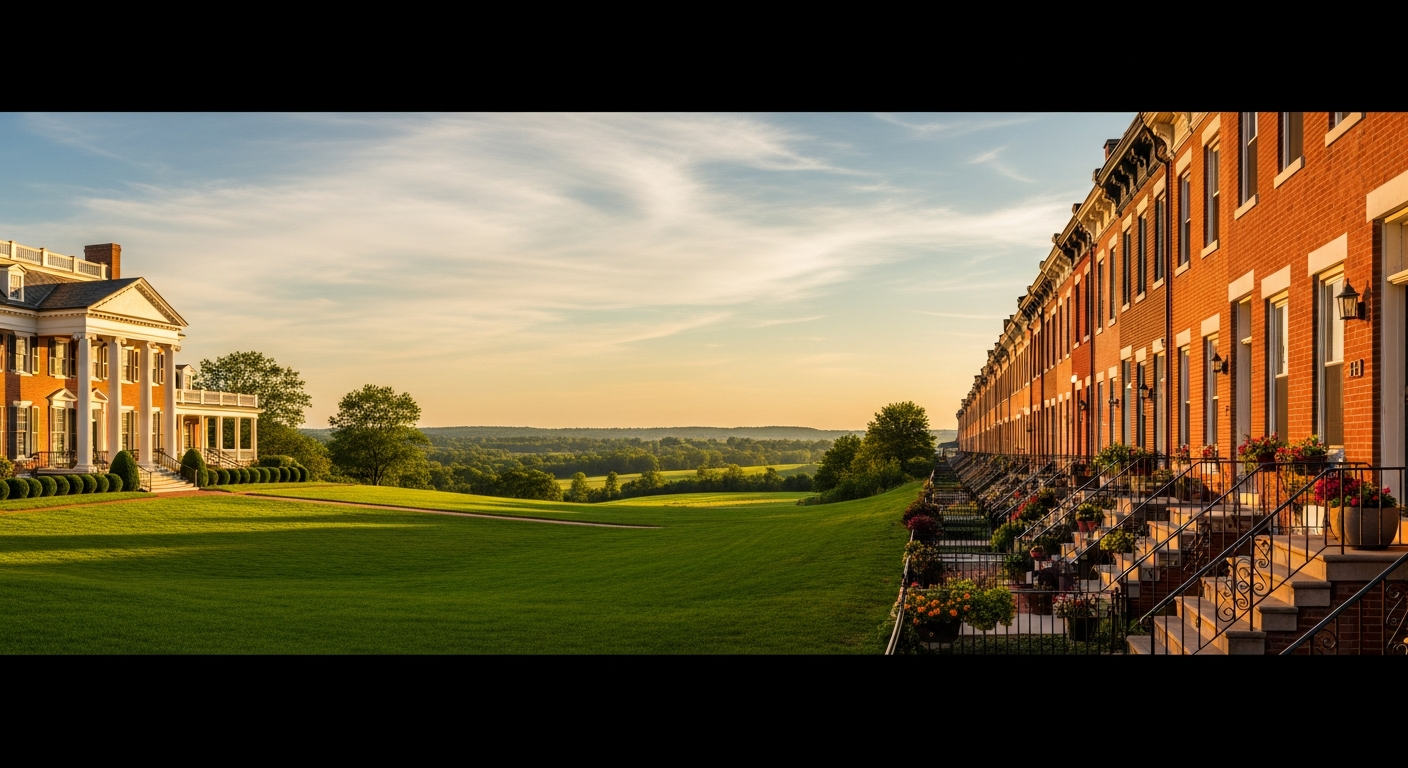
Maryland is a state of contrasts. Cross the border from DC into Montgomery
County and you're in some of the priciest zip codes on the East Coast. Drive
forty-five minutes northeast into Baltimore and you'll find rowhouses listed
for less than a new car. Between those two poles sits a sprawling,
economically diverse state that rewards buyers who know how to be creative.
Co-ownership, where two to four buyers purchase a home together as their
primary residence, is one of the most practical tools available in a state
where median prices vary by more than $300,000 depending on which county
you're in. This guide covers what you need to know about Maryland law, the
markets worth knowing, and how the numbers actually work when you split the
buy-in with people you trust.
Maryland Real Estate Law: What Buyers Need to Know
Maryland is an attorney state, which means a licensed attorney must be
present at closing. This is not optional. The attorney prepares the deed,
reviews title, handles the HUD-1 or Closing Disclosure, and officially
transfers the property. For co-buyers, this is actually a benefit. You have
a credentialed professional in the room who can answer questions about how
title is being held, what the governance agreement says, and what happens if
one owner wants to exit.
How Transfer Taxes Work
Maryland imposes both a state transfer tax and a county transfer tax on real
estate transactions. The state transfer tax is 0.5% of the purchase price
for most residential sales. First-time homebuyers receive a discounted rate.
County transfer taxes vary: Montgomery County charges 1%, Prince George's
County charges 1.4%, and Baltimore City has its own schedule. These costs
are factored into your closing costs, and in many transactions the seller
pays a portion.
For co-buyers purchasing through an ownership structure, which is the Rhome model, it is
worth asking your closing attorney how the entity is treated for first-time
buyer exemptions in your specific county, since rules differ. A good real
estate attorney, not just a settlement company, is worth the investment
here.
Ownership Structure in Maryland
Maryland recognizes LLCs as legal property owners under the Maryland Limited
Liability Company Act (Md. Code, Corps. & Ass'ns § 4A-101 et seq.). When
co-buyers purchase through a Rhome ownership structure, that entity holds title and
each member's interest is governed by the governance agreement. This
agreement is the document that spells out ownership percentages,
decision-making rights, what happens if someone wants to sell, and how
disputes get resolved.
For a primary residence purchase, this structure does not change your
occupancy obligations. All members must occupy the home as their primary
residence. The ownership structure is a vehicle for clarity and legal protection,
not a workaround for any residency rule.
One Maryland-specific note: some lenders in Maryland have historically been
cautious about lending to entities for residential purchases. FHA loans, which
are issued to individual borrowers, pair naturally with the Rhome model
because the loan itself sits with the individual buyers while the ownership entity holds
title post-closing through a deed transfer. Your Rhome advisor will walk you
through how this is structured in your specific transaction.
Baltimore: The Case for Co-Ownership in Charm City
Baltimore gets underestimated. The city has real neighborhoods with genuine
character, strong rental demand in the surrounding region, and home prices
that can seem almost impossibly low to buyers coming from DC or New York.
The median home price in Baltimore City sits well below the national median,
and there are specific neighborhoods where co-ownership isn't just a
nice-to-have, it's a practical way to buy something worth owning.
Charles Village
Charles Village, just north of Johns Hopkins University, is one of the most
architecturally distinctive neighborhoods in the mid-Atlantic. Victorian and
Edwardian rowhomes line streets shaded by mature trees. The neighborhood has
a genuine year-round community feel, walkable to multiple transit lines, and
home to one of the city's best-maintained stock of century-old housing.
Prices here tend to cluster in the $250,000 to $400,000 range for a solid
three-bedroom rowhouse, which makes it genuinely accessible even for a
single buyer. For co-buyers, a $320,000 home at 3.5% FHA down means a
combined down payment of $11,200 split two ways: $5,600 each.
Hampden
Hampden, known locally for its independent shops and the annual Miracle on
34th Street holiday display, has become one of Baltimore's most sought-after
neighborhoods over the past decade. It sits north of the Jones Falls
Expressway and has a walkable main street, The Avenue, lined with
restaurants and boutiques. Home prices have risen meaningfully here but
remain manageable: a well-maintained rowhouse in Hampden might list between
$300,000 and $450,000. Co-ownership lets two buyers at moderate incomes
compete for properties that would otherwise require a much higher single
income.
Canton
Canton is Baltimore's waterfront neighborhood, sitting on the north shore of
the Patapsco River. It draws young professionals and those who want
proximity to the Inner Harbor without the tourist congestion. Canton Square,
the neighborhood's central gathering point, is walkable to dozens of
restaurants and bars. Prices in Canton are higher than Charles Village or
Hampden, often running from $350,000 to $550,000 for a well-kept rowhouse.
For two buyers each putting in $9,625 on a $550,000 FHA purchase (if they
qualify under FHA county loan limits), the math becomes compelling in a
neighborhood where going it alone would stretch most budgets thin.
Note: Baltimore City and Baltimore County have different FHA loan limits,
and buyers should verify current limits for their target zip code. The FHA
floor and ceiling limits adjust annually.
Montgomery County and Bethesda: Where Co-Ownership Becomes a Necessity
Montgomery County is one of the wealthiest counties in the United States.
Bethesda, Chevy Chase, Potomac, and Rockville are all within its borders.
The median home price in Montgomery County consistently runs above $550,000
and, in zip codes like Bethesda and Chevy Chase, well above $800,000.
For buyers who work in DC or Bethesda and want to live close to where they
work without a brutal commute, co-ownership is not just a clever strategy,
it is often the only realistic path to ownership without substantial family
wealth or an unusually high income.
A two-bedroom condo in North Bethesda near the White Flint area might list
at $500,000. A small single-family home in Kensington or Silver Spring could
be $650,000 to $800,000. Two buyers splitting a $700,000 purchase with FHA
financing (down payment of $24,500 total, or $12,250 each) can buy something
in a top-tier school district and established neighborhood that would be
completely unreachable on a single income in the $80,000 to $120,000 range.
Montgomery County also has a robust transit infrastructure, including the
Red Line Metro running through Bethesda, Rockville, and Gaithersburg, and
the MARC train providing access to DC and Baltimore. For co-buyers whose
work is in different parts of the metro, the county's transit connectivity
can make shared geography feel natural rather than forced.
One important note on FHA in Montgomery County: because of the county's high
prices, FHA loan limits in the DC-MD-VA metropolitan area are set at the
high-cost ceiling, which makes FHA a viable tool in this market in a way it
would not be in lower-cost areas.
Prince George's County: The Best Value in the DC Metro
If Montgomery County is the prestige address, Prince George's County is
where sharp buyers have been finding value for years. The county borders DC
directly to the east and south, and it includes neighborhoods with Metro
access, good transit connections, and median home prices significantly lower
than its Montgomery County neighbor.
Areas like College Park, Hyattsville, Riverdale Park, and Mount Rainier sit
on or near the Green and Yellow Metro lines and have seen steady
appreciation as buyers price out of DC proper and neighboring Montgomery
County. A three-bedroom home in Hyattsville or College Park might list in
the $350,000 to $500,000 range, and the county has a strong pipeline of
first-time buyers because of the University of Maryland's gravitational pull
on young professionals who came to study and stayed to work.
For co-buyers, Prince George's County offers the most straightforward
version of the math: lower prices, Metro access, proximity to one of the
largest employment centers in the country, and a county government that has
been actively trying to attract homeowners.
It is worth noting that Prince George's County imposes one of the higher
county transfer taxes in Maryland at 1.4%, so buyers should budget for that
at closing.
The Maryland Mortgage Program: Down Payment Help Worth Knowing
The Maryland Department of Housing and Community Development operates the
Maryland Mortgage Program (MMP), one of the more comprehensive state-level
homebuyer assistance programs in the country. Through MMP, eligible buyers
can access below-market interest rates, down payment assistance, and closing
cost help.
The program's down payment assistance comes in the form of either a grant or
a deferred loan, depending on which product you qualify for. Income limits
and purchase price limits apply and vary by county and household size. In
high-cost counties like Montgomery, limits are set higher to account for
local prices.
For co-buyers using the Rhome model, MMP eligibility is determined by each
borrower's individual qualifications. Not every MMP product is compatible
with every loan structure, so buyers should work with a participating MMP
lender early in the process to understand which products apply to their
specific situation. A Rhome advisor can help coordinate this conversation.
The main MMP takeaway for co-buyers: do not assume you earn too much or too
little to qualify. The program has products designed for a wide range of
incomes, and in many counties the purchase price limits are high enough to
cover realistic target prices.
FHA Co-Buying Math for Maryland Buyers
FHA loans require 3.5% down for borrowers with credit scores of 580 or
above. The full down payment is 3.5% of the total purchase price, and
co-buyers split that cost according to their agreed ownership percentages.
Here is how the math looks across three Maryland price points:
Baltimore rowhouse at $320,000
Total down payment: $11,200
Split two ways: $5,600 per buyer
Each buyer brings their share plus their portion of closing costs (typically
2-5% of the purchase price).
Prince George's County townhome at $450,000
Total down payment: $15,750
Split two ways: $7,875 per buyer
This is a meaningful savings compared to the $15,750 one buyer would need to
bring alone.
Montgomery County home at $700,000
Total down payment: $24,500
Split two ways: $12,250 per buyer
Without co-ownership, a single buyer would need that full $24,500 plus
closing costs, and would also be carrying a much larger monthly payment
alone.
FHA mortgage insurance premiums (MIP) apply to all FHA loans: an upfront
premium of 1.75% of the loan amount (typically rolled into the loan) and an
annual premium that varies by loan-to-value ratio and term. These costs are
part of the full picture and your lender will disclose them clearly during
the loan estimate process.
All buyers on an FHA co-ownership purchase must intend to occupy the home as
their primary residence. This is both an FHA requirement and a Rhome
requirement. Co-ownership through Rhome is not structured as an investment
product.
How Rhome Works in Maryland
Rhome handles the structural complexity so co-buyers can focus on finding
the right home and the right people to buy it with.
When you work with Rhome in Maryland, the process starts with matching or
confirming your co-buying group, then helping each member through
pre-qualification. Rhome connects buyers with lenders who understand
co-ownership structures and have worked with the Maryland market before. The
governance agreement that governs your ownership entity is prepared with Maryland-specific
provisions, including what happens at sale, how buyouts are structured, and
how maintenance decisions get made.
Because Maryland requires an attorney at closing, Rhome coordinates with
closing counsel to ensure the deed transfer, entity setup, and loan closing
happen cleanly in sequence. This is not something buyers should try to
improvise.
After closing, Rhome's ongoing platform helps co-owners manage shared
expenses, track equity, and communicate about the home. The point is not
just to get to the closing table. It is to set the co-ownership up in a way
that works well for years.
Learn more about how the Rhome model works at
/how-it-works.
Frequently Asked Questions
See the FAQ section below for common questions about co-ownership in
Maryland.