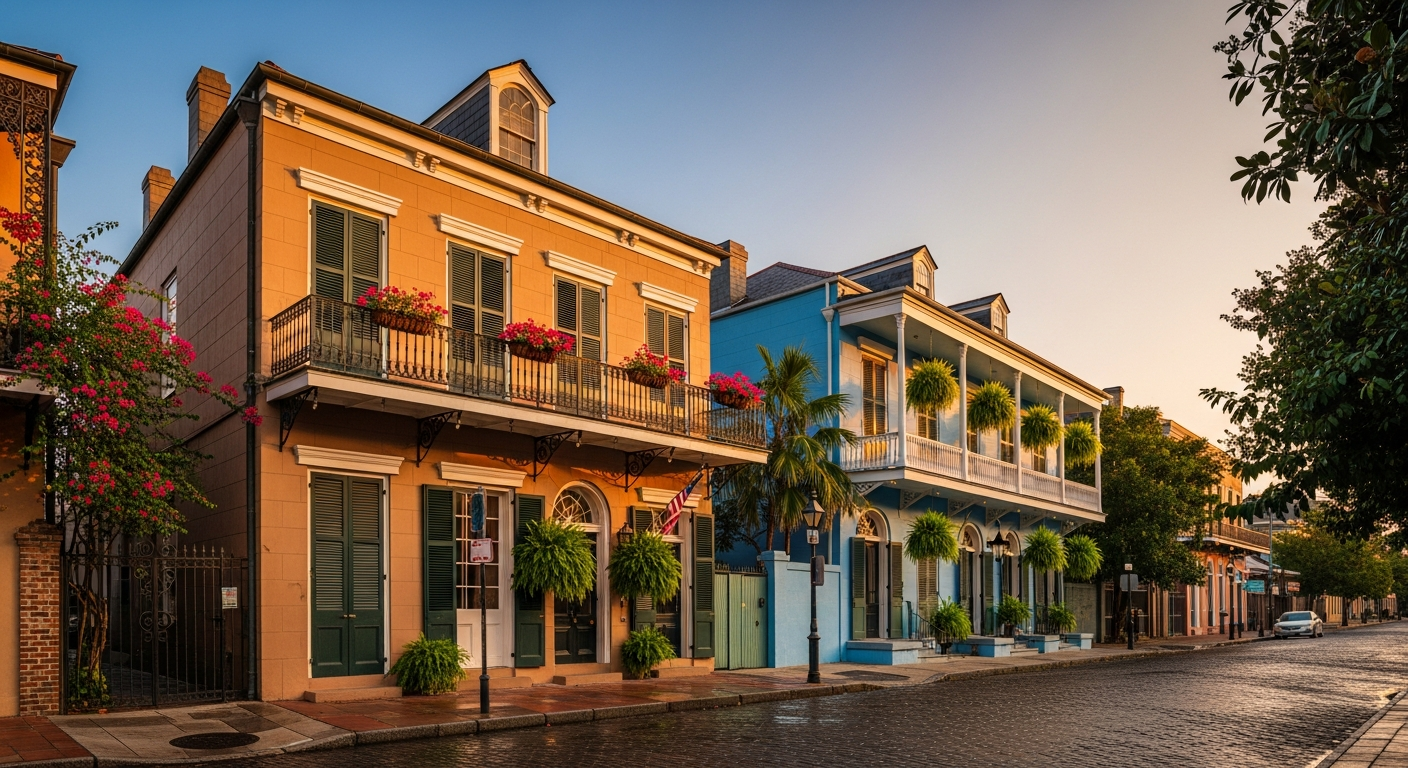
Louisiana is the only state in the country built on a civil law foundation, one rooted in French and Spanish legal tradition rather than English common law. That single fact touches everything from how property ownership is defined, to how co-buyers must structure their agreements, to what happens to shared property when an owner dies. It sounds complicated at first, but for buyers who understand the landscape, it opens clear and workable paths.
New Orleans is also one of the most expensive cities to insure a home in the entire United States, and that is a fact that any co-buyer needs to factor into their budget before they fall in love with a shotgun double on Magazine Street. This guide walks through how co-ownership works in Louisiana's legal system, what the market looks like in New Orleans and Baton Rouge, how Rhome co-buyers structure their purchase through an ownership entity, and how to think clearly about the insurance realities that make this market genuinely different.
Louisiana's Unique Civil Law System
Every other state in the US traces its property law to English common law. Louisiana does not. Its legal system comes from the Napoleonic Code and Spanish civil law traditions carried forward after Louisiana became part of the United States. The result is a set of concepts that look familiar in name but work differently in practice.
The most important difference for co-buyers is how Louisiana classifies property ownership among married couples. In most civil law states, married spouses automatically share ownership of property acquired during the marriage under community property rules. Louisiana is one of nine community property states, but its implementation has specific quirks. Property purchased during a marriage is presumed to be community property owned equally by both spouses, unless the couple has signed a matrimonial agreement opting out.
For unmarried co-buyers, such as two friends, two siblings, or a parent and adult child, property can be owned in indivision. That is the Louisiana term for what common law states call tenancy in common. Owners in indivision each hold an undivided share of the property. Either co-owner can theoretically petition a court to partition the property if the co-ownership relationship breaks down. This is why a written co-ownership agreement, or better yet a properly structured ownership entity, matters even more in Louisiana than in common law states.
Louisiana also has a legal concept called the forced heirship rule. Certain relatives, particularly children under 24 or those with permanent disabilities, have a legally protected share of a deceased person's estate. This can affect what happens to real property when a co-owner dies. If you co-own property in Louisiana without a clear legal structure addressing ownership transfer, forced heirship rules could complicate things significantly. An ownership entity with a properly drafted governance agreement can address this risk directly.
None of this is a reason to avoid co-buying in Louisiana. It is a reason to structure the purchase properly from day one.
LLC Formation in Louisiana: Still the Right Structure
Despite the civil law backdrop, a limited liability company works extremely well for co-buyers in Louisiana. LLCs in Louisiana are governed by the Louisiana Limited Liability Company Law, and the state has a reasonably straightforward formation process.
Forming an LLC in Louisiana involves filing Articles of Organization with the Secretary of State, paying a filing fee, and publishing a notice of intent to organize in a local newspaper in the parish where the LLC is organized. That publication requirement is unique to Louisiana among most states, but it is a routine step that attorneys and registered agents handle regularly. The cost is modest.
The LLC holds title to the property. Each co-buyer holds an ownership interest in the entity corresponding to their ownership share. The governance agreement governs everything: how decisions get made, what happens if one member wants to sell, how expenses are split, buyout procedures, and what happens if a member dies or becomes incapacitated.
For Rhome co-buyers, the ownership structure does the heavy lifting that co-ownership in indivision cannot. It insulates each member's personal assets from liabilities related to the property, and it gives the group a legally enforceable document for every scenario that might come up over the life of the ownership.
One Louisiana-specific note: because of the forced heirship rules mentioned above, the governance agreement should include clear provisions about membership transfer on death. Heirs may inherit a deceased member's interest, and the governance agreement can specify whether other members have a right of first refusal in that scenario.
New Orleans: The Crescent City's Market
New Orleans is one of the most architecturally distinct cities in the country. Walking through Uptown, the Marigny, or Mid-City, you encounter Creole cottages, double shotgun houses, Greek Revival mansions, and camelback doubles that cannot be found in quite the same form anywhere else in the United States. That architectural character attracts buyers, drives competition in desirable neighborhoods, and makes co-buying a compelling strategy for people who want to own a piece of the city rather than rent indefinitely.
Uptown is one of the most sought-after neighborhoods in New Orleans. The St. Charles streetcar line runs through it. It has tree-lined streets, large historic homes, proximity to Tulane and Loyola, and a mix of classic doubles and single-family residences. Median home prices in Uptown range from the mid-$300,000s to well above $600,000 depending on size and block. For buyers splitting the purchase and the down payment, Uptown becomes far more accessible.
The Marigny and Bywater neighborhoods sit downriver from the French Quarter and have become destination neighborhoods for younger buyers and creative professionals. Both have seen significant price appreciation over the past decade. Smaller Creole cottages and shotgun doubles can still be found in the mid-$200,000s to mid-$300,000s, making them some of the most attainable options in the city for co-buyers combining resources.
Mid-City is a more central, residential neighborhood that has recovered strongly since Katrina. It runs along Bayou St. John and has become one of the more price-accessible areas for buyers who want a neighborhood feel with proximity to City Park and the central business district. Prices in Mid-City span a wide range, from the low $200,000s on up, with many double-style homes that are well-suited to co-ownership structures.
Algiers, across the Mississippi on the West Bank, is often overlooked. It has historic neighborhood stock, walkable blocks near the Algiers Point ferry landing, and prices that are meaningfully lower than comparable properties in Uptown or the Marigny. For co-buyers on tighter budgets, Algiers and other West Bank communities can offer real value.
New Orleans has historically had a more affordability-challenged rental market than people outside Louisiana realize, and rising rents post-2020 have pushed more residents toward ownership. Co-buying addresses this by letting people pool resources and enter a market that, for a solo buyer, might remain just out of reach.
Baton Rouge: Louisiana's Capital Market
Baton Rouge is Louisiana's second-largest city and state capital, and it operates on a different rhythm than New Orleans. It has a large university anchor in LSU, a substantial government employment base, and growing healthcare and technology sectors. The housing market is generally more affordable on a per-square-foot basis than New Orleans, with median home prices across the metro area in the mid-$200,000s.
Neighborhoods like Mid City Baton Rouge, the Garden District, and south of I-10 in the University Lakes area are popular among young professionals and university-affiliated buyers. The Garden District in Baton Rouge, distinct from New Orleans' Garden District, has historic homes and walkable blocks at prices that can feel attainable even for individual buyers. For co-buyers, that affordability means more room to buy into higher-quality properties or neighborhoods with stronger long-term fundamentals.
Baton Rouge also has active employer growth in industries that attract young workers: ExxonMobil, Turner Industries, BASF, and the state government collectively employ a large workforce. For buyers who meet in professional contexts and want to buy together in proximity to work, Baton Rouge presents a straightforward case for co-buying.
Louisiana Housing Corporation Programs
The Louisiana Housing Corporation, or LHC, is the state's housing finance agency and administers several programs relevant to first-time buyers and moderate-income buyers.
The LHC offers mortgage revenue bond programs that pair below-market interest rates with down payment assistance. The Mortgage Revenue Bond Assisted program provides a 30-year fixed rate mortgage with down payment and closing cost assistance for eligible buyers. Income and purchase price limits apply and vary by parish.
The LHC also administers the Soft Second Mortgage program, which provides a second mortgage in the form of deferred or forgivable assistance. These programs have historically targeted buyers at or below 80% of area median income, though specific eligibility thresholds shift as the programs are updated.
For Rhome co-buyers who are using an FHA loan to fund the entity-held purchase, it is worth noting that LHC programs are typically structured for individual borrowers. The interaction between state assistance programs and an entity-held purchase requires careful coordination with a lender experienced in co-buying transactions. This is one reason having a Rhome-matched lender familiar with Louisiana programs matters.
FHA Co-Buying Math in Louisiana
The FHA loan is central to how Rhome co-buyers finance a shared purchase. FHA requires a minimum 3.5% down payment for buyers with qualifying credit scores, and that total down payment is split across the co-buying group.
Here is how the math works in practice. On a $350,000 home in Mid City New Orleans, the total down payment at 3.5% is $12,250. Split three ways among co-buyers, each person contributes approximately $4,083. Closing costs are added on top, typically ranging from 2% to 5% of the purchase price depending on lender and title fees. Louisiana has relatively modest transfer taxes compared to some states, which helps keep closing costs manageable.
On a $280,000 home in Baton Rouge, the FHA down payment is $9,800 total, or about $3,267 per person in a three-buyer group. That entry point, combined with split mortgage payments, can make ownership costs comparable to or lower than renting a similar space.
FHA co-buyer qualifications: all borrowers on the loan are underwritten individually. Credit scores, debt-to-income ratios, and employment history matter for each person. FHA also requires all buyers to occupy the home as their primary residence. For Rhome, that requirement aligns with the model: all co-owners must live in the home. This is not a passive investment vehicle. It is a home that you actually live in, with others.
Insurance Costs in Louisiana: Be Honest With Yourself
This section matters more in Louisiana than in almost any other state, and it would be wrong to bury it at the bottom of the article.
Louisiana has some of the highest homeowner's insurance costs in the country. After several large insurers exited the Louisiana market following back-to-back hurricane seasons, the Louisiana Citizens Property Insurance Corporation became the insurer of last resort for many homeowners who could not obtain private coverage. Private insurance that remains available in the market often carries substantially higher premiums than comparable coverage in lower-risk states.
Flood insurance is a separate policy from standard homeowner's insurance and is typically required by lenders for properties in FEMA-designated flood zones. Much of New Orleans and surrounding parishes sit in Special Flood Hazard Areas. Flood insurance through the National Flood Insurance Program, or NFIP, is based on a property's elevation certificate and flood zone designation. Annual NFIP premiums for New Orleans properties commonly run from $800 to $2,500 or more per year, and some properties facing remapping under FEMA's Risk Rating 2.0 methodology have seen premiums increase significantly.
Windstorm coverage in coastal parishes adds another layer. Policies for wind and named-storm events can be expensive, particularly in Jefferson, Lafourche, Terrebonne, and St. Bernard parishes. Orleans Parish itself has seen insurance availability improve somewhat compared to rural coastal areas, but premiums remain elevated.
What does this mean for co-buyers? It means that insurance costs must be treated as a real line item in the monthly cost analysis, not a footnote. A co-buying group should request insurance quotes from at least two providers before going under contract. Elevation certificates, if not already on file for the property, should be obtained early. And the co-ownership agreement should clearly specify how insurance expenses are shared.
The silver lining: when those insurance costs are split across a group of co-buyers, the burden on each individual becomes much more manageable. A $4,800 annual flood and homeowner's insurance bill split three ways is $1,600 per person, roughly $133 per month. The same bill paid by a solo owner represents a much more significant monthly hit.
How Rhome Works in Louisiana
Rhome coordinates the entire co-buying process from group formation through closing. In Louisiana, that includes connecting co-buyers with licensed Louisiana real estate agents who understand the civil law context, lenders experienced with FHA co-buying transactions and Louisiana Housing Corporation programs, and attorneys who can draft the governance agreement under Louisiana LLC law.
The process works as follows: co-buyers connect with Rhome, either as a pre-formed group of friends or family, or through Rhome's matching process. The group is pre-qualified together so everyone knows the combined purchasing power before searching for homes. A Rhome-affiliated Louisiana agent guides the search. The group forms an ownership entity that holds the property title. Each member's ownership share, contribution obligations, and exit rights are documented in the governance agreement before closing.
Rhome also handles the ongoing coordination tools: shared expense tracking, communication between co-owners, and a defined process if one member eventually wants to exit or buy out the others.
For New Orleans buyers specifically, Rhome agents are familiar with the architectural styles, flood zone implications, and neighborhood-level factors that affect value and insurability. That local knowledge matters when you are evaluating whether a double shotgun in Gentilly has the elevation certificate that keeps flood insurance affordable.
Frequently Asked Questions
See the FAQ section below.