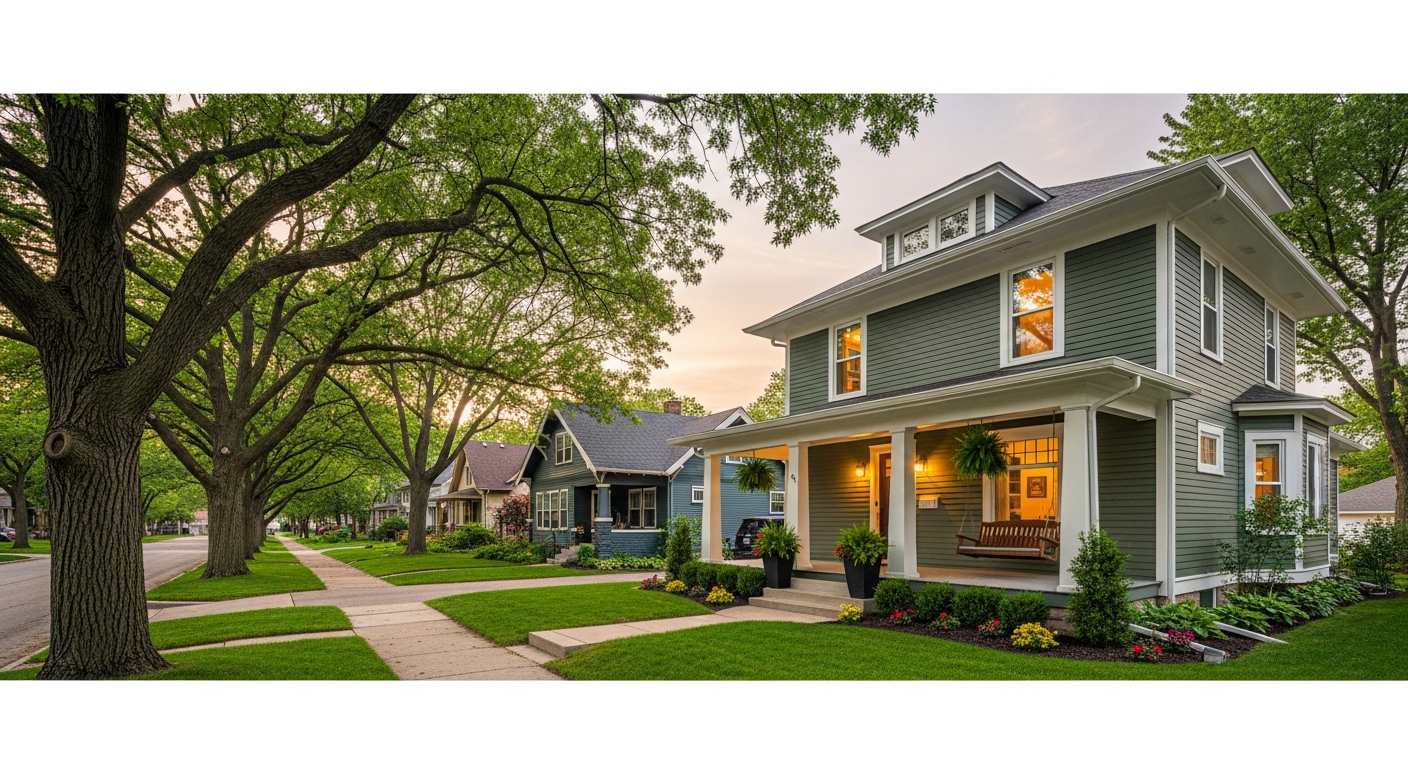
Iowa does not get its fair share of attention from people who are thinking seriously about homeownership. That is a mistake worth correcting. The state has some of the most affordable housing in the country, a legal environment that is genuinely friendly to entity-based property ownership, and a handful of neighborhoods in Des Moines and Cedar Rapids that offer the kind of quiet quality of life that buyers in coastal cities spend twice as much trying to find.
For buyers working through Rhome, Iowa is one of the most compelling markets in the country. The math here just works.
Iowa Real Estate Law and the Ownership Structure Advantage
Iowa has no special restrictions on using a limited liability company to purchase residential property. Two to four buyers can form an Iowa-based ownership structure, take title to a home through that entity, and occupy the property together as their primary residence. The process is straightforward: file Articles of Organization with the Iowa Secretary of State, pay the $50 fee, and establish a governance agreement that clearly defines each owner's rights, responsibilities, and what happens if someone eventually wants to sell.
Iowa's entity formation fees are among the lowest in the country, and the state does not impose a separate income tax on the property itself at the entity level when the structure is treated as a pass-through for tax purposes. That keeps the administrative cost of the structure well within reason.
The governance agreement is the most important document in a Rhome co-ownership arrangement. It covers buyout pricing, maintenance cost splits, dispute resolution, and the process for adding or removing owners over time. Rhome prepares a co-ownership agreement tailored to Iowa law as part of every transaction.
Des Moines: The Case for Iowa's Capital
Des Moines has been quietly transforming for the better part of two decades. The city now has a legitimate restaurant scene, a bikeable downtown core, strong job growth in finance and insurance, and a cost of living that makes it genuinely possible to own a home on a moderate income. The metro population is growing steadily, and that growth is driving demand across a diverse set of neighborhoods.
For co-buyers, the most relevant number is the median home price. Des Moines consistently sits well below $250,000 for a single-family home, and in several neighborhoods you can find solid three- and four-bedroom houses with mature landscaping for far less than that. That price range is significant when you apply co-ownership math.
East Village
East Village sits just east of the Iowa State Capitol and has become the city's most energetic neighborhood. Former industrial buildings have been converted into apartments, restaurants, and boutique retail. Homeownership in East Village means walkable access to some of the best coffee and dining in the metro, with prices still well below what comparable urban neighborhoods cost in larger Midwest cities like Minneapolis or Chicago. Co-buyers who want density and energy without sacrificing the ability to actually own tend to land here.
Gray's Lake
Gray's Lake is one of Des Moines's most livable neighborhoods for buyers who spend time outdoors. The 167-acre lake at its center has a 2.2-mile paved path that draws runners and cyclists year-round, and the surrounding streets have the kind of mature tree cover and residential character that takes decades to develop. Homes here tend to be well-built and hold value well. For co-buyers focused on quality of life, this neighborhood offers a lot.
Beaverdale
Beaverdale is a northwest Des Moines neighborhood with a loyal following. The commercial strip on Beaver Avenue has independently owned shops and restaurants, and the surrounding homes are the kind of classic 1920s and 1930s construction that buyers find appealing: good bones, original character, reasonable maintenance profiles. Prices remain accessible, and the neighborhood has a genuine community identity that matters when you are committing to a primary residence.
Windsor Heights
Windsor Heights is technically its own municipality, completely surrounded by Des Moines. For buyers focused on value, it is worth a close look. The housing stock is similar to adjacent Des Moines neighborhoods but prices can be somewhat lower, and the city's services and maintenance reputation are strong. For co-buyers trying to maximize what they get for their combined budget, Windsor Heights often delivers.
Drake Neighborhood
The Drake neighborhood surrounds Drake University and has the energy that university-adjacent neighborhoods tend to bring: a mix of students, faculty, long-time residents, and newer buyers drawn by the price point and walkability. Homes in the $150,000 to $220,000 range are common, and the neighborhood has coffee shops, a farmers market, and access to the Drake Relays track facilities. For a group of co-buyers in their late twenties or early thirties, Drake is often the right fit.
Cedar Rapids: Iowa's Second Market
Cedar Rapids is Iowa's second-largest city and offers a different ownership proposition than Des Moines. The city has a strong manufacturing and technology employment base, lower median home prices than Des Moines, and neighborhoods that reward buyers willing to look carefully.
The Czech Village and New Bohemia districts have undergone significant revitalization and now offer walkable, character-rich options for buyers who want neighborhood identity. The Wellington Heights area is known for its pre-war housing stock and affordable prices. For co-buyers who work in Cedar Rapids or simply prefer its pace and scale, the ownership math is even stronger than in Des Moines.
The Cedar Rapids metro median home price has historically been lower than Des Moines, which means co-buyers in Cedar Rapids can often access larger homes for the same budget, or reach ownership at a lower total down payment.
Iowa Finance Authority Programs
Iowa's state housing finance agency, the Iowa Finance Authority, runs two main programs that can combine with a Rhome co-ownership arrangement depending on the transaction structure.
FirstHome is the IFA's flagship program for first-time buyers. It offers below-market interest rates on 30-year mortgages and can be paired with down payment assistance. Income and purchase price limits apply and vary by county, but in most Iowa markets the limits are generous enough to accommodate moderate earners.
Homes for Iowans is a broader program that does not have the first-time buyer requirement. It is available to any buyer who meets the income and purchase price limits. This matters for co-buyers because it expands eligibility to people who have owned a home previously.
Both programs are administered through participating lenders and are designed for primary residence purchases, which aligns directly with Rhome's model. Buyers should speak with an IFA-approved lender early in the process to understand current rates and whether the co-ownership structure qualifies under program guidelines.
The FHA Co-Buying Math in Iowa
This is where Iowa's affordability advantage becomes genuinely striking. Walk through the numbers.
FHA requires 3.5% down. For a $200,000 home in Des Moines, the total down payment is $7,000. Between two buyers, that is $3,500 each. Between three buyers, it is roughly $2,333 each. The FHA mortgage insurance premium adds to the monthly cost, but even with MIP factored in, the monthly payment on a $200,000 home at a 30-year fixed rate is dramatically lower than renting a comparable property in almost any Des Moines neighborhood.
Now extend that to a $240,000 home, which buys a solid three-bedroom in several Des Moines neighborhoods. Three co-buyers would split an $8,400 down payment three ways: $2,800 per person. Monthly principal, interest, taxes, insurance, and MIP on a $240,000 home at current rates comes to somewhere in the mid-$1,600s to low $1,700s total. Split three ways, each buyer is contributing roughly $550 to $580 per month toward homeownership.
Rent on a one-bedroom apartment in Des Moines frequently exceeds $900. The numbers are not close.
Co-buyers who stretch to a $280,000 or $300,000 home, which opens up better neighborhoods and more square footage, are still looking at per-person monthly costs that undercut the local rental market significantly. That spread between rent and ownership cost is what makes Iowa one of the strongest co-buying markets in the country.
Why Des Moines Is an Underrated Ownership Market
Des Moines ranks consistently near the top of lists measuring quality of life per dollar spent. The reasons are not complicated: the city has good schools, low crime in most residential neighborhoods, short commutes relative to larger metros, a functioning downtown with genuine amenity concentration, and a job market that has diversified well beyond its agricultural roots.
The financial sector is large. Principal Financial Group, Wells Fargo, and dozens of insurance carriers have major operations in the city. The tech sector has grown meaningfully over the past decade. Healthcare is a major employer. All of this creates a stable employment base that supports home values.
For buyers priced out of Denver, Austin, or the Pacific Northwest, Des Moines offers an honest proposition: you can own a real home, in a real neighborhood, with co-owners who share your values and your timeline, for a cost that leaves room in your budget for everything else that matters.
That is not a consolation prize. For many buyers, it is the better outcome.
How Rhome Works in Iowa
Rhome structures co-ownership as a shared primary residence. All co-buyers must occupy the home as their primary residence. The ownership structure holds title, and each buyer holds an ownership interest proportional to their stake. The co-ownership agreement governs everything else: cost sharing, maintenance responsibilities, the process for buying someone out, what happens if someone needs to relocate.
Rhome's team handles the entity formation, coordinates the co-ownership agreement drafting with local Iowa counsel, and works with FHA-approved lenders to structure the financing. The process is designed to make co-ownership as straightforward as individual ownership, with the protections that come from a properly structured legal entity.
Buyers start by connecting with Rhome, establishing their ownership group, and working through the qualification process. From there, the home search, offer, closing, and post-closing structure all follow a tested process that Rhome has built specifically for co-ownership transactions.
Iowa buyers can explore available homes or learn more about how the process works.
Frequently Asked Questions
See below for common questions about co-ownership in Iowa.