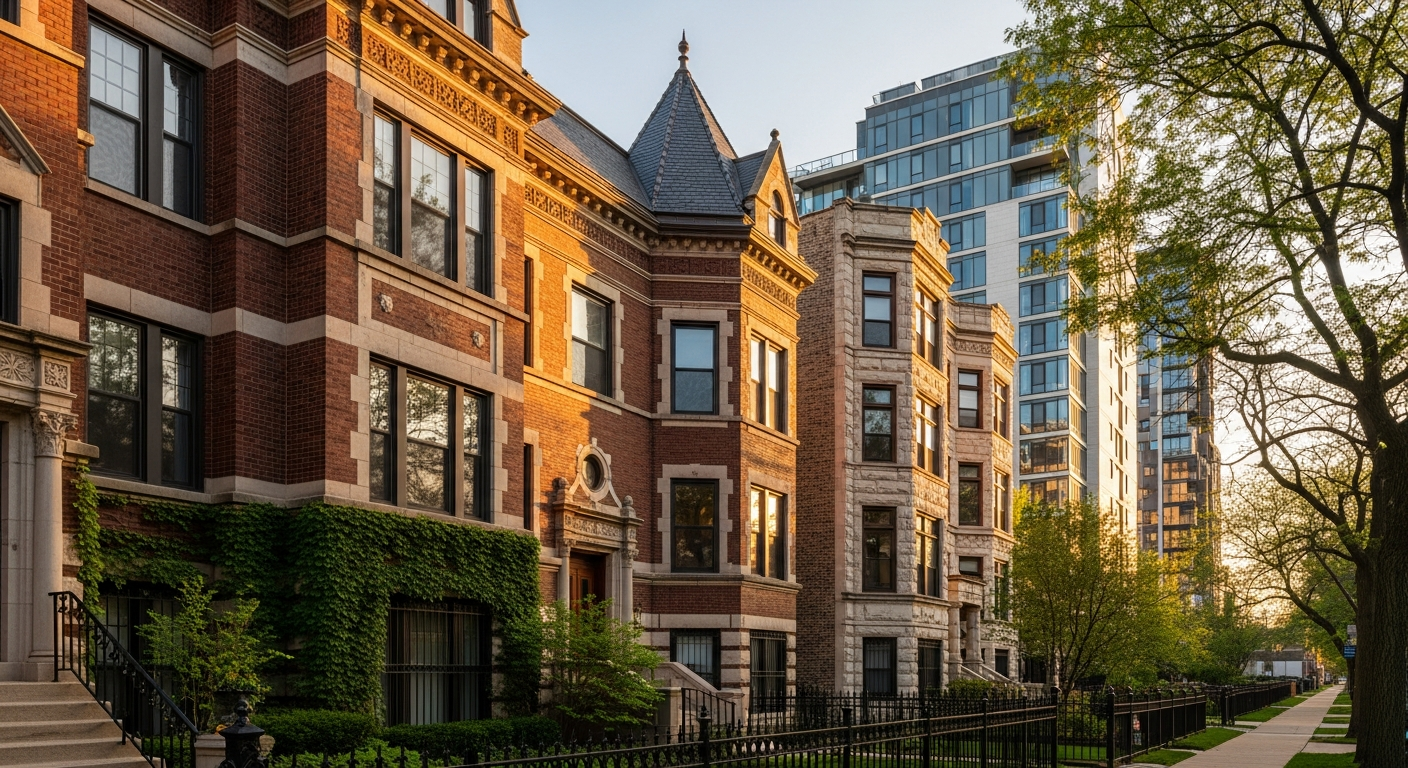
Chicago is one of the most architecturally rich housing markets in the country. Greystones in Logan Square, classic two-flats in Pilsen, brick courtyard buildings in Edgewater, new construction in the suburbs ringing Cook County. It is also, for a lot of people, a market where buying alone feels out of reach. Prices in desirable neighborhoods have climbed steadily, while incomes have not kept pace. Co-ownership offers a path in.
But co-buying a home in Illinois involves real legal and financial decisions that vary by state. What ownership structure should you use? How does Cook County assess property taxes when a shared entity holds title? Are IHDA programs accessible to a group of buyers? What does the math actually look like in the Chicago market?
This article works through all of it.
Illinois Real Estate Law for Co-Buyers
Illinois recognizes several forms of co-ownership for real property. Understanding the differences matters before you put anything in writing.
Joint tenancy means all co-owners hold equal, undivided shares. If one owner dies, their interest passes automatically to the surviving co-owners under the right of survivorship, without going through probate. Joint tenancy in Illinois requires the four unities: same time, same title, same interest, and same possession. Courts in Illinois have generally required that joint tenancy be expressly declared in the deed.
Tenancy in common is the default form of co-ownership in Illinois when no other structure is specified. Each owner holds a defined percentage interest that can be unequal, and each owner can sell or bequeath their share independently. There is no right of survivorship. For co-buyers coming in at different contribution levels, tenancy in common reflects the economic reality more clearly, which is why many co-ownership attorneys recommend it as a starting baseline before layering in additional governance documents.
Shared entity ownership is the structure Rhome uses, and it offers significant advantages for co-buyers who plan to live together in the property. The entity, formed under the Illinois Limited Liability Company Act (805 ILCS 180), holds title to the property, and each co-buyer holds an ownership interest in it. The governance agreement covers how decisions are made, how costs are shared, what happens if someone wants to exit, and how disputes are resolved.
The practical benefit is that a governance agreement is far more flexible than a deed. You can define unequal ownership percentages, set buyout formulas, establish decision-making procedures, and address life events like job loss or relationship changes, all in a private document that does not have to be recorded publicly. Illinois courts have consistently upheld these agreements as binding contracts between members.
One important note: Illinois does not require an attorney to form an LLC, but the governance agreement for a co-owned primary residence should be drafted or reviewed by a licensed Illinois real estate attorney. Generic templates miss state-specific nuances that matter.
Forming an Illinois Entity for a Co-Owned Home
The mechanics of forming an Illinois LLC are straightforward. You file Articles of Organization with the Illinois Secretary of State, pay the filing fee (currently $150 for standard processing), and receive a Certificate of Organization. The entity can be set up online through the Illinois Secretary of State's Cyberdrive portal.
Once the entity is formed, you draft the governance agreement. For a co-owned primary residence, this document should cover:
- Ownership percentages tied to each member's financial contribution
- Monthly cost-sharing: mortgage, property taxes, insurance, HOA dues, maintenance reserves
- Decision-making: what requires unanimous consent versus majority vote
- Exit provisions: right of first refusal for remaining members, buyout pricing methodology, timeline
- Life event clauses: what happens if a member loses their job, gets married, has a child, or needs to relocate
- Default provisions: what happens if a member cannot meet their financial obligations
After the governance agreement is signed, the entity opens a bank account and the purchase proceeds through normal channels. The entity is the buyer of record. Title is held in the entity's name.
Cook County records all property transactions in the Recorder of Deeds office. When a shared entity purchases property, the deed is recorded in the entity's name, which is a public record. The names of individual owners are not publicly recorded in the deed, though the Secretary of State's business registration is public. Illinois does not have a beneficial ownership registry requirement at the state level for residential entity purchases as of early 2026, though federal FinCEN beneficial ownership reporting requirements introduced under the Corporate Transparency Act apply to most small LLCs. Co-buyers should confirm current federal reporting obligations with their attorney.
Cook County and Chicago-Specific Considerations
Property Tax Assessment
Illinois has one of the highest effective property tax rates in the country, and Cook County compounds this with a complex assessment system. The Cook County Assessor reassesses properties on a triennial cycle, meaning your assessed value is updated every three years depending on which township you are in.
Cook County's effective property tax rates vary significantly by location. Properties in Chicago proper often run between 1.5% and 2.5% of market value annually. Suburban Cook County can run higher. This is not a dealbreaker, but it is a number co-buyers need to build into their monthly cost projections from day one.
The Homeowner Exemption is Cook County's most significant property tax relief program. It reduces the equalized assessed value (EAV) of a primary residence by $10,000, which translates to roughly $1,000 in annual tax savings depending on the local tax rate. To receive the Homeowner Exemption, the property must be the owner's primary residence as of January 1 of the tax year. The exemption is applied automatically in most cases after the first year, but co-buyers purchasing through a shared entity should verify with the Cook County Assessor's office that the exemption is properly applied. The property must be owner-occupied.
If a co-buyer is over 65 and meets income requirements, the Senior Citizen Homestead Exemption provides additional EAV reduction. The Senior Freeze Exemption caps the EAV for eligible seniors whose income falls below a threshold. These are individual-level benefits, so their applicability to an entity-owned property requires direct confirmation with the Assessor.
Transfer taxes are an important line item in Chicago. The City of Chicago imposes a real property transfer tax on purchases. The buyer pays $3.75 per $500 of purchase price, and the seller pays $1.50 per $500. At a $450,000 purchase price, the buyer's transfer tax alone is $3,375. Chicago is periodically considering modifications to its transfer tax structure, so buyers should verify the current rate with a real estate attorney at the time of their transaction.
Chicago-Specific Zoning and Two-Flat Considerations
Chicago has a large stock of two-flat and three-flat buildings that are attractive for co-buyers. A group of two buyers purchasing a two-flat can each occupy one unit, which can work well structurally, but it raises an important question for FHA financing: FHA loans for multi-unit properties have specific owner-occupancy and underwriting rules that differ from single-family loans. Co-buyers interested in two-flats should discuss the specific property type with their lender before making assumptions about financing.
Chicago zoning also regulates short-term rentals aggressively. Under the Rhome model, co-owners are primary residents, not short-term rental operators, so this generally does not apply. But it is worth understanding that if a co-owner ever tried to convert their unit into a rental in the future, Chicago's licensing and zoning rules would apply.
IHDA Programs: What Illinois Co-Buyers Should Know
The Illinois Housing Development Authority (IHDA) runs several programs that help Illinois homebuyers with down payment and closing cost assistance. These programs operate through participating lenders and have income and purchase price limits that vary by county.
IHDAccess Forgivable provides up to 4% of the purchase price (maximum $6,000) as forgivable down payment and closing cost assistance. The assistance is forgiven over 10 years at a rate of 10% per year. If you stay in the home for 10 years, you owe nothing back.
IHDAccess Deferred provides up to 5% of the purchase price (maximum $7,500) as a zero-interest deferred loan. Repayment is due only when the home is sold, refinanced, or no longer serves as the primary residence.
IHDAccess Repayable provides up to 10% of the purchase price (maximum $10,000) as a 10-year interest-free loan with monthly repayment.
All IHDA programs require borrowers to complete a homebuyer education course. They are available for single-family homes, condos, and certain townhomes. Income limits apply and vary by household size and county.
The critical question for co-buyers is how IHDA programs interact with shared-entity ownership. IHDA programs are designed for individual borrowers, not business entities. If the purchase is structured with a shared entity holding title, IHDA assistance is generally not compatible with that structure because IHDA assistance attaches to the individual borrowers and the property must be in their name, not an entity's. Co-buyers who want to use IHDA assistance should discuss this with a participating IHDA lender, as the structure of the transaction matters.
For co-buyers using Rhome's model, the sequencing can sometimes work as follows: IHDA assistance goes to the individual borrowers, and title holding is arranged to meet IHDA's requirements. Rhome's team can help you understand how the structure works in practice with an IHDA-participating lender.
The Chicago Metro Co-Buying Landscape
Chicago offers a wide range of price points depending on neighborhood and property type. Here is a general picture to help co-buyers think about where the math works.
Chicago proper: Neighborhoods like Rogers Park, Roseland, and South Shore can offer single-family homes and condos in the $200,000 to $350,000 range, where two co-buyers can each contribute a manageable amount to reach a 3.5% FHA down payment. Neighborhoods like Logan Square, Wicker Park, and Lincoln Square have climbed into the $450,000 to $700,000 range for single-family homes, where co-buying becomes a meaningful affordability tool. Lakeview, Lincoln Park, and the Gold Coast push further still.
Suburban Cook County: Evanston, Oak Park, and Berwyn offer architecturally interesting housing stock at a range of price points, often with access to Metra or CTA for city commuters. Many buyers who are priced out of comparable Chicago neighborhoods find strong options here.
Collar counties: DuPage, Lake, Kane, Will, and McHenry counties sit outside Cook and have their own tax rates, often lower than suburban Cook. For co-buyers open to a longer commute or remote work, these markets offer significant purchasing power.
The key variable across all of these markets is the property tax rate. Chicago's rate is significant, but collar county rates vary widely. Co-buyers should always model the total monthly cost including taxes, not just the mortgage payment.
FHA Co-Buying Math in the Chicago Market
FHA loans allow a down payment as low as 3.5% of the purchase price for borrowers with a credit score of 580 or higher. When two, three, or four buyers pool their resources, that 3.5% becomes a shared number.
Here is how the math looks at a few Chicago-area price points:
$350,000 home (accessible in several Chicago neighborhoods and suburban Cook County):
- 3.5% down payment: $12,250
- Split two ways: $6,125 per person
- Loan amount: $337,750
- At a 7% interest rate (illustrative), monthly principal and interest: roughly $2,248
- Split two ways: roughly $1,124 per person before taxes and insurance
$500,000 home (Logan Square, Pilsen, parts of the North Shore suburbs):
- 3.5% down payment: $17,500
- Split two ways: $8,750 per person
- Loan amount: $482,500
- At 7%, monthly principal and interest: roughly $3,211
- Split two ways: roughly $1,606 per person before taxes and insurance
$650,000 home (Lincoln Square, Andersonville, inner-ring suburbs):
- 3.5% down payment: $22,750
- Split two ways: $11,375 per person
- Loan amount: $627,250
- At 7%, monthly principal and interest: roughly $4,174
- Split two ways: roughly $2,087 per person before taxes and insurance
Note that FHA loan limits apply. For 2024, the FHA loan limit in Cook County for a single-family home was $498,257. Co-buyers targeting homes above that limit would need to consider conventional financing, which typically requires a higher down payment but has no upper loan limit for conforming loans.
FHA mortgage insurance premium (MIP) is a real cost to factor in. FHA loans require an upfront MIP of 1.75% of the loan amount (added to the loan in most cases) and an annual MIP that runs approximately 0.55% of the outstanding loan balance for loans with 3.5% down and a 30-year term. On a $482,500 loan, that is roughly $222 per month in MIP, split two ways at $111 per person. It adds up, but for co-buyers without a large down payment, the access to ownership often outweighs the cost.
All co-borrowers on an FHA loan must meet FHA credit and income guidelines. The lender will underwrite each borrower individually. All borrowers must intend to occupy the property as their primary residence, which is a core requirement of FHA lending.
How Rhome Works in Illinois
Rhome is built for exactly the kind of co-buying this article describes. Two to four buyers who want to co-own a primary residence, live in it together, and structure the arrangement properly.
Here is what Rhome handles:
Ownership structure setup and governance agreement. Rhome coordinates the formation of an Illinois entity and works with attorneys to draft a governance agreement tailored to your group's specific ownership percentages, cost-sharing arrangement, and exit terms. You are not starting from a generic template.
Lender coordination. Not every lender is comfortable with co-buyer transactions, and even fewer know how to handle a shared-entity structure. Rhome works with lenders who understand co-buying and can underwrite the transaction correctly.
Co-buyer matching. If you have one or two people in mind but need a third or fourth, Rhome can help connect you with vetted co-buyers who share your target market, timeline, and expectations.
Ongoing structure support. After closing, questions come up. A member wants to sell their share. A member loses income and needs accommodation. Rhome's governance agreements are designed to handle these moments, and the team is available when they arise.
For Chicago-area buyers specifically, Rhome's familiarity with Cook County's tax structure, Illinois entity law, and the FHA landscape in this market means you are not figuring out the details on your own.
To get started, visit rhome.com/how-it-works.
Frequently Asked Questions
See FAQ section below.