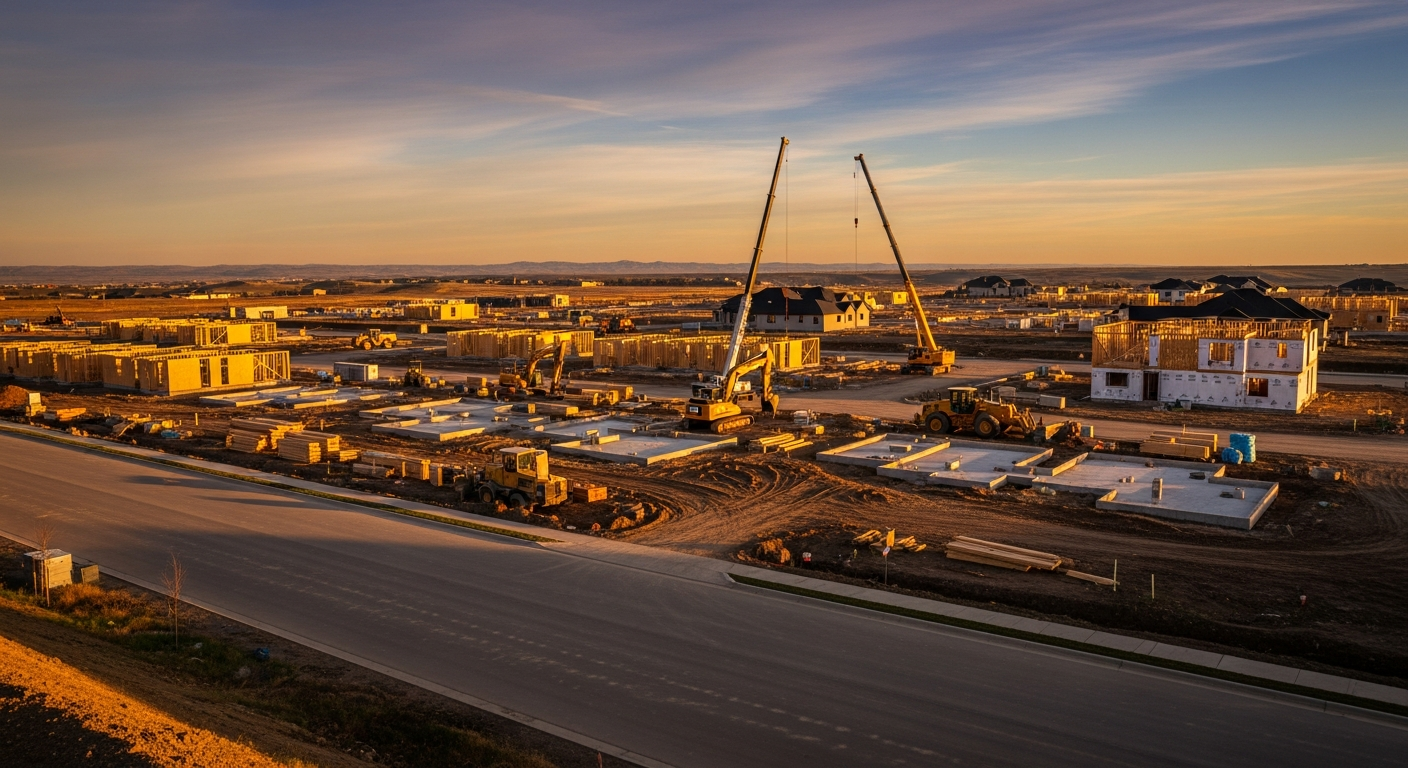
Every few months a headline declares that homebuilders are finally ramping up. Permits are rising. New communities are breaking ground. The supply problem, the story goes, is being solved.
It isn't. Not yet. Not at the pace required.
The structural housing shortage in the United States is deep, years in the making, and stubbornly resistant to short-term fixes. For the buyers being priced out right now, the timeline for relief from new construction doesn't match the timeline of their lives. They need a home, a mortgage rate, and a monthly payment they can manage. And they need it in the next year, not the next decade.
Co-ownership doesn't solve the housing crisis. Nothing on the demand side does. But for a meaningful share of buyers, it makes homeownership possible right now, inside the crisis, rather than waiting for the market to fix itself.
Understanding why starts with the supply numbers.
The Housing Supply Shortage: What the Data Actually Shows
The housing deficit in the United States is large and well-documented by multiple independent research institutions.
Freddie Mac estimated in 2021 that the US was short approximately 3.8 million housing units. That number reflected decades of underbuilding relative to household formation, a shortfall that had compounded quietly since the 2008 financial crisis when construction activity collapsed and never fully recovered. The National Association of Realtors has cited similar figures, with some analyses putting the gap at anywhere from 2.3 million to 5.5 million units depending on methodology and the baseline assumptions used.
The Harvard Joint Center for Housing Studies, which produces the most widely cited annual housing conditions report in the country, has consistently documented that housing cost burdens are reaching record levels, particularly for renters and first-time buyers. In their 2023 State of the Nation's Housing report, they found that more than one in three American households was cost-burdened, meaning they spent more than 30 percent of their income on housing. Among renters, nearly half fell into that category.
The National Low Income Housing Coalition has separately documented that in no state in the country can a full-time worker earning the federal minimum wage afford a modest two-bedroom apartment at fair market rent. While that speaks specifically to rental housing, it illustrates the same underlying structural reality: the supply of housing at prices that working people can actually afford is nowhere close to meeting demand.
These aren't rounding errors. A shortage of three to five million units at a time when the country builds roughly one to one and a half million new homes per year means we are a decade or more away from closing the gap through construction alone, even under optimistic assumptions about permitting, zoning reform, and builder capacity.
Why Supply-Side Solutions Won't Fix Affordability Fast Enough
Building more homes is the right long-term answer. Almost every credible economist, housing researcher, and policy advocate agrees on this. The disagreements are about how to build more, where, at what density, and who pays for the infrastructure that new development requires.
But even in the scenarios where supply-side reform goes well, there is an unavoidable lag between breaking ground and a buyer moving in. The permitting process in most American cities takes months to years. Construction takes additional time. And newly built homes tend to enter the market at price points that reflect current labor and materials costs, which are significantly higher than they were even five years ago.
The National Association of Realtors has documented that the median price of a new single-family home is consistently higher than the median price of an existing home. New construction, by its nature, serves the upper end of the market first. It takes years for that inventory to filter down through the housing stock as wealthier buyers move into new homes and free up their previous ones. Economists call this the filtering process, and it works, but slowly.
There is also the rate environment to consider. The affordability crisis that accelerated after 2022 was driven not just by price appreciation but by mortgage rates rising from historic lows near three percent to above seven percent. That shift effectively doubled the monthly payment on a median-priced home. Building more houses doesn't change the cost of borrowing money, and the Federal Reserve's rate decisions operate on their own timeline.
For buyers sitting in that gap, the options are limited.
Demand-Side Solutions: What Actually Exists Today
When supply-side fixes are slow, the policy and market response tends to focus on demand-side tools. These are mechanisms that help buyers access the homes that already exist at prices they can manage.
Down payment assistance programs are the most common. Federal, state, and local programs collectively offer billions in grant and loan funding for qualifying first-time buyers. These programs are real and often underutilized, but they come with income limits, purchase price caps, and geographic restrictions that exclude many buyers in high-cost markets.
FHA loans lower the barrier to entry by requiring only 3.5 percent down for qualifying buyers, compared to the conventional 20 percent that many people assume is necessary. VA loans, available to veterans and service members, require no down payment at all. USDA loans offer zero-down options in qualifying rural areas.
Shared equity programs, offered by some nonprofits and community land trusts, allow buyers to purchase a home at a subsidized price in exchange for agreeing to sell at a controlled price in the future. These programs create permanent affordability but operate at small scale and are concentrated in specific cities.
And then there is co-ownership.
Co-ownership is different from the programs above in one important way: it doesn't require a government program, a qualifying zip code, or a nonprofit intermediary. It works through the same standard mortgage market infrastructure that already exists, using pooled income and shared down payment contributions from two to four buyers who all intend to live in the home as their primary residence.
How Co-Ownership Addresses the Affordability Gap
The mechanics of co-ownership are straightforward, even if the legal structure requires some care to set up correctly.
Two, three, or four buyers purchase a home together through a shared ownership structure. Each buyer occupies the home as their primary residence. They apply for an FHA loan, which allows a total down payment as low as 3.5 percent of the purchase price, split proportionally among all buyers. Monthly mortgage, insurance, and tax costs are shared. Equity builds collectively over time.
The affordability impact is immediate and significant. Consider a $500,000 home, which is close to the current national median. A single buyer using an FHA loan needs to bring $17,500 to closing plus closing costs. On a 30-year mortgage at current rates, that buyer also faces a monthly payment that may be $2,800 or more before taxes and insurance, depending on the rate.
Two buyers splitting that same purchase change the picture entirely. Each contributes roughly $8,750 to the down payment. Each is responsible for half the monthly payment. The same $500,000 home becomes accessible at a price point more comparable to a $250,000 purchase in terms of individual financial exposure. In markets where $250,000 homes don't exist, co-ownership creates a functional equivalent.
For buyers with good incomes who are nonetheless frozen out by the combination of high prices and high rates, the income pooling effect can be even more decisive. Lenders evaluate the combined income of all borrowers. Two buyers earning $75,000 each qualify as a household earning $150,000, which opens mortgage options that neither could access individually.
This isn't a loophole. It's the same logic that has always made two-income households more competitive in the housing market. Co-ownership extends that logic to households that aren't married couples, including friends, siblings, colleagues, and anyone else who shares the goal of owning a home and living in it.
Co-Ownership as a Bridge Strategy While Supply Catches Up
The housing supply shortage is not going to be solved in the next two years. The most optimistic projections from researchers and industry analysts still describe a multi-year process of incremental improvement. Zoning reform is moving, but slowly and unevenly across jurisdictions. Builder capacity is constrained by labor shortages and materials costs. Financing for new development at affordable price points remains difficult to assemble.
In that environment, co-ownership functions as a bridge. It allows buyers who are ready now to stop renting and start building equity, using the market as it actually exists rather than waiting for the market they'd prefer.
The equity argument matters more than it might appear. Homeownership has historically been the primary mechanism through which American households build intergenerational wealth. Every year a buyer spends renting while waiting for conditions to improve is a year of mortgage payments going to a landlord instead of toward their own balance sheet. In markets with ongoing appreciation, it can also mean chasing a moving target. A home priced at $450,000 today may be priced at $490,000 in two years, making the affordability math even harder.
Co-ownership allows buyers to get into the market now, establish a primary residence with legal ownership, and build equity as a group until individual circumstances change. Some co-owners eventually buy each other out. Others sell collectively when appreciation has created enough equity to support individual purchases. The ownership structure, when set up properly with a co-ownership agreement, creates a framework for managing these transitions.
The supply shortage also affects the rental market in ways that make co-ownership comparatively more attractive over time. As vacancy rates remain low and rental demand stays high, rent increases have outpaced income growth in most major metros. Co-owners paying a fixed mortgage payment gain insulation from that dynamic that renters don't have.
Why Co-Ownership Isn't Perfect, But May Be the Most Accessible Bridge
Co-ownership requires trust between co-buyers. It requires a clear legal agreement that spells out what happens when someone wants to leave, how costs are divided, how decisions are made, and how the property is eventually sold or transferred. Without that structure, disputes become likely and expensive.
It also requires that all buyers occupy the property as their primary residence. This isn't just a Rhome rule or a preference. It's fundamental to the legal and financial structure. FHA loans require owner-occupancy. The co-ownership model described here is about shared primary residence, not a rental arrangement or a vacation property.
For buyers who aren't ready to live together, co-ownership isn't the right tool. For buyers who don't have co-buyers they trust, the search for the right co-ownership partner takes time. For buyers in markets where the price gap is so severe that even four buyers pooling income can't qualify, co-ownership may not close the distance.
But for buyers who have potential co-buyers, who are ready to purchase, and who are being blocked primarily by the down payment requirement or the individual income ceiling for mortgage qualification, co-ownership is one of the most direct and accessible paths available in the current market.
It doesn't require an income limit to qualify for assistance. It doesn't require buying in a specific geography. It doesn't require a lottery or a waitlist. It requires a group of buyers who trust each other, a property they want to live in together, and a legal structure that protects everyone involved.
The housing supply crisis is real, structural, and not going away quickly. The people it affects most directly are the buyers who are ready to own a home right now. Co-ownership won't end the crisis. But for the right buyers, it ends their own personal version of it.
