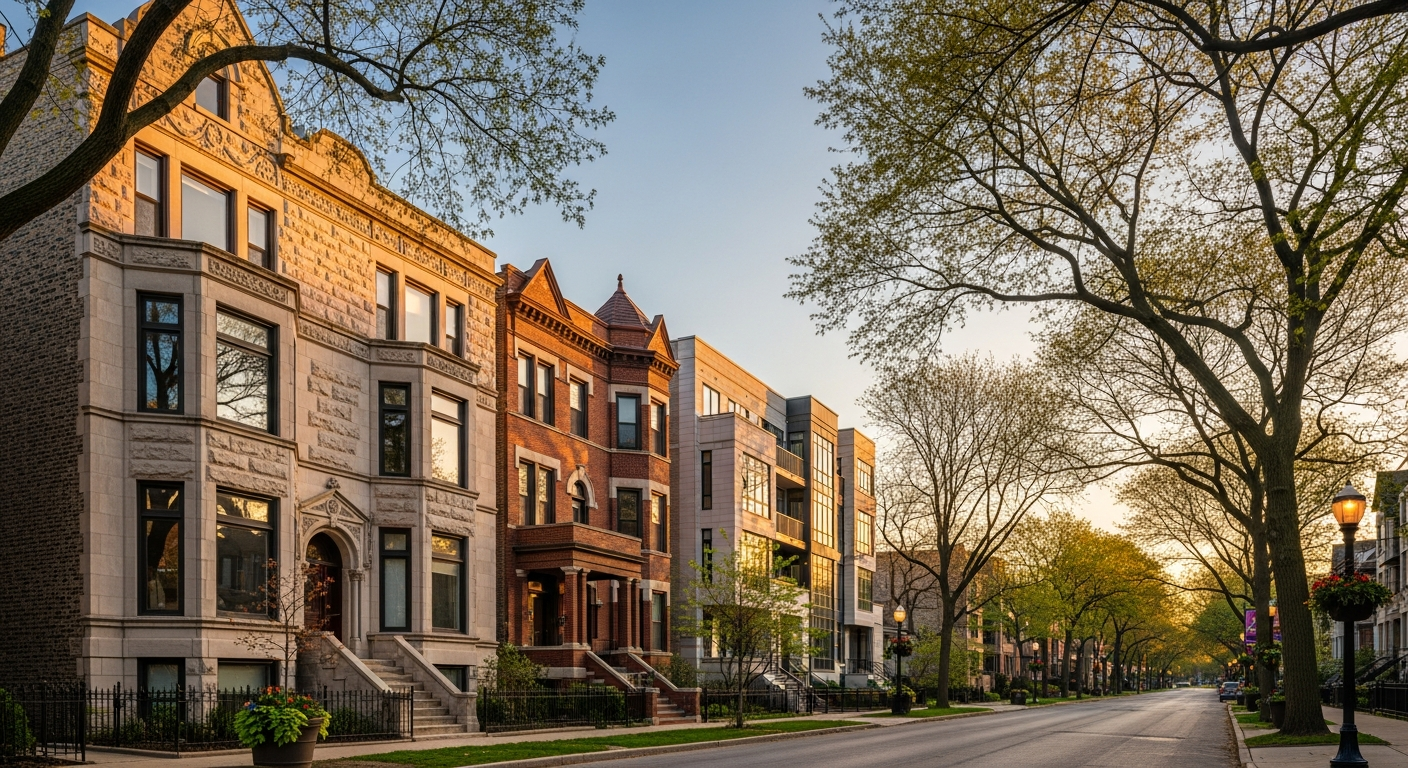
Chicago is one of the most architecturally rich cities in the world. It is also a city where the gap between renting and owning has become wide enough that many households are looking at the math differently than they were five years ago. Co-ownership, the model where two to four buyers purchase a primary residence together through a shared ownership structure, is gaining real traction here precisely because Chicago rewards it: the city has genuine neighborhoods with staying power, a broad spectrum of price points, and a legacy of building types that are well-suited to multi-buyer households.
If you are thinking about buying a home in Chicago with a partner, sibling, friend, or colleague, this guide covers the market, the legal landscape, the assistance programs available, and the specific mechanics of making it work.
Chicago Market Overview
Chicago is the third-largest city in the United States, and its housing market reflects that scale. You will find everything from six-figure two-flats in emerging South Side neighborhoods to multi-million-dollar Lakeview greystones. The median home sale price in the city proper has hovered in the low-to-mid $300,000s in recent years, though that number tells only part of the story. Neighborhoods on the North Side and those with lakefront proximity command significantly more. Communities on the Northwest and West sides often trade at half that figure or less.
What this creates is a city where your purchasing power as a co-buyer can stretch meaningfully depending on where you want to land. A household of two buyers bringing $15,000 each to the table is in a very different position than a solo buyer doing the same. Chicago rewards that math.
The market has remained competitive, particularly in the $250,000 to $450,000 range where co-buyers tend to shop. Inventory has been tight by historical standards, which makes having financing completely buttoned up before you start touring a genuine advantage. Interest from remote workers, people relocating from higher-cost coastal markets, and younger buyers priced out of single-family ownership has kept demand steady across the city's stronger neighborhoods.
Suburban Cook County adds another layer of opportunity. Communities like Oak Park, Berwyn, Evanston, and Forest Park offer transit access, walkable downtowns, and single-family homes at prices that can feel generous by Chicago standards. For co-buyers who want more square footage or a backyard, these suburbs are worth serious consideration.
Illinois Real Estate Law: What Co-Buyers Need to Know
Illinois does not have co-ownership-specific statutes, but the legal framework for buying together through a shared ownership entity is well-established and widely used. Here are the key points for Chicago-area co-buyers.
Entity formation in Illinois is handled through the Illinois Secretary of State's office. Forming a standard LLC costs $150 as of 2024, and annual reports run $75 per year. The process is straightforward, but your co-ownership agreement, the document that governs what happens if one buyer wants to sell, how decisions are made, and how expenses are split, is the document that actually protects everyone involved. This is worth doing with an attorney who understands both real estate and entity governance.
Cook County transfer tax applies to home sales in the county and is assessed at $0.75 per $500 of the sale price, split between buyer and seller. The seller typically pays the county portion, though this is negotiable in any transaction.
Chicago's additional transfer tax is a city-level tax on top of the county tax. The standard rate is $3.75 per $500 of value for the buyer and $1.50 per $500 for the seller on the city side. For a $350,000 purchase, the buyer-side city transfer tax runs approximately $2,625. This is a real cost to budget for, and it is worth confirming with your real estate attorney whether any exemptions apply to your specific transaction structure.
Co-buyers using a shared ownership structure should also be aware that some lenders require that the mortgage be held in individual names with the property then transferred to the ownership entity, or structure the transaction so the entity itself is the borrower. FHA loans, which are the primary tool for co-buying with a lower down payment, are made to individuals rather than entities, so the title and mortgage structure requires careful planning. A real estate attorney familiar with Illinois shared ownership and FHA lending can walk you through the right sequence.
Key Neighborhoods for Co-Buyers
Logan Square has been one of Chicago's most-watched neighborhoods for over a decade. The Blue Line connection to the Loop, the Milwaukee Avenue commercial corridor, and the stock of greystone two-flats and vintage courtyard buildings make it genuinely livable. Prices have risen substantially from where they were in the early 2010s, and the neighborhood now sits in a range where co-buying makes it accessible in ways that going it alone often does not.
Avondale, just northwest of Logan Square, offers a similar building stock at lower price points. The neighborhood has been attracting buyers priced out of Logan Square, and it has its own distinct character along Belmont and Kedzie. For co-buyers who want North Side access without North Side prices, Avondale is a strong option.
Humboldt Park on the West Side represents some of the most compelling value in the entire city for buyers who are willing to take a longer view. The neighborhood has significant architectural assets in its historic greystone housing stock, proximity to the 606 trail's western terminus, and community investment that has been building for years. Prices here can open doors for co-buyers at budget levels that feel impossible on the North Side.
Wicker Park and Bucktown sit at the premium end of the co-buyer conversation. These neighborhoods carry prices that reflect their walkability, restaurant density, and transit access. Two buyers combining resources can reach price points here that neither would realistically hit solo, which is exactly the scenario co-ownership was designed for.
Suburban Cook County is worth a dedicated mention. Oak Park in particular has a long history of intentional, inclusive community building and offers transit access to the Loop via Metra and the Green and Pink Lines. Berwyn and Cicero offer additional value at lower price points. For co-buyers who want a single-family home with a yard, these communities often offer more per dollar than anything in the city proper.
IHDA Programs for Illinois Co-Buyers
The Illinois Housing Development Authority (IHDA) administers several first-time and repeat buyer programs that are available throughout the state, including in Cook County and Chicago.
IHDA Access Forgivable provides up to 4% of the purchase price (maximum $6,000) in down payment and closing cost assistance, forgiven monthly over ten years. This is structured as a grant once the forgiveness period is complete, assuming the home remains your primary residence.
IHDA Access Deferred offers up to 5% of the purchase price (maximum $7,500) as a zero-interest, deferred loan repaid when you sell, refinance, or the loan matures. No monthly payment on the assistance portion.
IHDA Access Repayable provides up to 10% of the purchase price (maximum $10,000) as a ten-year, zero-interest loan with a fixed monthly payment. This one provides more cash for buyers who can handle the monthly obligation.
Income limits for IHDA programs vary by county and household size. For Cook County, limits are typically in the range of $90,000 to $120,000 for one to two person households, with higher limits for larger households. Purchase price limits are also in effect. Because IHDA programs are attached to the mortgage, not the title structure, co-buyers should confirm eligibility with an IHDA-participating lender who understands how co-ownership income is treated.
City of Chicago Down Payment Assistance Programs
The City of Chicago administers its own homebuyer assistance programs through the Department of Housing. These programs are targeted at buyers purchasing within city limits.
Chicago Home Buyer Assistance Program (CBHAP) has provided grants of up to $10,000 for qualifying first-time buyers purchasing in the city. The program has had periods of high demand and waiting lists, so confirming current availability and application windows directly with the City's Department of Housing is essential before counting on it in your budget.
Neighborhood Lending Programs administered through the City work with community lenders to offer below-market-rate mortgages and down payment support in targeted areas, particularly on the South and West sides. These can combine with IHDA assistance in some cases, making them worth exploring if your target neighborhood qualifies.
Chicago Community Land Trust offers a different structure entirely, where the land is owned by a community trust and the buyer purchases only the home, dramatically reducing the purchase price. This model has specific resale restrictions, so it is not the right fit for every buyer, but it is worth knowing exists.
Because city programs are funded and updated on an ongoing basis, the best source for current availability is the City of Chicago's Department of Housing directly. Program windows open and close, and a program that was paused last year may be accepting applications now.
FHA Co-Buying Math in Chicago
FHA financing is the most common tool for co-buyers who want to minimize the down payment. Here is how the math works in a Chicago context.
FHA requires 3.5% down for borrowers with credit scores of 580 or above. The critical point for co-buyers is that this 3.5% is calculated on the total purchase price, not on each buyer's individual share. Two buyers splitting that requirement each contribute 1.75% of the total.
For a $325,000 home in Avondale, the total FHA down payment is $11,375. Two co-buyers splitting that equally each need to bring $5,687.50 to closing, before closing costs. Closing costs typically add another 2% to 4% of the purchase price, so each buyer should plan for a total out-of-pocket figure that includes their share of both.
For a $425,000 home in Logan Square, the total down payment is $14,875. Split two ways, that is $7,437.50 per buyer. At three buyers, each person's share of the down payment drops to under $5,000.
This is the core financial logic of co-ownership: the entry cost drops substantially without requiring anyone to take on more debt or settle for a smaller or worse-located home. Combined with IHDA or city assistance, some co-buyers are getting into homes in strong Chicago neighborhoods with individual cash contributions well under $10,000.
FHA also has loan limits that vary by county. For Cook County, the FHA loan limit for a single-family property is well above the city's median price, so most co-buyers will not hit a ceiling there.
How Rhome Works in Chicago
Rhome is built specifically for the co-ownership model described in this guide. Two to four buyers who want to purchase a primary residence together in Chicago can use Rhome to structure the arrangement properly from the start.
The platform helps co-buyers find homes, understand the financial structure, and navigate the entity formation and co-ownership agreement that governs the purchase. Every buyer on a Rhome deal must occupy the home as their primary residence, which is both a legal requirement for FHA financing and a core part of how Rhome structures ownership.
Rhome works with lenders who understand co-ownership transactions and with real estate professionals in Chicago who have done these deals. The goal is to eliminate the coordination overhead that typically makes co-buying difficult, so buyers can focus on finding the right home rather than managing a complicated transaction.
If you are in Chicago and actively thinking about co-buying, starting on Rhome means getting a clear picture of what you can actually afford together before you tour a single home.
Frequently Asked Questions
Can a shared ownership entity own a home with an FHA loan in Chicago?
FHA loans are made to individual borrowers, not entities. In a co-ownership structure, the mortgage is typically taken in the names of the individual buyers, and the property is then transferred to the shared ownership entity. This sequence needs to be handled carefully to avoid triggering the due-on-sale clause in the loan. An Illinois real estate attorney and a lender experienced in co-ownership transactions can structure this correctly. It is a solved problem, but it requires the right professionals.
Do all buyers on a Rhome deal need to live in the home?
Yes. Every buyer must occupy the home as their primary residence. This is a requirement of FHA financing and a foundational rule of the Rhome model. Co-ownership through Rhome is not an investment structure or a rental arrangement. Everyone who owns lives there.
Are IHDA programs available for co-buyers in Chicago?
IHDA programs are available to qualifying buyers purchasing in Cook County, including Chicago. The programs are mortgage-attached, so eligibility depends on each buyer's income, credit, and the overall loan structure. Co-buyers should work with an IHDA-participating lender who has experience with co-ownership transactions to confirm which programs apply and how income from multiple buyers is evaluated.
What is the Chicago transfer tax and how does it affect co-buyers?
Chicago levies a city-level real estate transfer tax on top of the Cook County tax. The buyer-side portion of the city tax runs $3.75 per $500 of value. On a $350,000 purchase, that is roughly $2,625 just for the city's buyer-side tax. Co-buyers split this as part of total closing costs. Budget for all transfer taxes when calculating what you need to bring to closing.
Which Chicago neighborhoods offer the best entry point for co-buyers?
Avondale, Humboldt Park, and pockets of the Northwest and West sides offer the strongest value for co-buyers who want to be in Chicago proper. Suburban Cook County, particularly Berwyn, Cicero, and parts of Oak Park, can also offer single-family homes with more space at competitive price points. The right neighborhood depends on where each co-buyer's daily life is centered and how you collectively want to prioritize commute, walkability, space, and price.