Arkansas does not make many national headlines about housing costs, and that
is part of what makes it interesting. While buyers in coastal markets spend
years saving to clear a down payment on a median-priced home, buyers in
Arkansas are working with purchase prices that are genuinely accessible,
even before co-ownership enters the picture. Add a second or third buyer to
an Arkansas transaction and the math becomes compelling in a way that does
not require a lot of imagination.
This guide covers what co-buyers need to know about purchasing a primary
residence in Arkansas: the state's legal structure for LLCs, the markets
worth paying attention to, state assistance programs, and how FHA co-buying
numbers look in one of the most affordable states in the country.
Arkansas Real Estate Law and LLC Formation
Arkansas is a mortgage state, meaning the lender holds a lien against the
property directly rather than conveying a deed of trust to a third-party
trustee. In practice, foreclosure in Arkansas requires a judicial process,
which moves more slowly than non-judicial states. For co-buyers, this is a
nuance rather than a defining concern, but it is worth understanding.
The more relevant legal question for most co-buyers is how to hold title and
structure ownership between multiple people. Arkansas makes this
straightforward.
Forming an LLC in Arkansas
Arkansas LLCs are governed by the Arkansas Small Business Entity Tax Pass
Through Act and the Arkansas Limited Liability Company Act. Formation
requires filing Articles of Organization with the Arkansas Secretary of
State and paying a filing fee, which has historically been among the lower
fees in the region. Arkansas also requires LLCs to file an annual franchise
tax report, which is a modest recurring cost.
For co-ownership purposes, the LLC's operating agreement is where the real
work happens. The operating agreement defines each member's ownership
percentage, how expenses are split, what happens when one owner wants to
sell, how major decisions get made, and what the buyout process looks like.
Unlike holding title as tenants in common, which gives any individual owner
the right to petition a court for a partition sale, an LLC structure lets
co-buyers replace that legal default with rules they actually designed and
agreed to.
One practical note: FHA loans require title to be held in the names of the
individual borrowers, not in an LLC's name. Most co-buyers using FHA
financing hold title personally and use a co-ownership agreement alongside
it that provides the same structural protections an LLC operating agreement
would. Rhome's team helps co-buyers navigate this structure so the legal
framework is in place before anyone signs at the closing table.
Arkansas Property Law and Partition
Under Arkansas law, any co-owner holding title as a tenant in common can
petition a court for partition, which could result in a forced sale of the
property. This is the default legal outcome when co-owners disagree and have
no written agreement governing the situation. A thorough co-ownership
agreement, drafted before closing and signed by all parties, addresses this
risk by replacing the court-default process with a defined procedure: a
right of first refusal for remaining co-owners, a buyout formula, an
agreed-upon timeline, and a clear exit path.
Arkansas courts generally uphold well-drafted co-ownership and operating
agreements, so the investment in getting this done correctly before closing
pays off on the back end.
Little Rock: The Capital City Market
Little Rock is Arkansas's largest city and its economic and political
center. The metro area has a diversified employment base anchored by state
government, a strong healthcare sector led by the University of Arkansas for
Medical Sciences (UAMS), financial services, and logistics. This makes it
more economically stable than many cities of comparable size.
Home prices in Little Rock are genuinely affordable by national standards.
Median sale prices in the city have historically hovered in the low-to-mid
$200,000s, with considerable variation by neighborhood. This is not
distressed market affordability. Little Rock has stable, attractive
neighborhoods with long ownership histories and real long-term fundamentals.
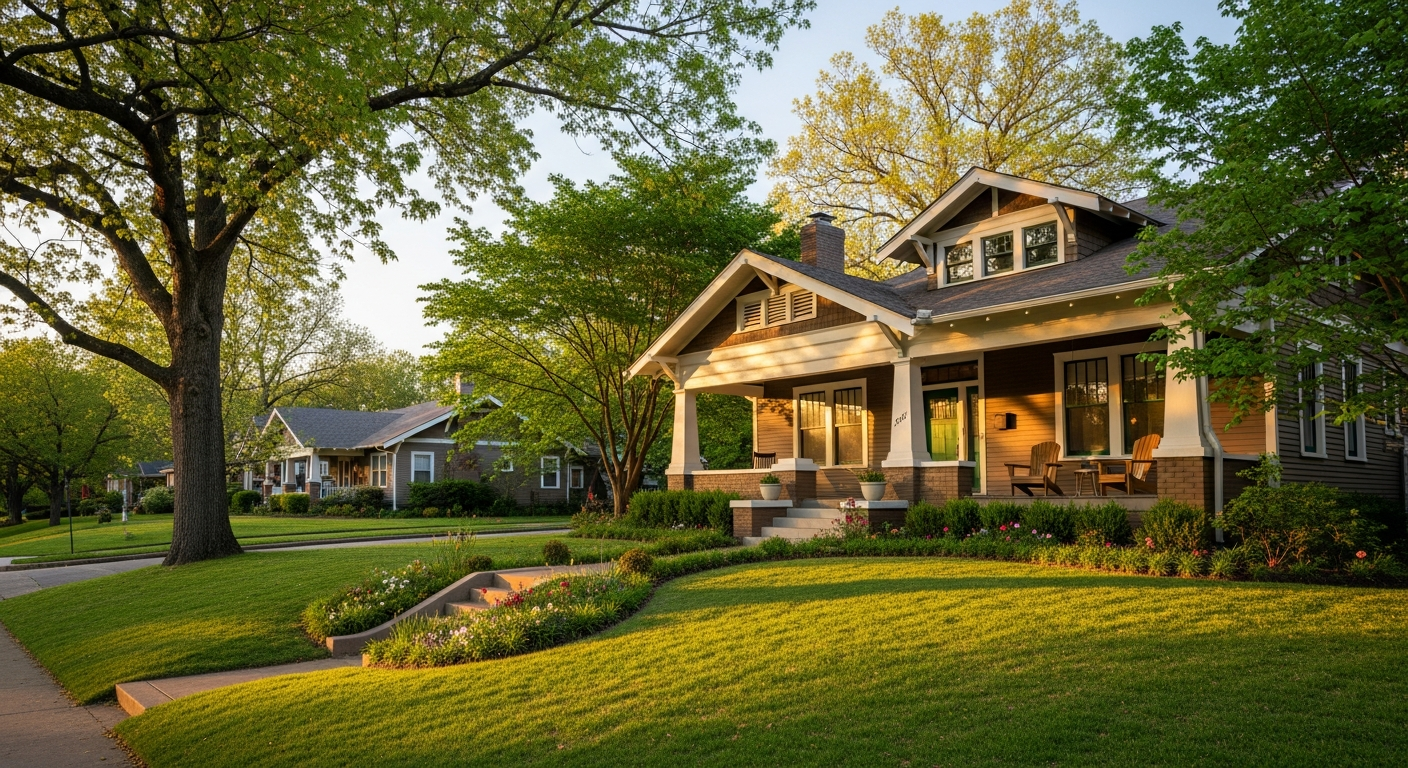
Hillcrest and The Heights
Hillcrest and the adjacent Heights neighborhood are Little Rock's most
desirable inner-city residential areas. Tree-lined streets, walkable retail
corridors, bungalows and craftsman homes from the early twentieth century,
and proximity to downtown make these neighborhoods highly sought after.
Prices here run above the city median, with many properties in the $300,000
to $450,000 range, though homes on smaller lots or needing updates can still
be found below that.
For co-buyers, Hillcrest and the Heights offer something valuable beyond
price: stability. These neighborhoods have maintained demand through various
economic cycles, and they attract buyers who stay. That is the right context
for a co-ownership purchase where co-owners plan to occupy the home as a
primary residence for several years.
West Little Rock
West Little Rock is the city's more suburban chapter. Larger lots, newer
construction, proximity to the retail corridor along Chenal Parkway, and
highly rated Pulaski County schools draw families and professionals. Median
prices in West Little Rock tend to run higher than the city average, with
newer construction in the $350,000 to $500,000 range in many pockets.
For co-buyers who want more space, newer finishes, and a neighborhood built
for car-dependent suburban life, West Little Rock delivers. The price points
here are where co-ownership's down payment split becomes most visible: a
$400,000 home with 3.5% down requires $14,000, which splits to $7,000 per
person for two buyers or roughly $4,667 for three.
Chenal Valley and New Construction
Chenal Valley is Little Rock's premier new construction corridor. Planned
community development, resort-style amenities, and proximity to top-rated
schools have made Chenal Valley one of the most active building areas in the
state. New construction here starts in the mid-$300,000s and stretches well
into the $600,000s and beyond for custom builds.
For co-buyers interested in new construction, Chenal offers a chance to
select finishes and floor plans without competing for existing inventory.
Builders in this corridor have experience working with co-borrower
transactions, though it is worth confirming with each builder's preferred
lender whether they are comfortable with multi-borrower FHA structures.
Northwest Arkansas: Fayetteville, Bentonville, and Rogers
The most economically dynamic part of Arkansas is not the capital. The
Fayetteville-Springdale-Rogers-Bentonville metro, often called NWA, has
become one of the fastest-growing corridors in the South. Walmart's global
headquarters in Bentonville is the anchor, but the ecosystem it has created
extends well beyond the retailer itself.
Thousands of Walmart vendors and supplier companies maintain offices in NWA,
often requiring representatives to live in the area. The University of
Arkansas in Fayetteville enrolls tens of thousands of students and employs a
substantial research and academic workforce. The region has also attracted
technology companies, logistics operations, and a growing startup community.
Crystal Bridges Museum of American Art in Bentonville has helped establish
the area's cultural credibility nationally.
The result is a housing market that looks different from the rest of
Arkansas. Median home prices in Fayetteville and Bentonville have climbed
significantly over the past several years. In much of Bentonville and
Rogers, median prices have moved into the $350,000 to $450,000 range, with
desirable neighborhoods and newer construction pushing higher.
Fayetteville's median sits somewhat lower but has been rising.
For co-buyers, NWA presents a different value proposition than Little Rock.
The case here is less about affordability in absolute terms and more about
access to a market where prices have been appreciating and where individual
buyers on typical regional salaries are increasingly being priced out. Two
buyers combining income for a $380,000 home in Bentonville have a
fundamentally different path than either buyer attempting the same purchase
alone.
NWA also has a significant population of young professionals, many of them
working at Walmart or its supplier ecosystem, who are at the early stages of
their careers. Steady income, limited accumulated savings, and strong
long-term earning potential describe many people in this corridor.
Co-ownership aligns well with that profile.
Fort Smith: The Value Market
Fort Smith sits on the western edge of Arkansas along the Oklahoma border.
It is the second-largest city in the state and has a different character
than either Little Rock or NWA. Fort Smith's economy is anchored by
manufacturing, healthcare, retail trade, and logistics. The city has faced
some long-term economic headwinds related to manufacturing shifts, but it
retains a stable residential market with extremely low price points.
Median home prices in Fort Smith have remained well below $200,000, with
solid residential neighborhoods available in the $150,000 to $220,000 range.
For co-buyers, Fort Smith represents a different kind of opportunity: lower
absolute prices mean lower down payments and lower monthly obligations. Two
buyers co-owning a $175,000 home in Fort Smith face a total minimum down
payment of roughly $6,125, split two ways into about $3,063 each.
Fort Smith is not the market for co-buyers chasing rapid appreciation. It is
the market for buyers who want to own rather than rent, who want to build
equity on a lower income, and who see long-term stability as the goal. For
people with deep ties to the Fort Smith area, co-ownership is a practical
tool for getting into a good home without stretching beyond a comfortable
monthly payment.
Arkansas Development Finance Authority Programs
The Arkansas Development Finance Authority (ADFA) administers homeownership
assistance programs that may be relevant to co-buyers depending on income
and purchase price.
The ADFA Move-Up Loan Program offers competitive fixed-rate mortgage
financing through a network of participating lenders. The program is
designed for buyers who do not qualify for certain first-time buyer programs
but still want access to competitive rates. The Home to Own program has
historically provided down payment and closing cost assistance, structured
as a second loan, to qualifying buyers.
For co-buyers, the income limit question is critical. ADFA programs set
household income limits that vary by county and household size. When two or
more buyers are applying together, their combined incomes typically count
toward these limits. In NWA and Little Rock, two professionals earning
market-rate salaries may find their combined income exceeds program
thresholds. In Fort Smith and smaller Arkansas markets, income limits are
often more accommodating.
It is worth calling an ADFA-approved lender before assuming eligibility or
ineligibility. Program specifics change, income limits are updated, and a
lender experienced with co-borrower transactions can assess your specific
situation accurately rather than relying on general guidance.
Arkansas also has community development financial institutions (CDFIs) and
local housing authorities in cities like Little Rock that administer
neighborhood-specific assistance. Some of these programs target specific zip
codes or census tracts and can be layered with FHA financing.
FHA Co-Buying Math in Arkansas
FHA loans allow up to four co-borrowers on a single application. All
borrowers must intend to occupy the home as their primary residence. This is
not a technicality. It is the core requirement that distinguishes
co-ownership from rental or investment property buying, and it is what makes
FHA's 3.5% minimum down payment available to the group.
Arkansas is one of the most compelling states for this math because its
price points are low enough that even a 3.5% down payment is genuinely
reachable for working buyers, especially when split.
Little Rock (approximate purchase price: $240,000)
- Minimum down payment (3.5%): $8,400
- Split two ways: $4,200 per person
- Split three ways: $2,800 per person
Bentonville/Rogers (approximate purchase price: $390,000)
- Minimum down payment (3.5%): $13,650
- Split two ways: $6,825 per person
- Split three ways: $4,550 per person
Fort Smith (approximate purchase price: $180,000)
- Minimum down payment (3.5%): $6,300
- Split two ways: $3,150 per person
- Split three ways: $2,100 per person
FHA loans require mortgage insurance premiums, both an upfront premium that
is typically rolled into the loan balance and an annual premium paid as part
of the monthly payment. This is a real cost that needs to be factored into
your monthly budget alongside principal, interest, property taxes, and
homeowners insurance.
Co-borrowers on FHA loans are jointly and severally liable. The lender can
pursue any one borrower for the full debt regardless of what the internal
co-ownership agreement says about contribution percentages. This reality is
not a reason to avoid FHA co-buying. It is a reason to take the co-ownership
agreement seriously, making sure it clearly defines each party's financial
obligations, what happens if one person cannot pay, and how the situation is
resolved.
How Rhome Works in Arkansas
Rhome exists for exactly this kind of purchase. The platform is built for
buyers who are ready to own but who recognize that doing it alone is harder
and slower than doing it together. Arkansas's affordability means that many
of the financial barriers are lower than in other states, but the structural
questions remain the same: How do co-buyers hold title? What happens if one
person wants to leave? How are expenses divided? What does the buyout
process look like?
Rhome works with co-buyers from the earliest stages of exploration through
closing. That includes helping groups understand the legal structure that
fits their situation, connecting them with lenders who have real experience
with multi-borrower FHA transactions in Arkansas, and making sure the
co-ownership agreement reflects what the group actually wants, not just a
generic template.
For Little Rock buyers looking at Hillcrest bungalows or West Little Rock
new construction, for NWA buyers navigating the Bentonville-Rogers market,
and for Fort Smith buyers looking to own something solid at a low monthly
cost, the starting point is the same: understand the structure, run the real
numbers, and get the agreement in place before you close.
Visit Rhome's how it works page to see the full process.
Browse available homes to get a sense of what co-ownership can
open up in Arkansas and beyond.
Frequently Asked Questions
See the FAQ section below.