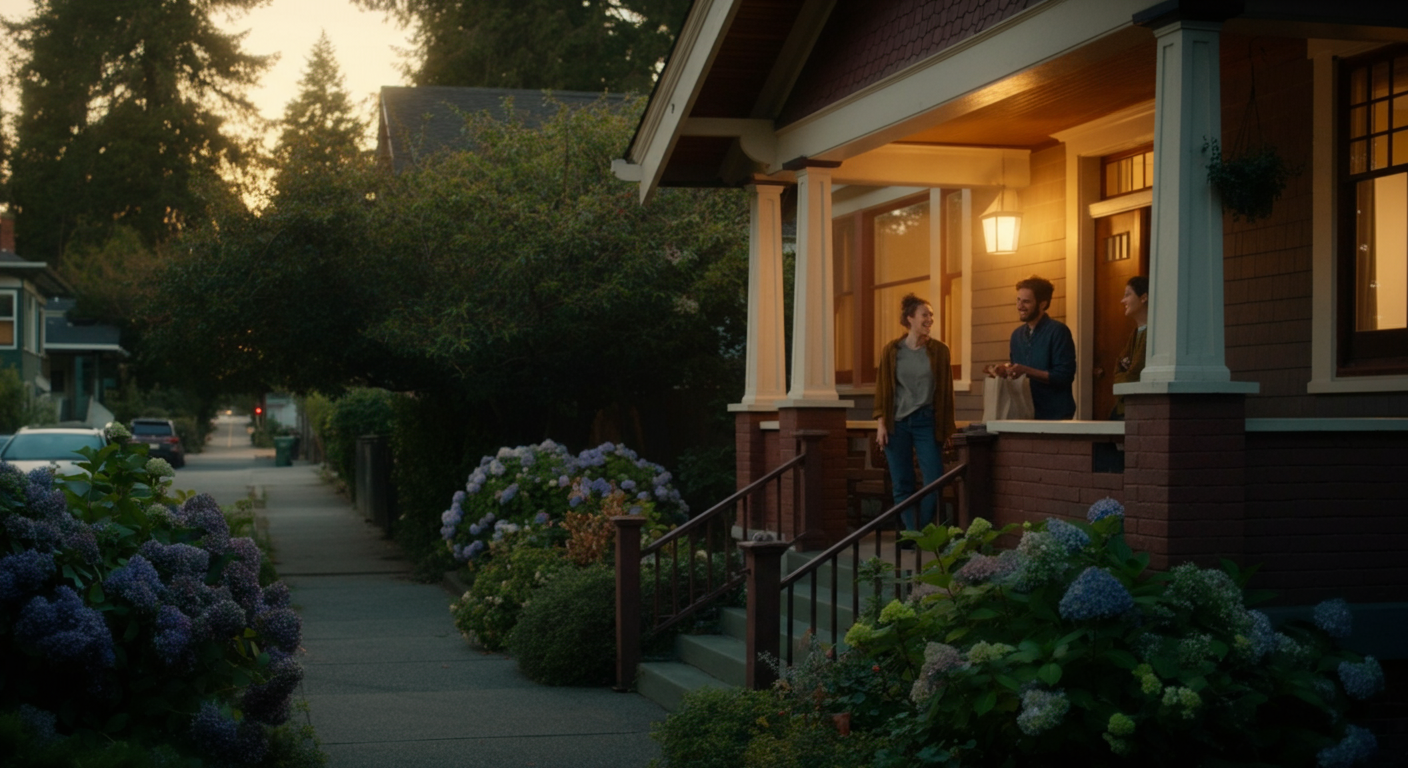
Portland has long held a reputation as a city where people move on purpose. They come for the outdoor access, the food culture, the independent-business density, the mild-ish winters, and the sense that a genuine neighborhood life is still attainable. What has changed in the years since 2020 is the math. Home prices that once made Portland look affordable relative to San Francisco or Seattle have climbed sharply, wages in the creative and tech sectors have not kept pace with housing costs for many residents, and the inventory of entry-level homes remains tight. For a large number of Portlanders, the honest question is no longer which neighborhood to buy in. It is whether solo buying is realistic at all.
Co-buying with one to three other people who share your values and your commitment to actually living in the home is one of the most direct answers to that question. Through Rhome, two to four buyers purchase a primary residence together through a shared ownership structure, split the FHA down payment and monthly costs, and each occupy the home as their primary residence. No subletting, no passive-income framing, no absentee ownership. Just real neighbors sharing real equity in a city they have chosen to call home.
Portland's Housing Market: Where Things Stand
Portland entered the 2020s as a relatively accessible West Coast city. Compared to Seattle or the Bay Area, median home prices were lower and the stock of craftsman bungalows, Tudor cottages, and newer townhomes was diverse enough that buyers at multiple income levels could find something. That window has mostly closed.
Since 2020, Portland has seen significant home price appreciation, driven by remote-work migration, low interest rates during 2020 and 2021, and constrained new supply. The metro area's urban growth boundary, established under Oregon's pioneering statewide land use planning system, limits outward sprawl and keeps developable land scarce. That boundary is one reason Portland has preserved its walkable urban neighborhoods and its agricultural green belt, but it also puts sustained upward pressure on prices within city limits.
By the mid-2020s, median home prices in Portland proper were generally tracking in the high $400,000s to low $500,000s depending on the source and the month, with well-maintained homes in popular inner eastside and northeast neighborhoods often reaching into the $500,000s and $600,000s. Mortgage rate increases beginning in 2022 cooled price growth and dampened sales volume, but they did not produce the broad price corrections many buyers hoped for. What rate increases actually accomplished was shrinking purchasing power, so buyers need more income to afford the same home they could have financed two years earlier.
For solo buyers earning Portland-area median household incomes, this combination of elevated prices and higher rates makes qualifying for a meaningful loan difficult without a very large down payment. That is precisely where co-buying changes the calculation.
Portland's economy is anchored by a mix of large employers, including Nike, Intel, Daimler Trucks North America, and Oregon Health and Science University, alongside a substantial creative, food, and technology sector. Many residents work in industries where income is solid but not exceptional, including design studios, restaurants, healthcare, software, and education. These are the exact workers for whom co-buying makes the most sense.
Oregon Real Estate Law and the Co-Ownership Structure
Oregon does not have a formal tenancy-in-common statute as elaborate as some other states, and it does not require co-buyers to hold title in any particular way. That flexibility is actually an asset. Rhome uses a shared ownership structure for co-ownership, and Oregon law accommodates this well.
When two to four buyers co-purchase through Rhome, a purpose-specific ownership entity holds title to the property. Each buyer holds an ownership interest in the entity proportional to their contribution, and a detailed co-ownership agreement governs decision-making, cost-sharing, exit rights, and the process for one co-owner to buy out another. This agreement is the structural backbone of the arrangement, and getting it right is what separates a well-structured co-purchase from a handshake deal that creates problems later.
Oregon's land use framework is worth understanding at a high level. The state has required cities and counties to establish urban growth boundaries since 1973, which means that Portland's developable footprint is legally defined. Zoning within the city has shifted in recent years. Portland has been at the forefront of middle-housing reform nationally, having eliminated single-family-only zoning city-wide before most other cities moved in that direction. This means duplexes, triplexes, quads, and accessory dwelling units are permitted across a much larger share of residential zones than was true five years ago. For co-buyers, this expands the universe of property types that can work, including multi-unit buildings where all co-owners live in the structure.
Transfer taxes in Oregon are handled at the county level. Multnomah County, which encompasses most of Portland, has a county transfer tax, and buyers should account for this in their closing cost estimates. Oregon has no state sales tax, which simplifies some parts of the financial picture, though property taxes are assessed at market value and have been rising as values climb.
Key Neighborhoods for Co-Buyers in Portland
Portland's neighborhood geography matters a great deal. Each quadrant has a distinct character, price point, and practical profile for buyers who plan to actually live there full-time.
Southeast Portland
SE Portland is the city's most eclectic quadrant, covering everything from the dense retail corridors of Division Street and Hawthorne Boulevard to quieter, tree-lined blocks further east toward Mt. Tabor and Woodstock. Prices vary widely within SE. Properties close to Division have been expensive for years, while blocks closer to Foster Road and further southeast offer more value. For co-buyers looking for a craftsman bungalow or a larger older home with enough bedrooms to share comfortably, SE Portland offers good options across a range of price points. Walkability is strong in the inner sections, and access to restaurants, parks, and transit is excellent.
Northeast Portland
NE Portland encompasses some of the city's most historically significant and architecturally rich neighborhoods. Alberta Arts District, Irvington, Beaumont-Wilshire, and Woodlawn each have a distinct personality but share good housing stock and genuine neighborhood infrastructure. NE has appreciated significantly, particularly in the inner sections, but it still offers the kind of four-bedroom, two-bathroom homes that work well for two to three co-buyers who each want their own room and some shared common space. Proximity to the MAX Yellow and Green lines provides transit access to downtown.
St. Johns
St. Johns sits at the north end of the peninsula between the Willamette and Columbia rivers, centered on its own small downtown with independent shops, restaurants, and coffee. For years it was overlooked by buyers priced into inner SE and NE, which means it absorbed significant appreciation as those areas became more expensive. Even so, St. Johns remains one of the more accessible places to find a larger home in Portland proper. The neighborhood has a strong community identity and is worth serious attention from co-buyers who want character, walkability, and a genuine sense of place without spending at the top of the market.
Beaverton and Hillsboro
For co-buyers who prioritize square footage and value over inner-city walkability, the westside suburbs offer considerably more purchasing power. Beaverton and Hillsboro are home to Intel's massive Oregon campuses and a growing technology corridor, which has created solid professional employment and infrastructure. Home prices in both cities are generally lower than in inner Portland, and the MAX Blue Line connects them to downtown Portland. For co-buyers in tech or healthcare whose jobs are on the westside, this corridor is worth serious consideration.
Oregon Housing and Community Services Programs
Oregon Housing and Community Services (OHCS) administers several programs relevant to first-time and lower-income homebuyers. The Oregon Bond Residential Loan Program offers below-market fixed interest rates to eligible buyers, and it can be combined with down payment assistance. The Rate Advantage program targets buyers at certain income levels with the most competitive rates, while the Cash Advantage program trades a slightly higher rate for a cash grant that can be applied toward down payment or closing costs.
Multnomah County and the City of Portland also administer their own homebuyer assistance programs through entities like Hacienda CDC and other community development organizations, with specific programs targeting buyers from communities that have faced historical displacement.
Co-buyers using Rhome's shared ownership structure should discuss OHCS program eligibility with their lender early in the process. FHA loans, which are the primary financing vehicle Rhome uses, are compatible with down payment assistance programs in many cases, though the specific rules depend on the program and lender. Oregon's housing agency programs are designed around individual buyers, so how they interact with a co-buying ownership structure warrants direct conversation with both the lender and a housing counselor.
The FHA Co-Buying Math in Portland
FHA financing allows a down payment as low as 3.5% of the purchase price, which is the most accessible entry point for buyers without large reserves. When two or more buyers co-purchase, that total down payment is split according to their agreed ownership shares, which can transform a nearly impossible solo transaction into a genuinely reachable group one.
Here is how the math looks in Portland. Assume a home priced at $480,000, which is a realistic target for a solid three-bedroom house in a mid-tier Portland neighborhood. On a solo FHA purchase, the 3.5% down payment would be $16,800. That sounds manageable until you account for closing costs, reserves, and the financial cushion any responsible buyer should maintain. For many Portland renters, assembling $25,000 to $30,000 in liquid savings while paying Portland rents is a multi-year project.
With two co-buyers splitting equally, that $16,800 down payment becomes $8,400 per person, and closing costs are similarly shared. With three co-buyers, it drops to $5,600 per person. Monthly costs, including principal, interest, property taxes, insurance, HOA fees if applicable, and any shared maintenance reserve, are divided the same way. The result is that three people who individually cannot qualify for or sustain a $480,000 mortgage can together buy and own that home, building equity month by month.
FHA loans require each borrower to occupy the property as their primary residence. The Rhome model is built precisely around this requirement. All co-owners must live in the home. This is not a loophole or a workaround; it is the correct and intended use of the program.
Why Co-Ownership Makes Portland Accessible
Portland has a cultural orientation toward collaboration and shared resources that makes it a natural fit for co-buying. The city has a long history of intentional community, cooperative housing, and shared living arrangements. Co-ownership through Rhome is distinct from those models, since the co-owners hold individual equity stakes and have clear contractual rights, but the underlying social comfort with sharing space and resources with people you trust is well-established in Portland's culture.
Beyond culture, the economics are direct. Portland has lost a significant share of its entry-level and working-class homeownership opportunities over the past decade. People who have lived in a neighborhood for years as renters are increasingly priced out when they try to buy in the same area. Co-buying restores the possibility of staying in the neighborhood, building equity, and stopping the cycle of paying rent that enriches a landlord without building any ownership stake.
For groups of friends, colleagues, or family members who have already been living together as renters, co-buying is often a natural next step. The transition from shared renting to shared ownership changes the financial dynamic entirely: instead of splitting rent with nothing to show at the end of a lease, every monthly payment builds equity in an asset that belongs to the group.
How Rhome Works in Portland
Rhome is built specifically for primary-residence co-ownership. The process starts with group formation: buyers who want to co-purchase can use Rhome's platform to identify and vet potential co-owners, or they can come in as an already-formed group of friends or colleagues.
Once a group is formed, Rhome coordinates the legal and financial structure. The shared ownership entity is established with a governance agreement tailored to the group's specific arrangement, including ownership percentages, decision-making rules, cost-sharing provisions, and a clear process for what happens if one co-owner wants to sell their share, moves out, or experiences a life change that affects the arrangement. This agreement is the document that protects every member of the group and gives the arrangement durability.
Rhome works with lenders experienced in co-ownership financing, and the FHA loan process is coordinated around the group's combined qualifications. After closing, Rhome provides ongoing support tools so co-owners can manage shared expenses, track maintenance, and communicate clearly about the home they share.
Portland properties are listed on the Rhome platform, and the team has relationships with local agents who understand the co-buying process and can represent co-buyer groups effectively in Portland's competitive market.
If you are a Portlander who has been watching home prices climb while your rent keeps pace, co-ownership is worth understanding deeply. The how it works page walks through the full process, and the homes listings show what is currently available in the Portland market.
FAQ
See faqItems below.