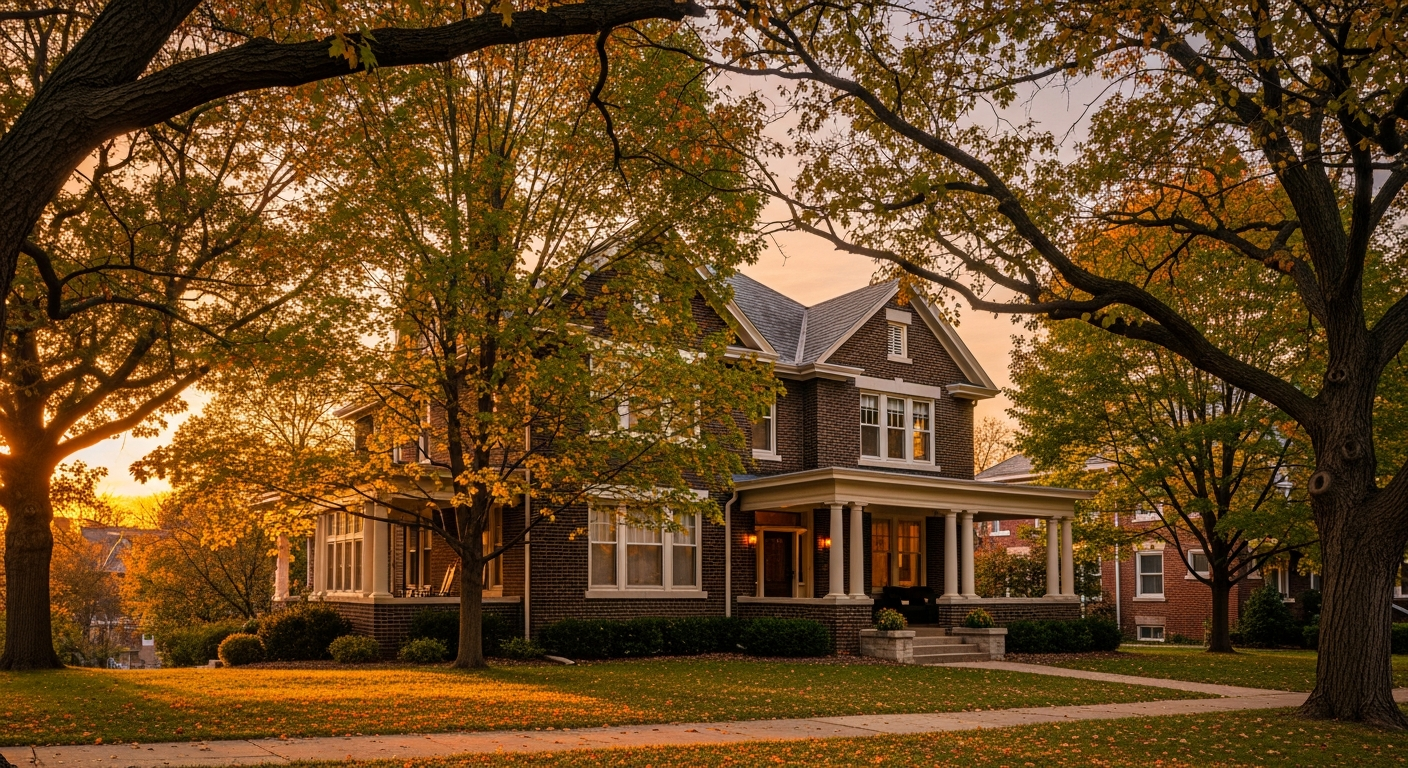
Kansas City MO Market Overview
Kansas City sits in an interesting position in the national housing conversation. It is a genuine major metro, home to over two million people across the broader metropolitan area, with a diversified economy in finance, healthcare, logistics, and a growing technology sector anchored by employers like Cerner (now part of Oracle), H&R Block, and Hallmark Cards. It has a real downtown, a nationally recognized restaurant scene, an airport that just finished a modern terminal, and neighborhoods with the kind of architectural character that coastal cities lost decades ago.
And yet, Kansas City consistently posts median home prices well below the national average. While the national median sale price has climbed well past $400,000, Kansas City, Missouri's median sits in a range that would seem almost impossibly low to buyers in San Francisco, New York, or even Denver. That gap is not a sign of a declining city. It is a structural feature of a Midwest market where supply has kept pace with demand more consistently than in coastal metros, where land is not artificially scarce, and where the political culture has historically avoided the most restrictive zoning policies that have strangled housing production elsewhere.
For co-buyers, that affordability creates opportunity that simply does not exist in pricier markets. In Kansas City, the question is not whether you can afford to buy at all. The question is whether you want to buy more house than you could get alone, reach a better neighborhood, reduce individual financial risk, or simply make the numbers work on a combined budget that opens doors a solo income cannot.
The city's job market has continued to attract young professionals who are priced out of the coasts but want a city with real amenities. The Kauffman Foundation, headquartered in Kansas City, has helped seed a startup culture that draws entrepreneurial talent. The Sprint Center (now T-Mobile Center) brought major events, and the Kansas City Chiefs and Royals keep the metro in national sports conversation year-round. Kansas City is not a sleepy secondary market. It is a city on a slow, steady upward trajectory that rewards buyers who get in before the rest of the country notices.
Neighborhoods Worth Knowing
The Plaza and Brookside. The Country Club Plaza is Kansas City's signature mixed-use district, with Spanish-influenced architecture, upscale retail, and restaurants that draw visitors from across the region. Homes near the Plaza command a premium, often in the $500,000 to $800,000 range for single-family properties, reflecting the walkability and prestige of the address. Brookside, just south of the Plaza, offers slightly more accessible prices while maintaining the charm of a walkable, tree-lined neighborhood with a strong local business district. Co-buyers targeting this corridor are trading entry-level savings for long-term location quality.
Waldo. A few miles south of Brookside, Waldo is one of Kansas City's most livable and reasonably priced inner-ring neighborhoods. You will find solid brick Craftsman and bungalow-style homes, a dense strip of neighborhood bars and restaurants along 75th Street, and a community feel that larger metros charge much more to replicate. Home prices in Waldo tend to be more accessible than Brookside while still offering proximity to the best parts of the city.
Crossroads Arts District. Crossroads is Kansas City's creative core, a warehouse district that has transformed over the past two decades into a destination neighborhood with galleries, studios, chef-driven restaurants, and a First Fridays art walk that draws thousands monthly. Housing options range from loft conversions to newer construction, and the neighborhood continues to attract buyers who want urban density with genuine cultural identity.
Blue Springs and Eastern Suburbs. For co-buyers who prioritize value above all else, the eastern suburbs, particularly Blue Springs and Independence, offer some of the most accessible price points in the metro. Blue Springs has good schools, established infrastructure, and single-family homes that can be found for well under the national median. The trade-off is a longer commute to downtown Kansas City, but for buyers whose work is hybrid or remote, the value calculus is compelling.
Midtown and Hyde Park. Midtown sits between downtown and the Plaza corridor, offering a mix of Victorian-era homes, mid-century properties, and newer infill development. Hyde Park in particular has beautiful historic architecture and an active neighborhood association that has maintained property values through deliberate reinvestment. Prices here can be surprisingly accessible given the quality of the housing stock.
A Note on Missouri Law and the State Line
Kansas City is unusual among American cities in that it straddles a state border. A significant portion of the broader metro area sits in Kansas, including major suburbs like Overland Park, Leawood, and Olathe. These are substantial communities with their own real estate markets, and they are technically part of the same metro economy.
For Rhome co-ownership purposes, the distinction matters. Missouri and Kansas are separate legal jurisdictions with their own LLC statutes, real property laws, and lending regulations. Rhome focuses on the Missouri side of the metro, where Kansas City proper is located along with neighborhoods like Brookside, Waldo, Hyde Park, Crossroads, and the Plaza. On the Missouri side, the ownership structure that underlies Rhome co-ownership is organized under Missouri law, which has clear and well-established rules governing LLCs, property ownership, and real estate transactions.
Missouri law does not impose unusual restrictions on LLC ownership of residential property, and FHA lending is available in Missouri for co-borrowers who each intend to occupy the property as a primary residence. The structure is clean and legally sound.
If your group is interested in a home on the Kansas side of the metro, a Rhome advisor can discuss the options, but the core product is designed and optimized for Missouri-side purchases.
MHDC Programs for Missouri Homebuyers
The Missouri Housing Development Commission, known as MHDC, is the state agency responsible for administering homeownership assistance programs across Missouri. Its programs are aimed at expanding homeownership access for moderate-income buyers, and several are directly relevant to buyers considering Rhome co-ownership.
First Place Loan. MHDC's First Place Loan program is designed for first-time homebuyers, though Missouri defines first-time buyer as someone who has not owned a primary residence in the past three years. The program offers below-market fixed interest rates on 30-year mortgages, which can make a meaningful difference in monthly payment. Income limits and purchase price caps apply, but they are set at levels that accommodate a wide range of Kansas City buyers.
Next Step Loan. For buyers who do not qualify as first-time homebuyers under the state definition, the Next Step Loan offers similar below-market rate financing without the first-time buyer requirement. This can be useful for co-buyer groups where one member has previously owned a home.
Cash Assistance Loan. MHDC also offers cash assistance that can be layered on top of the First Place or Next Step loans, providing funds to cover down payment and closing costs. The cash assistance is structured as a second mortgage with specific forgiveness or repayment terms depending on the program year and funding availability. Buyers should verify current terms directly with MHDC or an MHDC-approved lender.
Because Rhome co-ownership uses FHA financing, and because MHDC programs are frequently paired with FHA loans, there may be opportunities to stack benefits. At least one co-buyer in many groups will meet the first-time buyer definition. A Rhome advisor can work with you and an MHDC-approved lender to identify what your group qualifies for before you begin shopping.
FHA Co-Buying Math in a Genuinely Affordable Market
The numbers in Kansas City are striking when you run them alongside co-ownership.
Consider a solid three-bedroom home in Waldo or Midtown priced at $270,000. Here is what the math looks like with FHA financing and two co-buyers:
- Purchase price: $270,000
- FHA down payment (3.5%): $9,450
- Per co-buyer (equal split, 2 buyers): approximately $4,725 each
- Estimated monthly mortgage payment (30-year fixed): approximately $1,650 at current rates
- Per co-buyer: approximately $825 per month
- Taxes, insurance, and maintenance reserve: variable, but often $400 to $600 total per month in this price range
- All-in per co-buyer: roughly $1,025 to $1,125 per month
For context, a two-bedroom apartment in Waldo or midtown Kansas City regularly rents for $1,100 to $1,400 per month. Co-buyers are approaching or beating rental parity while building equity and gaining the legal and financial benefits of ownership.
With three co-buyers, the down payment per person falls to about $3,150, and the monthly share drops further. The model scales cleanly, and the structure holds because each co-buyer is individually underwritten on their own income and credit.
Now consider a $450,000 home near the Plaza, a price that would be modest in many coastal metros but is a premium purchase in Kansas City:
- FHA down payment (3.5%): $15,750
- Per co-buyer (2 buyers): approximately $7,875 each
- Monthly mortgage (30-year fixed): approximately $2,750
- Per co-buyer: approximately $1,375 per month
For a home in one of the most desirable corridors of a major American city, those are numbers that work for two people with professional incomes who would otherwise be locked out of that market entirely.
Why Kansas City Underperforms in National Coverage
Open any national publication's list of underrated cities and Kansas City appears reliably. That recognition has not yet translated into the kind of speculative demand that drives prices in markets like Austin or Nashville, and that is both a frustration for Kansas City boosters and an opportunity for buyers.
Several dynamics contribute to this gap between the city's actual quality and its national profile.
First, Kansas City sits in the middle of the country in a way that makes it easy for coastal media to overlook. It is not a gateway to anywhere and does not sit on a coast. The city's story has to be sought out rather than stumbled upon, which means coverage tends to be reactive and episodic rather than sustained.
Second, the city's economic identity is diverse but not dominated by any one flashy industry. Tech hubs get tech press. Finance hubs get finance press. Kansas City's blend of logistics, agriculture, healthcare, and finance does not generate a clean narrative hook. The result is a city that is genuinely doing well but rarely appears in the headlines that move real estate markets.
Third, the state line cuts the metro in two for statistical purposes, which means neither the Missouri side nor the Kansas side ranks as highly in metro-level comparisons as the combined metro would. The data fragmentation obscures the full picture.
For buyers, these dynamics are good news. Kansas City's value proposition is real and not yet fully priced in. The buyers who recognize it now are buying into a market that has room to appreciate, in a city that already has the bones and amenities of a destination.
How Rhome Works in Kansas City MO
Rhome is not a lender, a landlord, or a real estate agent. Rhome is the structure that makes co-ownership between two to four buyers legally sound, financially coherent, and built to last.
When a group of buyers in Kansas City wants to purchase a home together, Rhome sets up an ownership structure under Missouri law to hold the property. Each co-buyer owns an ownership interest corresponding to their agreed ownership share. The ownership entity is the property owner of record, and each buyer's rights and responsibilities are documented in a formal co-ownership agreement.
Rhome then helps the group secure FHA financing. FHA loans are designed for buyers who will occupy a property as a primary residence, and they are fully available to co-borrowers who each intend to live in the home. Each person on the mortgage is individually underwritten, meaning your group's combined income counts in your favor and no single buyer needs to carry the full qualification burden.
The co-ownership agreement that Rhome prepares covers the practical realities of shared ownership: how monthly costs are divided, how decisions about maintenance and improvements are made, what happens when someone wants to sell their share, how exits and buyouts are handled, and how disputes are resolved. The agreement is customized for your group and is legally binding under Missouri law.
After closing, co-buyers move in and live their lives. Rhome remains available to support the ongoing relationship, helping navigate the moments, whether minor or significant, that inevitably arise when people share ownership of a home.
Kansas City is one of the strongest markets in the country for Rhome co-ownership precisely because the price points are accessible enough that the down payment math is manageable for ordinary working adults. The entry barriers are lower here than in almost any comparable metro. For two or three people who want to plant roots in Kansas City, buy more house than they could afford alone, and build real wealth over time, co-ownership is worth a serious look.
Frequently Asked Questions
Do all co-buyers have to live in the Kansas City home?
Yes. Rhome co-ownership requires every co-buyer to occupy the home as their primary residence. No absentee co-owners, no subleasing to third parties, and no short-term rental arrangements are permitted under the model.
How does the FHA down payment split work in Kansas City?
FHA financing requires a total down payment of 3.5% of the purchase price. That amount is divided among co-buyers according to their agreed ownership share. On a $250,000 Kansas City home, the total down payment is $8,750, roughly $4,375 each for two buyers, or about $2,917 each for three.
Can co-buyers use MHDC programs alongside Rhome co-ownership?
Potentially yes. MHDC programs like First Place Loan and Next Step Loan offer below-market interest rates and cash assistance for eligible buyers. Because Rhome co-ownership uses FHA financing, buyers may be able to layer certain MHDC benefits with their co-purchase. A Rhome advisor can help you work through what programs apply to your group.
Does it matter that Kansas City straddles the Missouri-Kansas border?
It matters for legal and lending purposes. Rhome focuses on the Missouri side of the metro, where the ownership structure is organized under Missouri law. If you are buying in Overland Park, Leawood, or another Kansas suburb, different state rules apply. For the Missouri side, including all of Kansas City proper, the structure works cleanly under Missouri's well-established LLC statutes.
What happens when a co-buyer wants to sell their share or move out?
Rhome structures every co-ownership through a detailed governance agreement that spells out exactly how exits work, including buyout rights, timelines, and what happens if no remaining co-owner wants to buy the departing person out. The process is defined from day one so no one is surprised later.